Whether you are selling or letting a home, buying one, or simply trying to understand the A-to-G letter shown on a listing, the DPE (Diagnostic de Performance Énergétique — the French Energy Performance Certificate, or EPC) is everywhere. In just a few years it has become the document that can decide a property's price, the right to let it, and access to renovation grants. Yet few people really know what it contains or how it is calculated.
This guide answers a simple question — "what is a DPE?" — but with the precision you need to avoid mistakes in 2026, the year the electricity-coefficient reform changes things for hundreds of thousands of homes. No needless jargon: every technical term is defined, every rule is sourced.
About 850,000 homes rated F or G as of 1 January 2023 leave the "thermal sieve" (passoire thermique) status on 1 January 2026, solely because the electricity coefficient drops from 2.3 to 1.9 (order of 13 August 2025). Understanding the EPC means understanding what is at stake behind a single letter.
What this article covers
The exact definition of the DPE, what it contains (the dual energy and climate label, the consumption of the five uses, summer comfort, renovation recommendations), how it is calculated by the conventional 3CL-DPE 2021 methodology, what it is actually for (sale, letting, MaPrimeRénov' grant), its legally binding status since 1 July 2021, its validity period, and what changes in 2026.
What is a DPE, exactly?
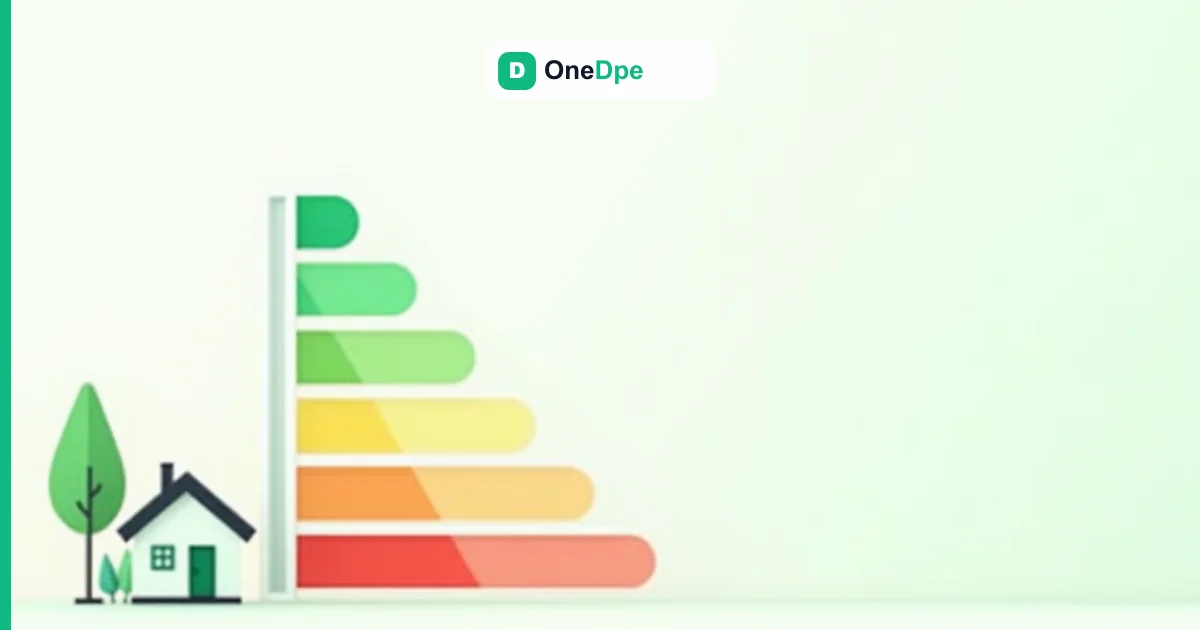
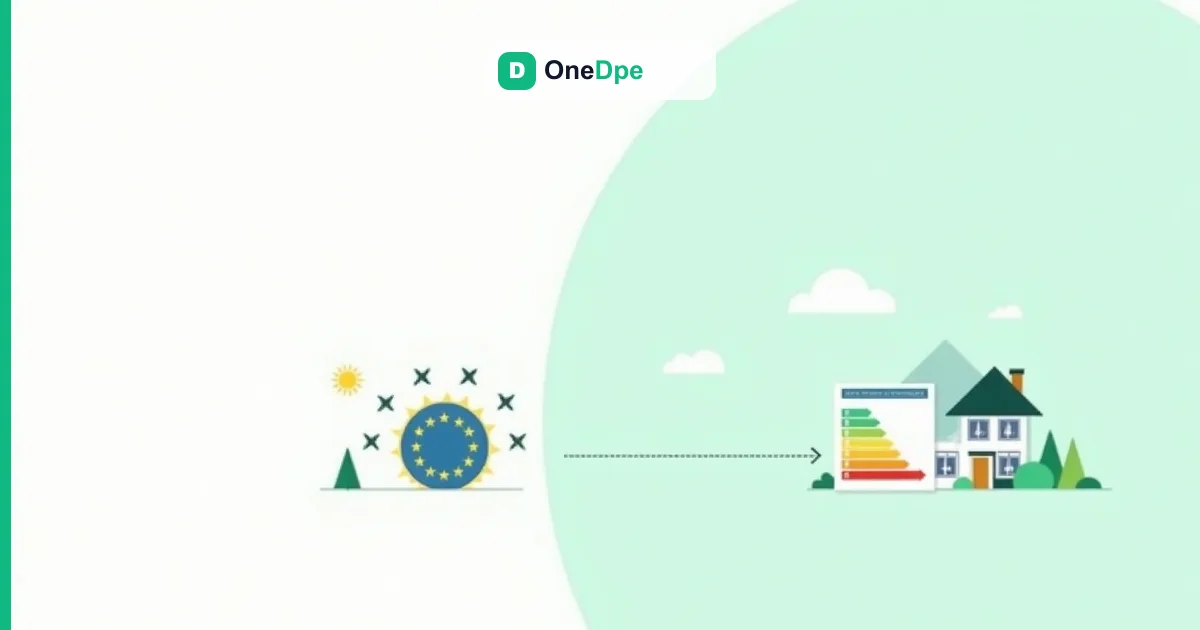
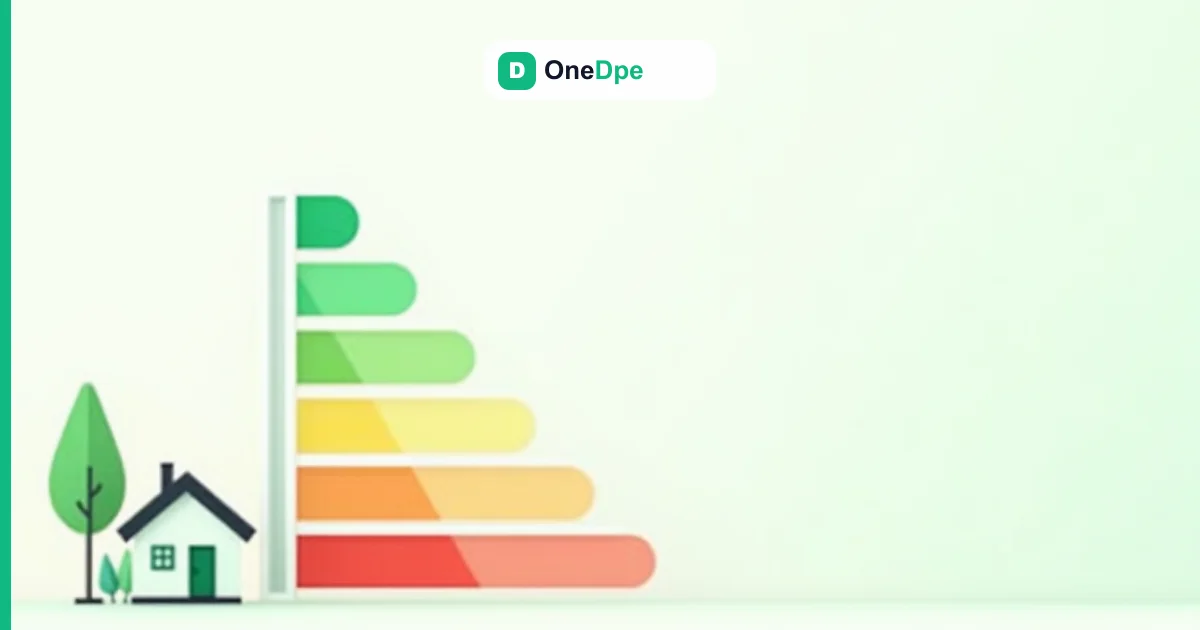
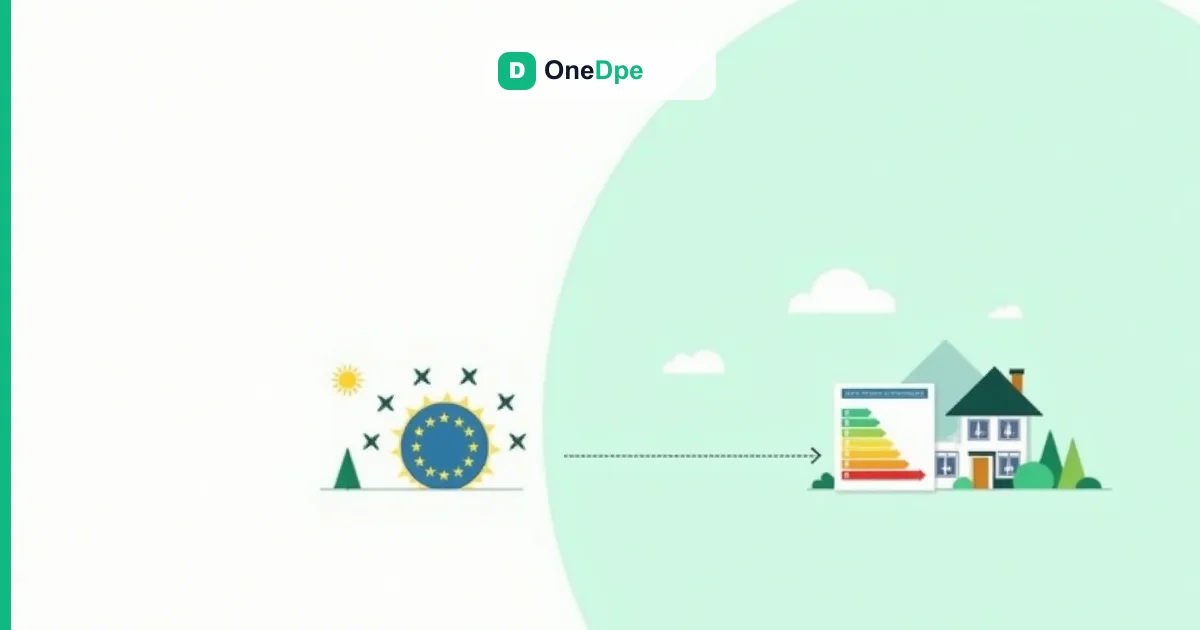
The DPE — diagnostic de performance énergétique, the French EPC — is an official document that assesses a home's energy performance and rates it on an A-to-G scale, from the most efficient (A) to the most energy-hungry (G). It was created by transposing a European directive and is now governed, in both method and content, by the French Construction and Housing Code (CCH) and several decrees.
In practice, a DPE is produced by a certified assessor (certification issued by a COFRAC-accredited body), who visits the home, surveys its features, then generates the certificate using approved software. The result is recorded in the national database of ADEME (the French Environment and Energy Management Agency) and receives a 13-character identification number that lets anyone verify its authenticity.
One key point to grasp from the outset: the DPE does not measure your actual consumption. It estimates a conventional consumption — what the home would use under standardised conditions (heating temperature, occupancy, reference climate), regardless of your habits. Two very different households in the same home would get the same DPE; this is intentional, so that properties can be compared on a consistent basis.
What a DPE contains in 2026
A DPE is not just a letter. The report, several pages long, contains key pieces of information that every owner, buyer or tenant should be able to read.
The dual label: energy and climate
The DPE shows two distinct labels. The first, the energy label, expresses consumption in primary energy (the term refers to energy "at source", before transformation and transport losses) in kilowatt-hours per square metre per year (kWh/m²/year). The second, the climate label, expresses greenhouse-gas emissions in kilograms of CO₂ equivalent per square metre per year (kg CO₂/m²/year).
Key takeaway: the final class (A to G) of the DPE keeps the worse of the two labels. A home that is excellent on energy but heated by oil can be downgraded by its climate label. This is the dual-threshold principle.
The consumption of the five uses
The DPE details conventional consumption for five regulatory uses: heating, domestic hot-water production, cooling (air conditioning), lighting and auxiliaries (ventilation, pumps, etc.). These five uses have been the official scope of the calculation since the 2021 reform. Cooking and household appliances are not included.
Summer comfort and recommendations
Since 2021 the DPE also includes an indication of the home's summer comfort — its ability to stay cool without air conditioning — rated on three levels. Finally, it offers ranked renovation recommendations, with estimated costs and savings, plus an estimate of the annual energy bill (as a range). To decode each section of the report, see our guide on how to read an EPC page by page.
How is a DPE calculated? The 3CL-DPE 2021 methodology
This is the heart of the matter, and the source of most misunderstandings. Since 1 July 2021, all home DPEs are produced using a single, conventional calculation methodology, known as 3CL-DPE 2021, defined by the order of 31 March 2021 on the methods and procedures applicable to the energy performance certificate. "3CL" stands for Calcul de la Consommation Conventionnelle des Logements (conventional calculation of dwelling consumption).
A calculation based on the building, not on your bills
The 3CL methodology does not read your meter readings. It reconstructs the home's theoretical consumption from its physical features: floor area, orientation, wall/roof/floor insulation, window type and performance, heating and hot-water system, ventilation, year of construction. The assessor enters this data, and the software applies regulatory conventions (setpoint temperature, occupancy scenario, zone climate data) to produce the consumption of the five uses.
This conventional nature has a direct consequence: the quality of the DPE depends on the thoroughness of the survey. Two assessors who interpret a wall's insulation or a boiler's age differently can arrive at two different labels. To go further on how the calculation engine works, see our explanation of the 3CL methodology in plain terms.
From consumed kWh to "primary" kWh: the role of the coefficient
Once final consumption is estimated for each energy source, the calculation converts it into primary energy using a conversion coefficient. For electricity, this primary-energy conversion coefficient was 2.3 until the end of 2025: 1 kWh of electricity consumed counted as 2.3 kWh of primary energy in the label. This factor historically reflected losses in the power system. It is precisely this coefficient that changes in 2026, as explained below.
| Calculation element | What it is | Reference |
|---|---|---|
| 3CL-DPE 2021 methodology | Conventional calculation from the building | Order of 31 March 2021 |
| Five uses | Heating, hot water, cooling, lighting, auxiliaries | Order of 31 March 2021 |
| Energy label | Primary energy, in kWh/m²/year | CCH art. L.126-26; order of 31 March 2021 |
| Climate label | CO₂ emissions, in kg/m²/year | CCH art. L.126-26; order of 31 March 2021 |
| Electricity coef. | 2.3 until 31/12/2025, then 1.9 | Order of 13 August 2025 |
What is a DPE for? Sale, letting, grants
The DPE is not just an information document: it triggers concrete obligations and rights. Here are its three main uses.
Sale and letting: an obligation and a price argument
The DPE is mandatory for any sale or letting of a home: it is part of the technical diagnostics file (DDT) handed to the buyer or tenant, and the energy class must appear in the property listing. Beyond the obligation, the class directly influences price: this is the "green value" effect, documented by Notaires de France (the French Notaries Federation), where a poorly rated home suffers a discount versus an equivalent better-rated one. To understand the full scale, see our guide to EPC classes from A to G.
Letting: the timetable banning thermal sieves
The Climate & Resilience Act (Law no. 2021-1104 of 22 August 2021) introduced into the CCH a phased timetable banning the letting of the most energy-hungry homes. G-rated homes can no longer be offered for letting since 1 January 2025; F-rated will follow in 2028, and E-rated in 2034 (CCH art. L.173-1-1 and L.173-2). The DPE class therefore directly conditions the right to let.
Renovation grants: the DPE as an entry document
The DPE (or the energy audit that extends it) serves as the starting point for grants towards energy renovation, beginning with MaPrimeRénov' (the French national energy renovation grant), managed by Anah (the French National Housing Agency). The large-scale renovation pathway relies on an energy baseline and targets a class gain measured by the DPE. Knowing your starting class is thus the first step to estimating relevant works and accessible grants.
The DPE has been legally binding since 2021: what that changes
Here is a major change many still overlook. Since 1 July 2021, the DPE is legally binding (opposable): it has the same legal value as the other diagnostics in the technical diagnostics file (CCH art. L.271-4). In concrete terms, its information engages the seller's and landlord's liability, and a buyer or tenant who suffers a loss because of a wrong DPE can act against them — who can in turn act against the assessor.
Before 2021, the DPE was merely informative: it was provided "for guidance only". That is no longer the case. A DPE is therefore not a trivial document to skim: it is a binding act. If you buy a property advertised as class D and a new, serious assessment places it in F, its binding status opens avenues of recourse. Conversely, as a seller or landlord, you have every interest in hiring a thorough assessor rather than the cheapest one.
⚠️ Warning: legally binding does not mean infallible. Consumer-press studies have shown that the same home can be rated differently depending on the assessor. Where there is an obvious inconsistency — a class A on never-renovated old stock, for instance — a check is warranted before signing.
How long is a DPE valid?
A DPE is valid for ten years (CCH art. D.126-19, from decree no. 2021-872 of 30 June 2021). A DPE produced in 2026 is therefore valid until 2036, unless works altering the home's performance justify a new assessment.
Transitional rules, however, shortened the validity of older DPEs produced before the reform: those issued between 1 January 2018 and 30 June 2021 ceased to be valid on 31 December 2024, and the oldest (2013-2017) on 31 December 2022. In practice, in 2026, only DPEs produced under the 3CL-DPE 2021 methodology remain in circulation for transactions.
What changes in 2026: the electricity coefficient
The major change in 2026 concerns neither the 3CL methodology nor the report's content, but a calculation parameter: the primary-energy conversion coefficient for electricity drops from 2.3 to 1.9 on 1 January 2026 (order of 13 August 2025). In other words, each kilowatt-hour of electricity consumed now "weighs" less in the energy label.
The government's stated aim is to correct an unfavourable treatment of electricity — a largely decarbonised energy in France — compared with gas or oil. According to the Ministry of the Economy, about 850,000 electrically heated homes, rated F or G as of 1 January 2023, leave the thermal-sieve status thanks to this single measure — out of the 4.8 million sieves the primary-residence stock then counted. Importantly, no home will see its label downgraded as a result of the reform.
This reform illustrates a reality of the DPE: a label is not an immutable physical figure, but the product of a calculation and conventions that can evolve. To anticipate the reform's effect on an electrically heated home, the DPE simulator lets you test the label before and after the coefficient change.
Estimate and verify your DPE
Estimate a home's energy class, simulate the effect of the new 2026 electricity coefficient (2.3 to 1.9), check the consistency of an existing DPE and assess the possible class gain after works: the OneDpe DPE tool suite brings these calculations together from your property's features.
To go further: the guide to classes A to G and the 3CL methodology explained simply.
Conclusion
The DPE is far more than a letter on a listing: it is a certificate calculated under a conventional methodology (3CL-DPE 2021), legally binding since 2021, valid for ten years, that conditions a property's price, the right to let it and access to grants. Understanding it means reading a label rather than being subject to it — and spotting inconsistencies before you sign.
In 2026, the drop in the electricity coefficient from 2.3 to 1.9 reclassifies hundreds of thousands of homes: a good moment to take stock. The OneDpe DPE tools let you estimate a class, simulate the reform's effect and verify an existing assessment from the home's real features.