You are holding an EPC — the French Energy Performance Certificate, or DPE (Diagnostic de Performance Énergétique) — for your home, or for a property you are thinking of buying or renting, and you do not know what to do with it beyond the famous coloured label. That is the most common reflex: look at the letter, A to G, and close the document. Yet this few-page report contains far more: an estimate of your annual energy bills, the breakdown of your consumption, the details of insulation and equipment, the recommended works, and validity information that legally binds the seller.
Learning to read an EPC page by page means learning to spot a dubious label, to anticipate the real cost of a home, and to know whether the certificate is still valid. A well-read EPC saves you a nasty surprise after the purchase; a badly-read one makes you miss a warning sign. Here is the user manual, section by section.
Legally binding since 1 July 2021 — the EPC is no longer a purely informational document. Its information engages the seller's and landlord's liability (French Construction and Housing Code, CCH, art. L.271-4), which makes careful reading all the more important.
What this article covers
A guided reading of an EPC from start to finish: the two labels (energy and climate) and the annual cost estimate, the breakdown of consumption by use, the description of the building fabric and equipment, the works recommendations, the summer-comfort indicator, and finally the ADEME number and the period of validity. For each section, what to check and the pitfalls to avoid.
The legal framework: what an EPC must contain
An EPC's content is not left to the assessor's discretion: it is fully regulated. The current calculation method is the 3CL-DPE 2021 methodology (Calcul de Consommation Conventionnelle des Logements — conventional consumption calculation for dwellings), set by the decree of 31 March 2021 on the EPC for residential buildings in mainland France. This decree imposes the document's structure, the mandatory indicators and how they are presented.
Since the reform that took effect on 1 July 2021, the EPC rests on a single method known as the "fabric-based" method: consumption is calculated from the home's physical characteristics (insulation, floor areas, equipment), no longer from the occupants' bills. This overhaul also made the EPC legally binding within the meaning of article L.271-4 of the CCH: the buyer or tenant can invoke it against the seller or landlord in the event of erroneous information.
The document contains several regulatory blocks that always appear in the same order: the dual label on the first page, the annual energy cost estimate, the breakdown of consumption, the description of the home and its equipment, the works recommendations, the summer-comfort indicator, and the identification details (ADEME registration number, date, validity). One important regulatory change concerns the primary-energy conversion coefficient for electricity: the order of 13 August 2025 moves it from 2.3 to 1.9 as of 1 January 2026, which mechanically alters the calculation for electrically-heated homes.
⚠️ Key takeaway: an EPC drawn up under the old method (before 1 July 2021) has no longer been valid since 1 January 2025. If the document you are reading predates that reform, it can no longer be used for a sale or a rental: ask for an up-to-date certificate.
Page 1: the two labels and the cost estimate
The first page is the home's energy identity card. It concentrates the three pieces of information the law foregrounds most: the energy class, the climate class, and the annual cost range. It is also the most misread page, because many stop at the colour.
The dual label: energy and climate
The EPC shows two distinct labels, a point many overlook. The energy label measures the home's primary-energy consumption, expressed in kilowatt-hours per square metre per year (kWh/m²/yr). The climate label measures greenhouse-gas emissions, expressed in kilograms of CO₂ equivalent per square metre per year (kg CO₂eq/m²/yr). Both run from A (best) to G (most energy-intensive).
The classic trap: believing the displayed class corresponds to consumption. In reality, since 2021 the home's final class takes the worse of the two labels (the "dual threshold" principle). A very low-consumption home heated by oil can be dragged down by its climate label. Conversely, an all-electric home may show a good climate label but a poor energy one. To understand this dual-threshold mechanism, read our guide to EPC classes A to G.
The annual cost estimate: a range, not a bill
Below the labels is an estimate of annual energy costs, shown as a range (a minimum and a maximum, in euros per year). It is the figure buyers look at most — and the one most often misread.
The trap to avoid: this estimate is not the amount of your future bills. It is calculated from conventional use (set-point temperature, standardised occupancy scenario) and energy prices frozen at a reference date. Your real bills will depend on your behaviour, the number of occupants and how tariffs evolve.
So read this range as a comparative order of magnitude between homes, not as a guaranteed figure. Two homes of different classes can validly be compared through this estimate; a single home does not guarantee you the stated amount.
The breakdown of consumption by use
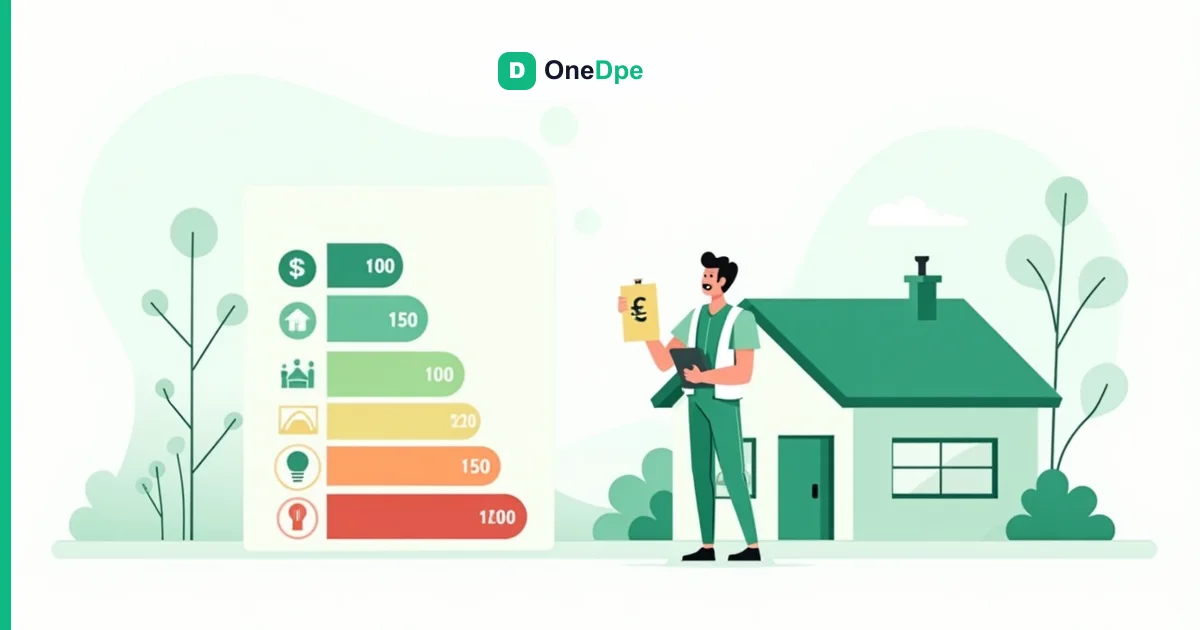
Further into the document, the EPC details the breakdown of consumption by use. This is a valuable section, because it tells you where the energy goes — and therefore where to act first. Five uses are systematically distinguished: heating, domestic hot water (DHW), cooling, lighting, and auxiliaries (ventilation, pumps, circulators).
How to read the breakdown
In the vast majority of homes, heating dominates, followed by domestic hot water. Together, these two items often account for most of the consumption. Cooling appears only if the home is air-conditioned; lighting and auxiliaries generally remain marginal. This hierarchy is logical: that is why insulation and heating works are almost always a priority over the rest.
Profile: an old, poorly-insulated flat with electric heating will show an overwhelming heating item — a sign that renovating the envelope (walls, windows, roof space) will have the greatest leverage.
The trap of an inconsistent breakdown
Check this breakdown for consistency with the home's description. An abnormally low heating item for an old, never-renovated home, or a cooling share recorded when no air-conditioning is described, should draw your attention. These inconsistencies do not prove an error on their own, but they warrant a second look — exactly the kind of signal an automated verification tool can spot.
The description of the building fabric and equipment
This is the technical heart of the EPC, and the section most revealing of the assessment's quality. The description lists the physical characteristics surveyed by the assessor: the walls and their insulation, the roof and roof space, the floor, the joinery (single, double or triple glazing), the heating system, the domestic hot water system, and the type of ventilation.
This data is decisive: the entire 3CL-DPE 2021 calculation rests on it. If the assessor entered wall insulation where there is none, or got the year of construction wrong, the final label is distorted. This is where the document's reliability is decided.
What to check on your EPC: do the described characteristics match the reality of the home? Year of construction, glazing type, presence or absence of insulation, type of heating: confront each line of the description with what you know of the property. A single wrong data point can shift the class.
Default values, a source of imprecision
When a characteristic is unknown (for example the insulation of a hidden wall), the assessor applies regulatory default values, generally pessimistic. A home that is actually insulated but documented "by default" will therefore be under-rated. Conversely, over-favourable assumptions over-rate performance. The EPC should normally indicate when a data point was entered or estimated by default: spotting these mentions helps you judge how solid the assessment is.
The works recommendations
The EPC must include a works recommendations section aimed at improving the home's performance. This section proposes one or more renovation scenarios, with an estimate of the expected class improvement and, often, a cost range for the works.
Read these recommendations as a first lead, not as a quote. The cost estimates are indicative and based on national averages; they do not replace a professional study or a calculation tailored to your home. Moreover, the order of works matters: insulating before changing the heating system avoids over-sizing — and therefore overpaying for — a new appliance.
Key point: the EPC recommendations point the direction (insulation, heating, ventilation) but not the reliable detailed figures. To estimate the real class gain and the return on investment of each scenario, a works simulator cross-checking the EPC data with your property gives a far more precise picture.
Summer comfort
Introduced with the 2021 reform, the summer-comfort indicator assesses the home's ability to stay bearable during heatwaves, without resorting to air-conditioning. It rests on criteria such as the building's thermal inertia, the presence of solar protection (shutters, blinds), the possibility of natural cross-ventilation, and roof insulation. The EPC generally reports it as a qualitative rating (for example: "good", "average" or "insufficient" comfort).
This indicator is becoming more important as heatwave episodes multiply. A home rated as efficient in winter can prove unliveable in summer if it is poorly shaded and lacks inertia. Read this section as an essential complement to the energy label: purely informative, this indicator does not enter into the A-to-G class calculation and carries no obligation, either on sale or on letting. Across 11.2 million DPEs, our 2026 summer comfort barometer finds 40.2% rated "insufficient".
The ADEME number and the period of validity
The last section, but the first thing to check: the document's identification. Every valid EPC carries a 13-character ADEME registration number, assigned when the assessment is filed in the national database run by ADEME (the French Environment and Energy Management Agency). This number lets you verify the assessment's authenticity and consult it in the public observatory.
An EPC without a valid ADEME number has no legal value. The first reflex is therefore to find it and check it against the national database — that check heads the list of the 7 signs of a sloppy or fraudulent energy assessment.
Validity: 10 years, but with exceptions
An EPC is valid for 10 years from its date of issue (CCH art. D.126-19, created by decree no. 2021-872 of 30 June 2021). But this rule has one major exception linked to the reform: certificates issued under the old method had their validity shortened. In practice, EPCs drawn up before 1 July 2021 have no longer been valid since 1 January 2025. A pre-reform document, even less than ten years old, can therefore no longer be used.
What to do now: find the date of issue and the ADEME number at the bottom of the document. If the EPC dates from before 1 July 2021, it is expired: demand an up-to-date certificate before any transaction. If the ADEME number is missing or does not have 13 characters, treat the document as invalid.
Check your EPC's consistency
Check your EPC section by section
Paste your EPC number: the OneDpe verification tool checks the assessment's authenticity (ADEME number, validity), reads each indicator for you — labels, costs, consumption breakdown, building description — and compares it with similar homes to flag the inconsistencies that warrant a second look.
To go further: the complete EPC guide for 2026.
Conclusion
An EPC is not just its letter. Read properly, it gives you a home's estimated annual cost, the breakdown of its consumption, the real state of its insulation and equipment, the works to plan, its summer behaviour, and its legal validity. Each section has its trap: the label that keeps the worse of the two thresholds, the cost estimate mistaken for a bill, the description filled in by default values, or the expired certificate without a valid ADEME number.
Reading an EPC page by page means giving yourself the means to spot what is wrong before you sign. And if you want to go faster, the OneDpe EPC check dissects each indicator and points out the inconsistencies for you.