Two owners of an identical home each hire an assessor. The first pays €120, the second €240. The result? They may get two different energy classes — and it is not necessarily the pricier one who got it right. The French EPC (the DPE) has an unregulated price, and that price tells you nothing about its reliability. Here is what the data says, and the five checks that really matter before you choose.
The question is far from theoretical: now that the EPC is legally binding and conditions the right to let, a wrong label can be very costly — a home wrongly rated F means an unjustified discount and pointless works; rated better than it deserves, it means a trapped buyer or tenant. Telling a serious assessment from a sloppy one has become a basic protective reflex.
70% of assessors checked by France's consumer-protection authority (DGCCRF) in 2023 had at least one anomaly (Court of Auditors, 2025). And the price paid changes nothing: no official source links an EPC's fee to its reliability.
What this article covers
Why an EPC's price is unregulated and highly variable, what studies reveal about its reliability (and the absence of any link with price), what actually predicts a dubious assessment, how the State has tightened controls since 2025, and the checklist of five concrete criteria to choose a reliable assessor and verify your EPC.
An EPC's price: unregulated, and highly variable
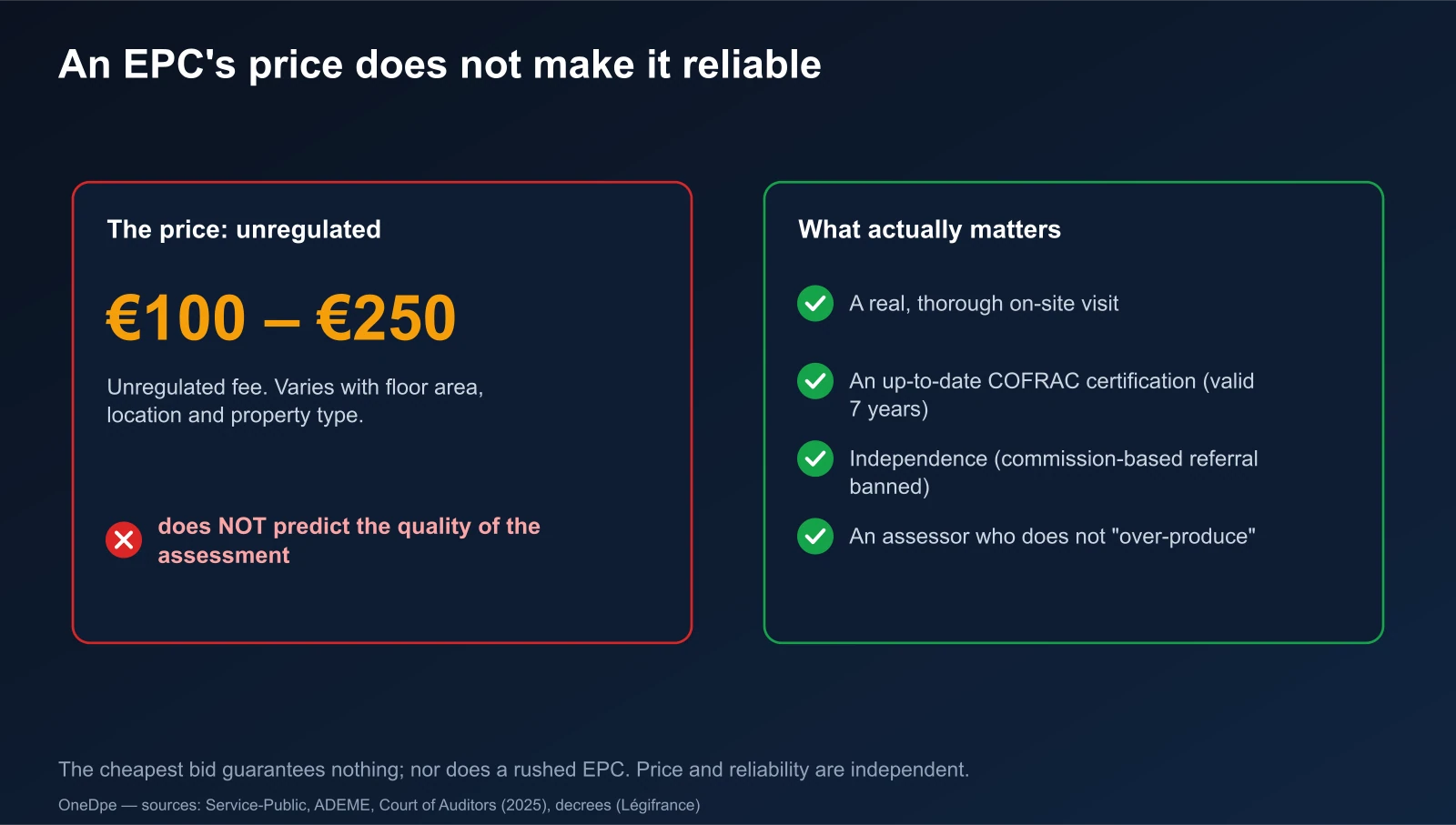
First key point: the price of an EPC is not regulated. Every assessor sets their own fee freely (service-public.gouv.fr). ADEME puts the usual range between €100 and €250 for a home, the price varying mainly with floor area, location and property type (house or flat).
The spread is real. According to estimates from an assessment firm (Kiwidiag), the 2026 average would be around €188 for a mid-sized flat and €245 for a house, with marked differences across departments — roughly €140 in the Nord to over €270 in the Meuse. These figures, from a market player rather than an official statistic, give an order of magnitude: the same service can cost twice as much depending on the professional and the region.
Why such variability? The EPC has become markedly more complex: the 2021 reform, then method adjustments — including the electricity coefficient moving from 2.3 to 1.9 on 1 January 2026 — demand more skill and data-entry time. An established professional, properly insured and who takes the time to visit the home, does not have the same cost structure as a high-volume operator. But beware: this cost logic does not mechanically translate into quality of the result. That is exactly the heart of the matter.
Price tells you nothing about reliability
One might assume a pricier assessment is necessarily more rigorous. The data does not bear this out. Tests by the consumer press are telling: when 60 Millions de consommateurs had four houses assessed by five assessors each, the results diverged by up to two energy classes for the same home — regardless of the price paid. UFC-Que Choisir reached the same fundamental conclusion: the same property can change class depending on who assesses it.
As for the gap with reality, it is documented: cross-checking 221 homes with their actual consumption measured by smart meters (Linky, Gazpar), Hello Watt found that 71% of EPCs did not match actual consumption, nearly a third of them by two to three classes. Here too, the price of the assessment does not explain how accurate the result is.
This gap stems from the very nature of the calculation. The EPC relies on data entered by the assessor — floor areas, wall and roof insulation, heating type, joinery, year of construction — and on regulatory calculation conventions, not on the occupants' real consumption. Two professionals who measure or interpret a wall's insulation or a boiler's age differently will arrive at two different labels. The thoroughness of the survey therefore trumps everything else: it is what makes reliability, and it cannot be read off the quote.
⚠️ The reflex to avoid. Choosing the cheapest assessor "because it's the same document" is a false economy: a wrong EPC can trigger an unjustified discount on sale, a rental ban, or a costly dispute. But paying more guarantees nothing either. It is not the price you should look at — it is the rigour.
The stakes are not minor. The EPC has been legally binding since 1 July 2021: its information engages the seller's and landlord's liability, and a wrong assessment can ground an action against the assessor. A bad EPC is therefore not a mere administrative detail: it is a real legal and financial risk, for whoever commissions it as much as whoever relies on it. Hence the importance of choosing well upstream, rather than having to contest downstream.
What really predicts a dubious assessment
If not the price, what sets a reliable EPC apart? The signals identified by the State in its reliability plan point mainly to the assessor's behaviour, not their fee.
The first signal is volume. A professional producing hundreds of assessments a month cannot do them all seriously. So much so that, since the decree of 28 July 2025, an assessor exceeding 1,000 home EPCs over a rolling twelve months can be suspended (in force since 1 October 2025). The second is speed: a rushed assessment, without a thorough visit of the home, produces sloppy data. The physical visit of the building is, moreover, mandatory.
At your level, a few concrete red flags should raise vigilance: an appointment rushed through in a few minutes, no survey of materials or photos, an assessor "recommended" (and sometimes paid) by the estate agent or the renovation firm, or data that seems copied from an old assessment. None of these signals relates to the fee charged; all reflect a lack of rigour. Conversely, a professional who takes the time to inspect the attic, to measure, to photograph and to ask about the building's history legitimately inspires more confidence — whatever their price.
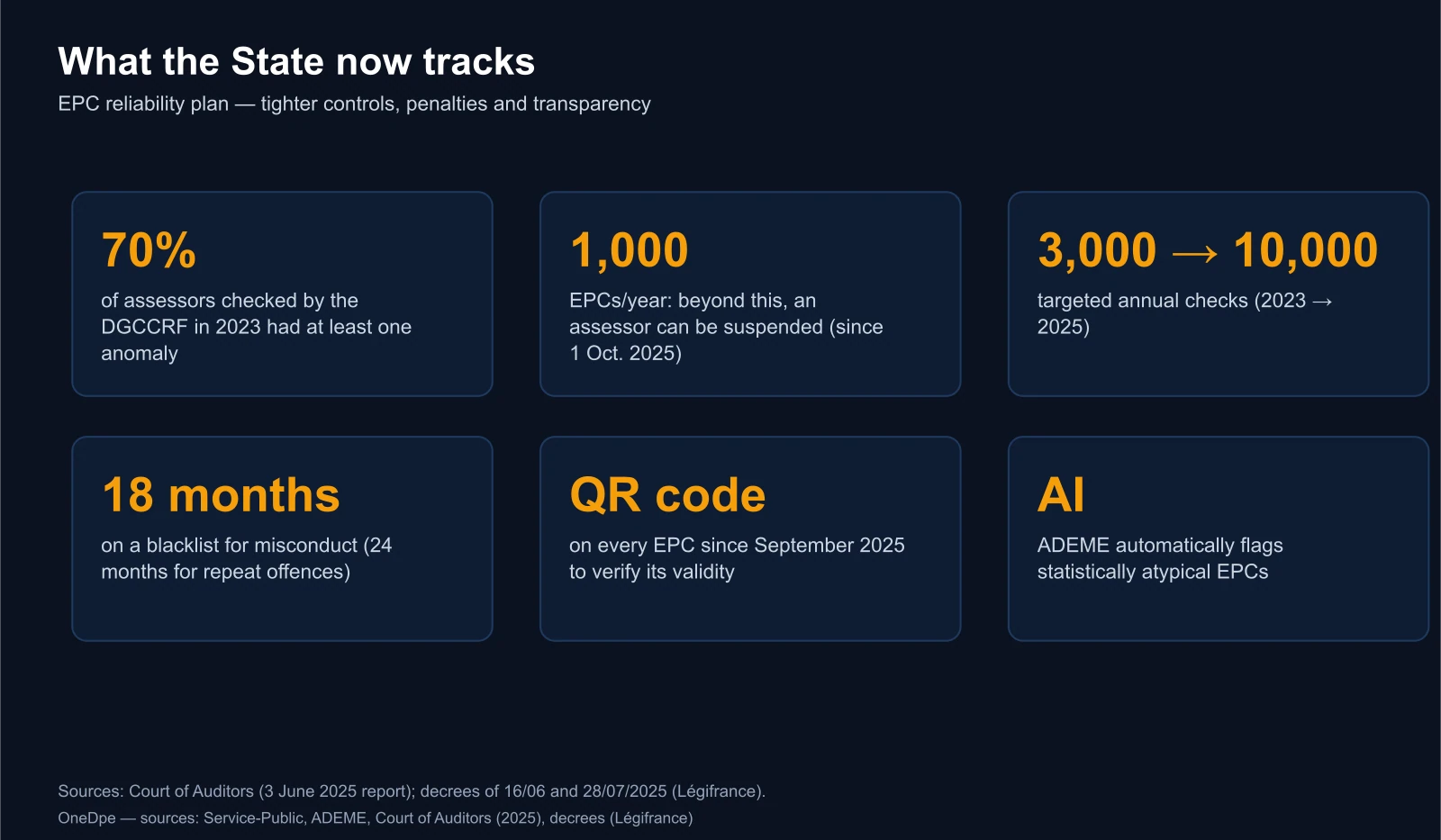
The State has indeed cracked down. The volume of EPCs exploded — from 120,000 a month in 2018 to over 350,000 a month in 2024 — and quality did not follow: 70% of assessors checked by the DGCCRF in 2023 had at least one anomaly. In response, annual checks rise from 3,000 (2023) towards a target of 10,000 (2025), breaches now carry 18 months on a blacklist (24 months for repeat offences), and ADEME automatically flags statistically atypical EPCs using artificial intelligence. A QR code has appeared on every EPC since September 2025 to verify its validity online.
This statistical detection echoes what our own analyses reveal: across millions of assessments, some profiles are physically very improbable — an entire old building rated A while heated by electric convectors, for instance. These atypical signatures, which a serious assessor does not produce in series, are precisely what ADEME's algorithm and verification tools seek to spot. Here again, the price paid is not part of the equation: it is the professional's rigour that makes the difference.
5 checks to choose a good assessor
Before hiring a professional — and therefore before looking at the price — run through these five criteria.
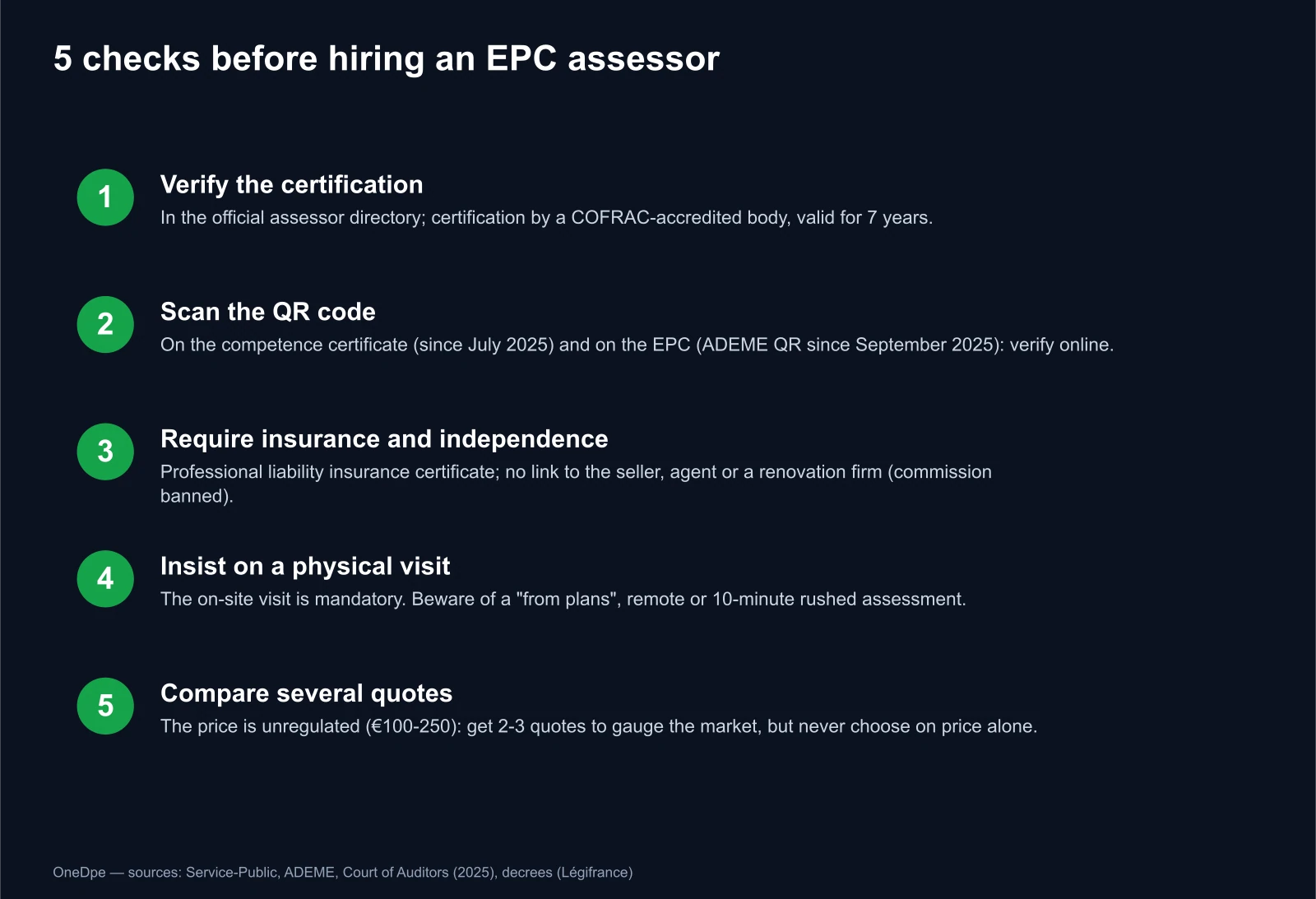
- Verify the certification. The assessor must appear in the official directory of certified assessors and hold a certification issued by a COFRAC-accredited body, valid for seven years.
- Scan the QR code. The competence certificate has carried a QR code since July 2025, and every EPC an ADEME QR code since September 2025: they let you verify online, in seconds, that the professional and the assessment are genuine.
- Require insurance and independence. Ask for the professional liability insurance certificate, and make sure the assessor has no link to the seller, the estate agent or a renovation firm — commission-based referral is banned (decree of 11 October 2010).
- Insist on a physical visit. The building visit is mandatory; beware of an assessment done "from plans", remotely or rushed in a few minutes. A serious assessment means a careful examination of walls, joinery, heating and insulation.
- Compare several quotes — without choosing on price. Since the fee is unregulated, get two or three quotes to gauge the market (ADEME's order of magnitude is €100-250), but never pick the lowest bid on price alone.
And if your EPC is already done?
Have a doubt about an assessment already carried out — yours, or that of a property you covet? The first reflex is to verify its authenticity (13-character ADEME registration number, QR code) then its consistency: an A or B class on never-renovated old stock, or a label very different from comparable homes in the same building, deserve a second look.
If the check reveals a serious inconsistency, you can request a counter-assessment from another certified professional, then report the assessment to the body that certified the assessor, to ADEME or to the DGCCRF. Where there is a quantifiable loss — extra works, a loss on a sale, an inability to let — the assessor's liability can be engaged. Better, though, to prevent than to cure: applying the five criteria before hiring avoids, in the vast majority of cases, having to get there.
Paste your EPC number: the OneDpe verification tool checks the assessment's authenticity, compares it with similar homes and flags the inconsistencies that warrant a second opinion — before you commit to a sale, a purchase or a rental.
To go further: the 7 signs of a sloppy or over-rated EPC.
Conclusion
An EPC's price is unregulated, variable, and fundamentally disconnected from its reliability. What separates a good assessment from a bad one is not the size of the bill: it is the thoroughness of the visit, the validity of the certification, the professional's independence and the absence of over-production. At a time when the State is tightening controls and a wrong label is costly, choosing your assessor on the right criteria — and verifying the assessment obtained — is the best protection.
The useful reflex: apply the five criteria before hiring, then confront the label with reality. The OneDpe EPC check does it for you.