Apartment F → E
65 m²All electric
65 m² all-electric 3-room apartment, 360 kWh PE/m²/yr on the 1.9 scale. On the 1.7 scale: 322 kWh PE/m²/yr → rated E instead of F, out of the energy-sieve bracket.
The electricity conversion factor is 1.9 for certificates issued in 2026 and 1.7 for those issued from 1 January 2027 (order of 19 August 2026). Compare the rating on your certificate with the one your home would get on the 1.7 scale. Free and instant simulation.
How does it work?
The electricity-to-primary-energy conversion factor is 2.3 for certificates issued from 1 July 2021 to 31 December 2025, 1.9 for those issued in 2026 (order of 13 August 2025) and 1.7 for those issued from 1 January 2027 (order of 19 August 2026). For an all-electric home the first step removes up to 17.4% of primary energy, the second up to 10.5% more — enough to move the energy rating. A certificate within its validity period keeps its rating (or that of an attestation obtained at a change of factor) until it expires; from 1 January 2027, an ADEME attestation on the 1.7 scale can replace it.
1.9 → 1.7
Electricity conversion factor, for certificates issued from 1 January 2027
161,479
EPC-assessed homes that would leave the energy-sieve bracket on the 1.7 scale
555,068
Cumulative exits across the 2.3 → 1.9 → 1.7 span, same perimeter
1 Jan 2027
Entry into force of the order of 19 August 2026
OneDpe measurements on the ADEME open database. The counts cited on this page (161,479, 555,068, 604,669) rest on the same target perimeter of 9,625,591 EPC-assessed homes, ratings reclassified against the statutory threshold table; on that perimeter, the 2.3 → 1.9 step, applied to certificates issued in 2026 and to ADEME’s recalculated data, counts 393,589 exits. We count certificates, never a housing stock: these are floors.
1
Input your DPE number or enter consumption data manually.
2
The calculation applies the 1.9 factor, then the 1.7 factor, to your electricity share alone.
3
You read, side by side, the rating on your certificate and the one it would get on the 1.7 scale.
Three typical homes, and what the 1.7 scale changes to their rating.
65 m² all-electric 3-room apartment, 360 kWh PE/m²/yr on the 1.9 scale. On the 1.7 scale: 322 kWh PE/m²/yr → rated E instead of F, out of the energy-sieve bracket.
90 m² all-electric house, 450 kWh PE/m²/yr on the 1.9 scale. On the 1.7 scale: 403 kWh PE/m²/yr → rated F instead of G, but still a sieve: the bracket is only left from class E.
45 m² all-electric 2-room apartment, 270 kWh PE/m²/yr on the 1.9 scale. On the 1.7 scale: 242 kWh PE/m²/yr → rated D instead of E.
Examples computed against the statutory threshold table for a 100% electric home above 40 m² at low altitude (order of 19 August 2026). A non-electric share, a floor area below 40 m², altitude or climate zone shift the thresholds: your actual situation may differ.
The factor applies to electricity only: the larger the electricity share, the more the displayed primary energy falls. On the 1.7 scale, a further 161,479 EPC-assessed homes would leave the energy-sieve bracket, on a target perimeter of 9,625,591 certificates — ratings reclassified against the statutory threshold table.
The other energy sources carry a factor of 1. An all-gas home still has an electricity share — lighting and auxiliaries always are — but it is too small to shift the rating: the question is not who moves, it is who moves enough to change letter. And on the same perimeter, 604,669 EPC-assessed homes would remain sieves on the 1.7 scale as on the 1.9 scale — it is not their consumption that rates them, it is their boiler. The rating retains the worse of the two classes, energy and climate.
The electricity conversion factor is 2.3 for certificates issued from 1 July 2021 to 31 December 2025, 1.9 for those issued in 2026 (order of 13 August 2025) and 1.7 for those issued from 1 January 2027 (order of 19 August 2026). At each step it changes the calculation, not your home. That distinction has very concrete consequences.
What changes
What does not change
A DPE label always takes the WORSE of two scores: the primary-energy one and the greenhouse-gas one. That rule decides who gains something from the reform and who gains nothing.
Electric heating: the French mix is low-carbon, so your GHG score is generally good. It is primary energy that caps your label — and that is exactly what the reform improves. You are the winning case.
Gas, oil or wood heating: your label is usually capped by GHG, which the reform does not touch. You may see your primary-energy figure drop slightly without your letter moving at all. That is not a bug in the simulator.
Entering final energy instead of primary energy
In manual mode, the field expects primary-energy consumption — the large figure on the energy label, covering 5 uses. The DPE also shows a final-energy figure: for an all-electric home surveyed before 2026, it is roughly 2.3 times lower (1.9 times for a certificate issued in 2026, 1.7 times from 1 January 2027).
What it changes: The simulator then places the home several letters too high: entering 180 kWh/m²/yr of final energy instead of 415 in primary energy displays a D instead of an F. The percentage reduction itself stays the same — it is not the reduction that is wrong, it is the starting point, in the most flattering direction.
Declaring "electricity" for mixed heating
Choosing "Electricity" in manual mode makes the calculation assume all consumption is electric. Yet many homes combine electric heating with gas, oil or wood for hot water or as a backup.
What it changes: The label gain shown is overstated. The "by DPE number" mode solves this: the simulator retrieves your actual consumption and applies the reduction only to the electric share.
Forgetting that the climate label is unknown
A DPE label always takes the worse of two grades, energy and climate. In manual mode the simulator does not know your climate grade: it can only compute the energy side.
What it changes: For a home whose climate grade is what caps the label, the manual result is too optimistic. Here too, the "by DPE number" mode retrieves the climate grade and lets it apply.
Simulating a certificate already issued in 2026
Certificates issued in 2026 already apply the 1.9 factor, and those issued from 1 January 2027 the 1.7 factor. Applying the reduction to them a second time counts it twice.
What it changes: The label announced can come out one class better than the real one. Check the issue date at the top of the certificate: if it falls in 2026, the label shown is already on the 1.9 scale — only the move to the 1.7 scale remains to simulate, which is what the tool does in "by DPE number" mode.
Not checking the starting certificate
The simulator takes your certificate’s figures as they are: it converts them, it does not check them. If the starting certificate contains an error, the projection reproduces it exactly.
What it changes: Across the 689,279 certificates our data lets us observe, 11.1% carry at least one major inconsistency. That rate aggregates eight families of checks and does not include the primary-to-final-energy ratio, counted separately: 5.3% of certificates show an inconsistency there, all severities combined — precisely the ratio the reform changes.
Mistaking the simulation for a valid document
The result shown here is a projection: it is not a document you can rely on, and it does not replace your certificate. Only your certificate and, where applicable, the ADEME attestation that replaces its rating are — an attestation generated by the DPE-Audit Observatory, which the ministry presents as free and requiring no new visit from an assessor.
What it changes: A screenshot of the simulator carries no weight in a listing, a lease or a sale agreement. It is also what makes some owners receptive to a paid "updated DPE", when the ADEME attestation is presented as free.
Nothing mandatory, and certainly not a new survey. Your current certificate stays valid for its full ten years, with its rating. Certificates issued in 2026 already apply the 1.9 factor, and those issued from 1 January 2027 carry 1.7. For an earlier one, ADEME’s DPE-Audit Observatory generates a new-rating attestation — at the 1.9 factor until 31 December 2026, at the 1.7 factor from 1 January 2027 under the order of 19 August 2026 — which the ministry presents as free and requiring no new visit from an assessor: that is the document to ask for before paying anyone offering you an "updated" DPE.
Sources and method
Coefficient and timetable: order of 13 August 2025, in force from 1 January 2026; order of 19 August 2026 (NOR VLOL2617030A, Journal officiel of 26 August 2026), in force from 1 January 2027. Inconsistency rates by label: our barometer across 689,279 ADEME certificates, post-stratified by department and vintage. Atypical signatures: national certificate database (category A, 3CL-2021 method), flats grouped by address, buildings of at least 5 units. the reliability barometer · the verification tool
The new-rating attestation is generated by ADEME’s DPE-Audit Observatory: it replaces the rating of your certificate within its validity period without calling its input data into question, and keeps its expiry date. Until 31 December 2026 it applies the 1.9 factor; from 1 January 2027, the order of 19 August 2026 provides for an attestation at the 1.7 factor. The ministry presents it as free and requiring no new visit (press release of 31 August 2026).
ADEME ObservatoryOur verification tool analyzes your DPE with over 40 automated checks: consistency, fraud detection, comparison with similar properties.
Verify my DPEContinue your simulation with our other free calculators
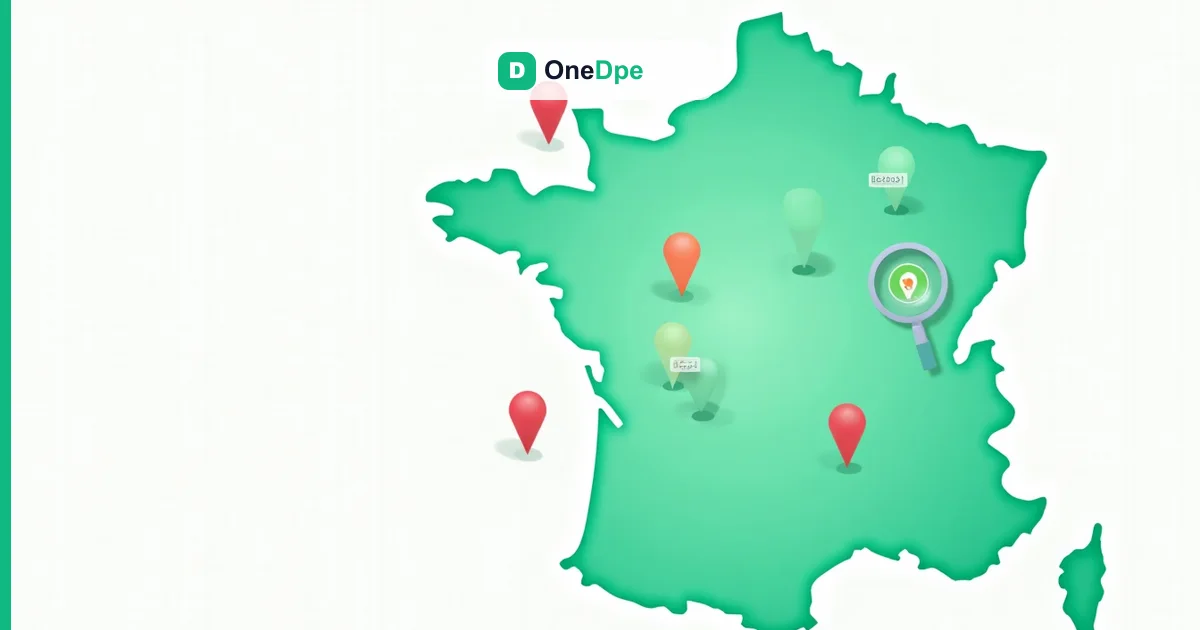
Our analysis of 16 million EPCs reveals the French departments where statistically suspect certificates concentrate. Cluster map, method and how to check yours.
Selling a home soon after supported works: when must you repay MaPrimeRénov'? The role of the rental commitment, the landlord case, and the distinction from CEE and the eco-PTZ loan, sourced from ANAH and France Rénov'.
Moving from F to D on the DPE/EPC: works-bundle scenarios by property type (old house, recent house, flat), with ADEME cost ranges and 2026 subsidies (MaPrimeRénov' full-scale, CEE).