⚠️ Article updated on 10 October 2026: new section on the "A0" mention ((ministerial) order of 11 June 2026 on the DPE). In mainland France, some A or B labels may carry it from 1 January 2027. The answer on validity is corrected: works do not shorten the ten years. In mainland France, the 2027 coefficient of 1.7 and the rental timetable are clarified, as are the overseas territories and the description of the simulator.
A single letter, from A to G, that today decides your right to let, your home's sale price and the cost of your renovation works. The energy class of your DPE (Diagnostic de Performance Énergétique — France's Energy Performance Certificate, or EPC) is no longer a simple environmental marker: it is a legal and financial data point in its own right. But you still need to understand what each letter means — and why the same home can change class on 1 January 2026.
Behind every label hide two thresholds, not one: an energy-consumption threshold and a CO₂-emissions threshold. And it is always the worse of the two that wins. Understanding this rule means you will not be caught out by an F class you thought was a D, or overvalue a property you are about to buy.
7 classes, 2 thresholds per class. An EPC class is never set by consumption alone: it always keeps the worse of the two scores between primary energy (kWh/m²/year) and climate (kg CO₂/m²/year), under the (ministerial) order of 31 March 2021.
What this article covers
What each EPC class from A to G actually means, the exact thresholds in primary energy (kWh/m²/year) and greenhouse-gas emissions (kg CO₂/m²/year), the worse-of-the-two rule, the timetable banning thermal sieves (passoires thermiques) from the rental market in mainland France (G in 2025, F in 2028, E in 2034), and the effect of the new electricity coefficient on 1 January 2026 for electrically heated homes.
The legal framework of EPC classes
The EPC's seven classes and their thresholds are set by the (ministerial) order of 31 March 2021 on the energy performance diagnosis for buildings or parts of buildings used as dwellings in mainland France; the conventional calculation method known as 3CL-DPE 2021 (Calcul de Consommation Conventionnelle des Logements — the official French residential energy-calculation methodology) falls under another order of the same day. Since that reform, the EPC no longer relies on actual bills but on a physical model of the home: insulation, floor areas, heating system, hot-water production, ventilation.
Two major legal developments transformed the reach of these classes. First, the EPC became legally binding on 1 July 2021: its information engages the seller's and landlord's liability, who may be held responsible in the event of an error. The EPC is also annexed to the technical-diagnosis file handed over at sale (CCH — French Construction and Housing Code — art. L.271-4). Second, the Climate & Resilience Act of 22 August 2021 (Act no. 2021-1104) wrote into article 6 of Act no. 89-462 of 6 July 1989 a timetable progressively banning the most energy-hungry homes from the private rental market, under the energy-decency rules. Its dates differ between mainland France and the overseas territories. The classes are those of article L.173-1-1 of the CCH.
The resulting energy-decency criterion, set out by decree no. 2021-19 of 11 January 2021 and then by decree no. 2023-796 of 18 August 2023, fixes for mainland France a consumption ceiling expressed in final energy that corresponds, in practice, to the exclusion timetable for classes G, F and then E. Finally, the (ministerial) order of 13 August 2025 revised a central parameter of the 3CL-DPE method: the coefficient converting electricity into primary energy, which drops in mainland France from 2.3 to 1.9 from 1 January 2026.
⚠️ Warning: the figures below are those for mainland France. The (ministerial) order of 31 March 2021 that sets these thresholds only covers mainland France, as its title states: they do not apply in the French overseas territories.
Understanding the two thresholds: primary energy and climate
The heart of the 2021 EPC lies in one idea: each class is defined by two simultaneous thresholds, not one. The first measures primary-energy consumption, the second measures the climate impact. A home only achieves a class if it meets both corresponding ceilings; otherwise, it drops to the lower class.
Primary energy (kWh/m²/year)
Primary energy is the energy consumed "at source", before transformation and transport to the home. For electricity, a primary-energy conversion coefficient is applied, reflecting the energy needed to produce and deliver 1 kWh consumed at home. Set at 2.3 in mainland France since the 2021 reform, this coefficient drops to 1.9 on 1 January 2026. The EPC adds up consumption across the five regulated uses — heating, domestic hot water, cooling, lighting and auxiliaries (ventilation, pumps) — and expresses it per square metre per year. This is the horizontal axis of the energy label.
Climate (kg CO₂/m²/year)
The second threshold measures the greenhouse-gas (GHG) emissions associated with the same consumption, expressed in kilograms of CO₂ equivalent per square metre per year. It heavily penalises fossil fuels: oil and, to a lesser extent, gas emit far more CO₂ than France's low-carbon electricity or wood. It is this second axis that can drop a well-insulated but oil-heated home by a class. Conversely, on the energy threshold this time, electrically heated homes in mainland France benefit from the new primary-energy coefficient (1.9): our analysis quantifies the 850,000 homes lifted out of classes F and G in 2026.
The worse-of-the-two rule
This is the decisive rule: the class shown is whichever of the two thresholds places the home lowest. A flat consuming 240 kWh/m²/year (band D for energy) but emitting 75 kg CO₂/m²/year (band F for climate) will be rated F, not D. Climate wins. This logic explains why two homes with identical consumption can carry different labels depending on their heating energy.
Key takeaway: your home cannot be "rescued" by its better threshold. If either of the two rates it G, it is G — even if the other placed it at C.
The 2026 EPC class threshold table
Here are the thresholds applicable in mainland France, set by the (ministerial) order of 31 March 2021. For each class, the home must meet both the primary-energy threshold and the emissions threshold; failing one, it drops by one or more classes.
| Class | Primary energy (kWh/m²/year) | Climate (kg CO₂/m²/year) | Status |
|---|---|---|---|
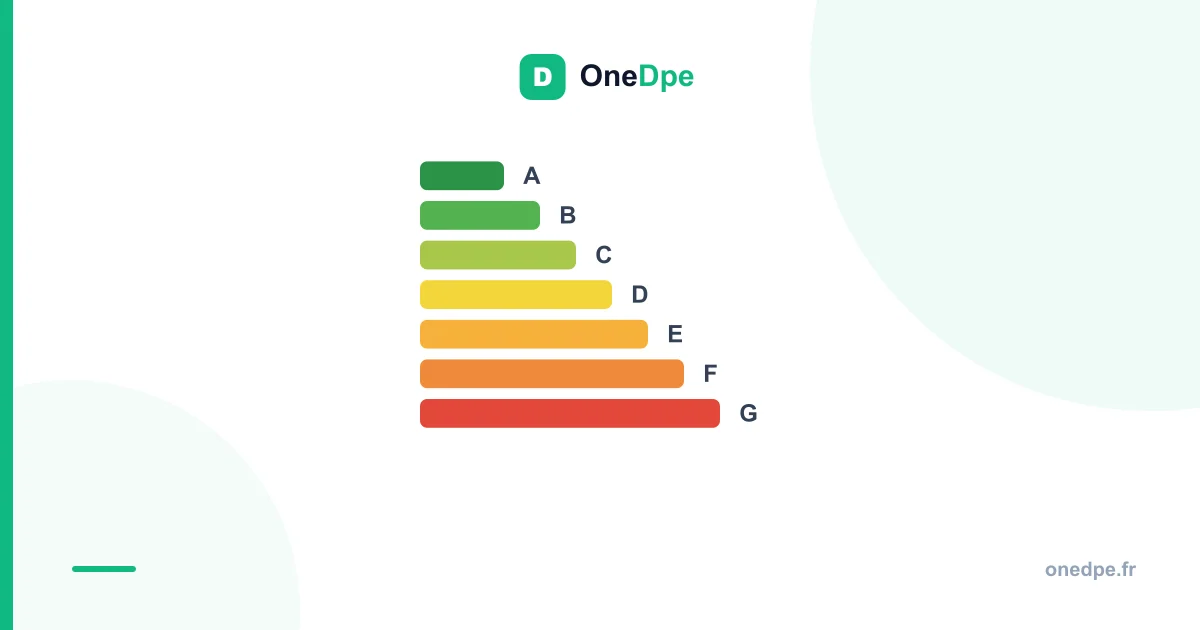
| A | < 70 | < 6 | Very efficient |
| B | 70 to 110 | 6 to 11 | Efficient |
| C | 110 to 180 | 11 to 30 | Decent |
| D | 180 to 250 | 30 to 50 | Average |
| E | 250 to 330 | 50 to 70 | Energy-hungry |
| F | 330 to 420 | 70 to 100 | Thermal sieve |
| G | ≥ 420 | ≥ 100 | Thermal sieve |
How to read the table: a home is rated A if it consumes less than 70 kWh/m²/year of primary energy and emits less than 6 kg CO₂/m²/year. As soon as either exceeds its ceiling, the class corresponding to the worse threshold applies. Classes F and G are the "thermal sieves", the direct target of the rental-ban timetable.
⚠️ Homes of 40 m² or less: the thresholds above do not apply as they stand. The 3CL method mechanically overstated the per-m² consumption of small dwellings — domestic hot water, largely a flat-rate item, weighs far more when spread over 25 m² than over 100 m², and the compactness of very small homes pushes in the same direction. The order of 25 March 2024, in force since 1 July 2024, corrects this bias by adjusting the label thresholds for homes whose reference floor area is 40 m² or less: around 140,000 homes left thermal-sieve status as a result. If your DPE was issued between 1 July 2021 and 30 June 2024 on a home of that size, a certificate carrying the new label can be generated free of charge on the ADEME DPE-Audit Observatory, without a new survey.
What each class means for you
Beyond the figures, each letter carries concrete consequences — comfort, bills, the right to let, the value of the property. Here is what each class implies.
Classes A and B: performance, no constraints
An A or B home is very well insulated and low-emitting. For you, that means reduced energy bills, no rental constraint on the horizon, and a stronger green value at resale. These classes mainly concern recent builds (post-RT 2012 or RE 2020 thermal standards) and high-performance whole-home renovations. No action is required: you sit above every regulatory deadline.
In mainland France, the (ministerial) order of 11 June 2026 on the DPE creates an "A0" mention for homes regarded as zero-emission. It will appear on certificates issued from 1 January 2027. It is not a new "A0 class": the scale remains A to G, with the same thresholds, and a home rated B that carries the mention is still rated B. For a certificate on an existing home, the label must be A or B. All the energy used must also be renewable (on site or nearby), electric or from an efficient heating or cooling network. No heating or hot-water installation may be "liable" to use fossil energy on site or nearby. A gas boiler kept as a backup therefore rules it out. No text provides for adding it to a certificate issued before 1 January 2027.
Classes C and D: the comfortable zone
Most of the housing stock sits at C or D. These homes face no rental ban and offer decent comfort. If you are a landlord, you are safe for the current decade. If you are an owner-occupier, targeted works (roof insulation, boiler replacement) can win you a class and cut your bills, but there is no legal urgency.
Class E: the last step before the ban
An E-rated home remains lettable today, but it is in the timetable's sights: in mainland France, from 1 January 2034, E-rated homes can no longer be offered for letting (energy decency: Act no. 89-462, art. 6). If you let an E-rated property, you have time to plan but not to ignore it: energy-improvement works span several years, and grants (MaPrimeRénov', France's national renovation grant; CEE, Energy Saving Certificates) keep evolving.
Classes F and G: thermal sieves under constraint
If your home is rated F or G, you are directly affected by the rental ban. In mainland France, G-rated homes can no longer be let since 1 January 2025; F-rated homes will be banned from 1 January 2028. An existing lease signed before these dates does not regularise the situation as regards decency: a tenant can demand compliance works.
For an owner-occupier, an F or G class means heavy bills and a property hard to resell without a discount. For a landlord, it is a countdown: either you undertake a renovation to climb back at least to E (then D), or the property leaves the rental market. It is precisely in these classes that renovation offers the best return on investment, both in energy savings and in recovered green value.
The 2025-2034 rental-ban timetable
In mainland France, the Climate & Resilience Act staggered the exclusion of thermal sieves from the private rental market. The timetable applies to new leases and renewals alike, and non-compliance exposes the landlord to a tenant's action to compel works, or even to reduce rent.
| Date in force in mainland France | Class banned from letting | Reference |
|---|---|---|
| 1 January 2025 | Class G | Act no. 89-462, art. 6 (Act no. 2021-1104) |
| 1 January 2028 | Class F | Act no. 89-462, art. 6 (Act no. 2021-1104) |
| 1 January 2034 | Class E | Act no. 89-462, art. 6 (Act no. 2021-1104) |
In Guadeloupe, Martinique, French Guiana, Réunion and Mayotte, article 6 of Act no. 89-462 sets a different timetable. A G-rated home ceases to be decent there from 1 January 2028, an F-rated home from 1 January 2031.
In mainland France, on top of this decency timetable comes, since 1 April 2023, the obligation of a regulatory energy audit when selling an F- or G-rated home (extended to E-rated homes on 1 January 2025), presenting the prospective buyer with costed renovation scenarios. The EPC class therefore conditions not only the right to let, but also the obligations attached to a sale.
The effect of the 1.9 coefficient on 2026 classes in mainland France
This is 2026's most structural change. The (ministerial) order of 13 August 2025 (published in the Official Journal on 26 August 2025) lowers the coefficient converting electricity into primary energy from 2.3 to 1.9 for certificates issued in mainland France from 1 January 2026. In concrete terms, a home's electricity consumption is, for an EPC issued in 2026 in mainland France, multiplied by 1.9 (rather than 2.3) to compute its primary energy: the primary-energy score of electrically heated homes improves mechanically, with no works.
Why this change? The 2.3 coefficient used in mainland France reflected an older electricity-production mix. In mainland France, the 1.9 value reflects the largely decarbonised and more efficient nature of France's electricity fleet as measured in 2026. The effect on labels can be significant: some electric homes previously rated F move to E, or from E to D — a class jump that can, on its own, lift a future rental ban.
For certificates issued in mainland France from 1 January 2027, the (ministerial) order of 19 August 2026 lowers this coefficient again, from 1.9 to 1.7. A certificate already issued keeps its label until its expiry date. From 1 January 2027, an ADEME attestation can, however, replace it: it "replaces the initial label of the energy performance certificate with a new label" (article 3, our translation). The letter does not change automatically: the drop must take primary energy across a class threshold, and the climate score can hold the home back.
⚠️ Warning: the coefficient affects only the primary-energy threshold, not the climate threshold. A home whose class was already pulled down by its CO₂ emissions (oil or gas heating) will not benefit from the new electricity coefficient. The worse-of-the-two rule continues to apply.
If your home in mainland France is electrically heated and its class hinges on a primary-energy threshold, first check the label it would get at the new coefficient. An EPC drawn up under an older coefficient remains valid until its expiry: it is the conversion convention for electricity that has changed, not your property. An ADEME attestation or a new assessment may then reveal a more favourable class, with consequences for your right to let and your resale value.
Compare your EPC class with the 2027 mainland-France scale
With your certificate number, or your primary energy consumption and floor area, the tool compares your label with the one your home would get on the mainland-France 1.7 scale. If you enter figures manually, it also asks for the heating type and the scale your figure comes from; add your climate label as well, so that it keeps the worse of the two scores. With the number, the tool reads it from the certificate. It does not calculate the A0 mention.
To go further: everything about the EPC in 2026 and the right time to redo your EPC (2026 or 2027).
Conclusion
The EPC class, from A to G, rests on a mechanism that is simple to state but decisive: two thresholds — primary energy and climate — of which it is always the worse that sets the letter. That letter today determines your right to let (in mainland France: G banned since 2025, F in 2028, E in 2034), your obligations at sale and the value of your property. And 2026 reshuffles the deck for electric homes in mainland France, whose primary-energy score improves as the coefficient drops to 1.9.
The right reflex: check which threshold your class hinges on, then simulate the effect of the new parameters. The OneDpe 2027 EPC simulator compares your label with the one your home would get on the mainland-France 1.7 scale — so you can decide with full knowledge of the facts.