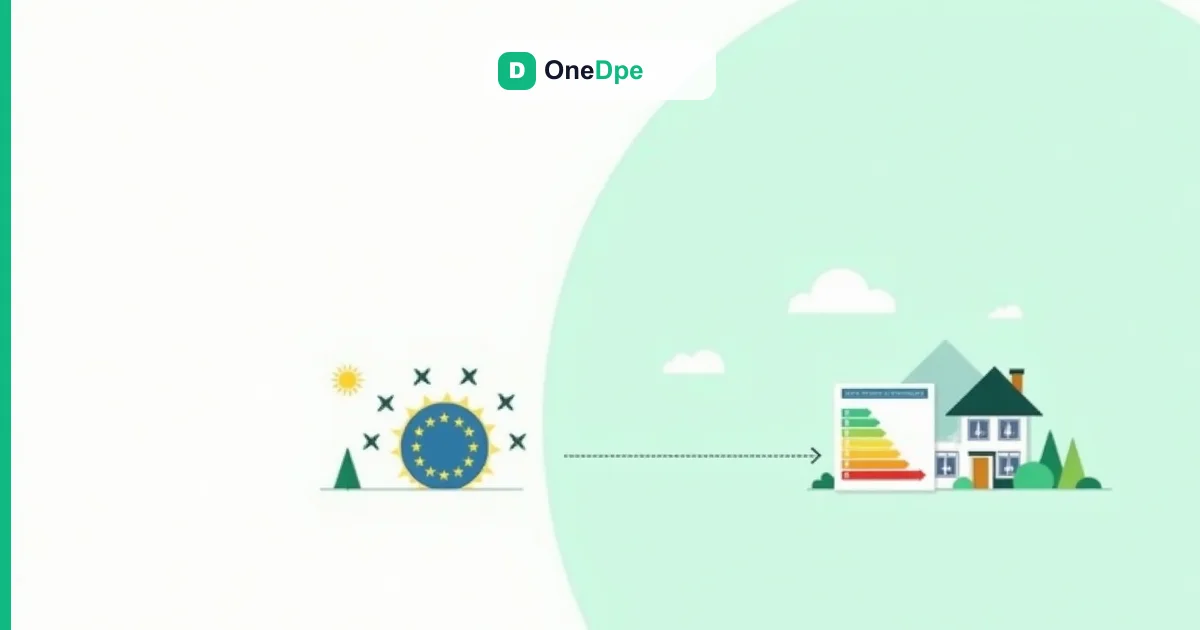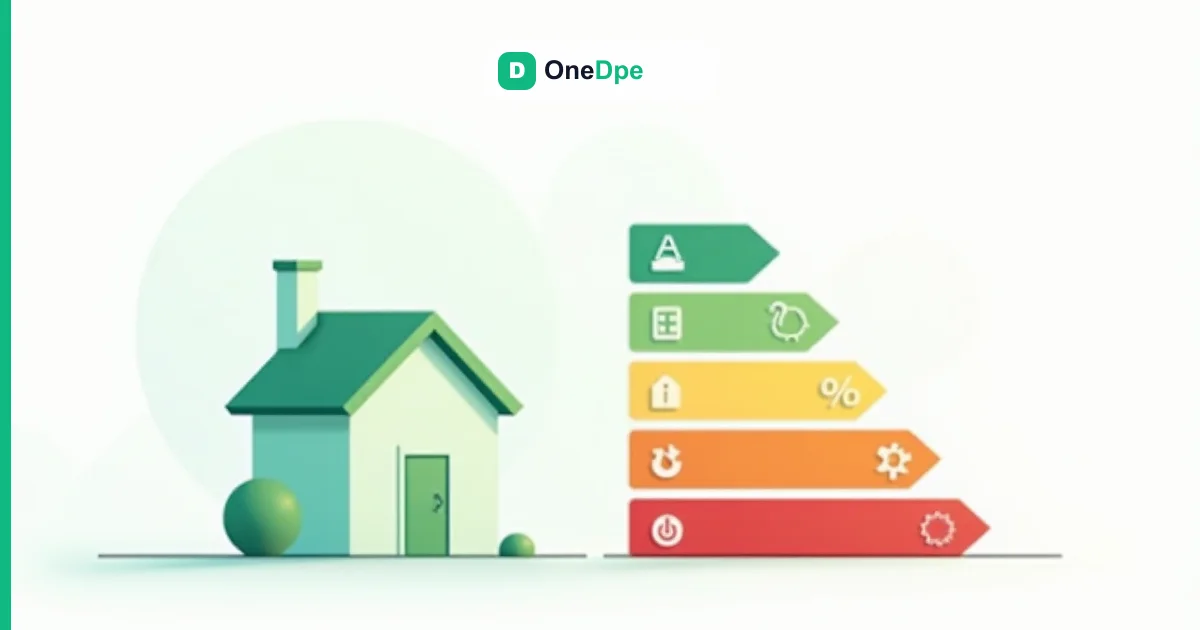
Since 1 January 2026, an electrically heated home no longer reads the same way on its energy label. The reform of the primary-energy conversion coefficient for electricity (the 2.3 factor cut to 1.9 in the 3CL-DPE methodology — the official calculation method for the French Energy Performance Certificate, DPE — Diagnostic de Performance Énergétique) has tipped hundreds of thousands of homes into a better class, without a single wall being insulated. According to government estimates, around 850,000 homes would exit thermal-sieve status as a result.
The question is therefore no longer simply "is my DPE up to date?" but "is it in my interest to redo it now, to have it updated for free, or to wait until 2027?". Other changes are adopted or announced: the ministerial order of 19 August 2026 sets the electricity coefficient at 1.7 for certificates issued from 1 January 2027, a strengthened summer-comfort indicator is planned by 2028, and a European directive hints at further adjustments. Depending on whether you want to sell, let or simply occupy your property, the answer differs. This article gives you the decision tree.
A DPE remains valid for 10 years — redoing a still-valid certificate prematurely means paying twice (in the order of €100 to €250 depending on the diagnostician) where a free label update is often enough since 2026.
What this article covers
The reform of the primary-energy coefficient for electricity on 1 January 2026 and its effect on labels, the difference between redoing a DPE and obtaining a free update via ADEME's DPE-Audit Observatory, the 10-year validity rule, the upcoming changes (the 1.7 coefficient for certificates issued from 1 January 2027, summer comfort 2028, the EPBD directive), and above all a concrete decision tree depending on whether you plan to sell, let or occupy your home — with a worked case of a G-rated home that moves back to F or E.
The DPE reform on 1 January 2026: what the rules say
The Energy Performance Certificate (DPE) rates a home from A to G based on its primary-energy consumption and its greenhouse-gas emissions. Consumption is expressed in primary energy, which means converting final energy (the figure read at the meter) using a coefficient. For electricity, this coefficient was 2.3 from the 2021 reform: it heavily penalised electrically heated homes compared with gas.
The ministerial order of 13 August 2025, published in the Official Journal on 26 August 2025, lowers this coefficient from 2.3 to 1.9 in the 3CL-DPE methodology and in the energy audit. It applies to certificates issued from 1 January 2026. The stated government aim is to correct an inequity penalising decarbonised electricity and to align France with the European reference value. A second step has already been published: the ministerial order of 19 August 2026 (NOR VLOL2617030A), published in the Official Journal on 26 August 2026, sets this coefficient at 1.7 for certificates issued from 1 January 2027, and repeals the order of 13 August 2025 on that date.
| Measure | Effective date | Reference |
|---|---|---|
| Primary-energy coefficient for electricity 2.3 → 1.9 | 1 January 2026 | Order of 13 August 2025 (OJ 26 August 2025) |
| DPE issued in 2026: 1.9 coefficient applied automatically | 1 January 2026 | Order of 13 August 2025 |
| Primary-energy coefficient for electricity 1.9 → 1.7, for certificates issued from that date | 1 January 2027 | Order of 19 August 2026 (OJ 26 August 2026) |
| New-rating attestation on the 1.7 scale for certificates within their validity period (none before that date) | From 1 January 2027 | Order of 19 August 2026, art. 3 |
| Free label update (DPE after 01/07/2021) | Since 1 January 2026 | ADEME DPE-Audit Observatory |
| Letting ban: G in place, F on 1 January 2028 | 2025 / 2028 / 2034 | Climate & Resilience Act of 22 August 2021 |
| Strengthened summer-comfort indicator (in preparation) | By 2028 | PNACC-3 (March 2025) |
Two calendar points frame every decision. First, the timetable for the progressive letting ban on thermal sieves under the Climate & Resilience Act of 22 August 2021 (Act no. 2021-1104): G-rated homes have been affected since 1 January 2025, F-rated homes will be on 1 January 2028, and E-rated homes on 1 January 2034, through the energy-decency criterion. Second, the European Energy Performance of Buildings Directive (Directive (EU) 2024/1275 of 24 April 2024), whose transposition deadline into national law was set at 29 May 2026, which targets a zero-emission building stock by 2050 and points to further adjustments of the methodology.
Redo, update or wait: how the new coefficient works
Understanding the mechanism is the key to the decision. Everything depends on three variables: the date of your DPE, your home's heating energy, and your plan (sell, let or occupy).
The free update: the first thing to check
DPEs issued before 1 January 2026 keep their original label, calculated with the old 2.3 coefficient — unless the owner requests an update. For DPEs issued after 1 July 2021 and still valid, this update is free and requires no new diagnostician visit: it is obtained online on ADEME's DPE-Audit Observatory (observatoire-dpe-audit.ademe.fr), which recalculates the label with the 1.9 coefficient and issues an updated certificate. This is the reflex to have before considering anything else.
Profile: owner of an electrically heated two-bedroom flat, DPE issued in 2022 rated G, planning to sell or re-let — the typical case where the free update may be enough to unblock the situation.
Redoing a DPE: when it is necessary
Fully redoing a DPE — with a visit and a diagnostician's invoice — only makes sense in specific cases. First case: your DPE was issued before 1 July 2021. All these certificates expired by 31 December 2024 at the latest (those drawn up between 2018 and 30 June 2021 were valid until 31 December 2024); they are no longer enforceable and must be redone before any sale or letting. Second case: you have carried out works (insulation, change of heating) that genuinely alter performance — the free update only accounts for the new coefficient, not your works. Third case: the original DPE contains an error you wish to challenge and correct.
Waiting until 2027: when it is rational
Waiting can be a sound patrimonial choice — provided your DPE is still valid and you have no immediate transaction plan. The first reason is now a matter of dates: the ministerial order of 19 August 2026 (NOR VLOL2617030A, Official Journal of 26 August 2026) sets the electricity coefficient at 1.7 for certificates issued from 1 January 2027, and provides, from that date, for an attestation on the 1.7 scale, which replaces the rating of a certificate within its validity period without calling its input data into question. Until 31 December 2026, no attestation on that scale can be issued; every certificate issued in 2026 applies 1.9. For an electrically heated home close to a threshold, with no sale or letting planned before 2027, waiting can therefore gain one more class. Two further changes are announced, further off. The third French national climate-change adaptation plan (PNACC-3), launched in March 2025, plans the development of a strengthened summer-comfort indicator by 2028, with a budget of €500,000, factoring in the property's location through degree-hours measurement. In addition, the EPBD directive, whose transposition deadline was set at 29 May 2026, may still change the methodology. A home well rated on its envelope but exposed to extreme heat could gain or lose under these future parameters: waiting then lets you obtain a certificate calibrated on the final rules.
| Your situation | Recommended action | Why |
|---|---|---|
| DPE after 01/07/2021, electric heating, sale/letting plan | Free ADEME update | Potential gain of 1 to 2 classes, no cost or visit |
| DPE issued before 01/07/2021 | Redo (mandatory) | Expired by 31/12/2024, not enforceable |
| Works done since the DPE | Redo | The free update does not account for works |
| Valid DPE, electric heating, no sale or letting before 2027 | Wait until 2027, then check the attestation on the 1.7 scale | 1.7 coefficient for certificates issued from 1 January 2027; no attestation on that scale before |
| Valid DPE, no immediate plan, heat-sensitive property | Wait until 2028 | Strengthened summer-comfort indicator in preparation |
Case study: an electric G that moves back to F or E (illustrative)
To make the trade-off concrete, let's take an illustrative case. The values are indicative and meant to show the mechanism; only a simulation on your actual home will tell you. You own a 65 m² flat in Lyon, electrically heated, whose DPE issued in 2022 shows class G, just above the threshold. This property is currently banned from letting (class G since 1 January 2025).
Scenario — Effect of the 2.3 → 1.9 coefficient cut on the label (illustrative)
| Item | Before (coef 2.3) | After (coef 1.9) |
|---|---|---|
| Final electricity consumption | 110 kWh/m²/year | 110 kWh/m²/year |
| Conversion to primary energy | × 2.3 | × 1.9 |
| Primary-energy consumption | ~253 kWh/m²/year | ~209 kWh/m²/year |
| Resulting label (illustrative) | G | F, or even E depending on GHG |
The actual consumption does not change — nor does your bill. Only the regulatory conversion changes, and it is enough to move the home back below the threshold. In practice, by requesting the free update, this owner can exit the letting ban applying to Gs, or even the future restrictions on Fs (on 1 January 2028) if the label reaches E. This is a patrimonial gain obtained without works or diagnostic fees — hence the value of checking the effect of the new coefficient before any plan.
The mistakes that cost dear when deciding
Mistake no. 1 — Redoing a still-valid DPE when a free update is enough
This is the most common and most costly mistake. If your DPE dates from after 1 July 2021, it is valid for 10 years: ordering a new diagnostic (in the order of €100 to €250 depending on the diagnostician) to benefit from the new coefficient is pointless. The free label update on the ADEME website produces the same effect at no cost or visit. Redoing is only required if you have carried out works or if the DPE contains an error.
Mistake no. 2 — Believing the free update accounts for your works
The free update only applies the new 1.9 coefficient to unchanged technical data. If you have insulated your loft or replaced a boiler with a heat pump since the DPE was drawn up, those works will not be taken into account: a full diagnostic is then needed to value them. Do not confuse a regulatory upgrade (free) with accounting for actual works (a new, paid DPE).
Mistake no. 3 — Waiting until 2027 with an already-expired DPE
Waiting only makes sense if your DPE is still valid. If yours predates 1 July 2021, it expired by 31 December 2024 at the latest: you can neither sell nor let without redoing one. Postponing in the hope of a future, more favourable indicator would simply block your transaction. Check the date of your DPE first before any waiting strategy.
⚠️ Warning: the free label update via ADEME applies to DPEs issued after 1 July 2021 and still valid. For earlier, already-expired DPEs, no update is possible: only a full, paid diagnostic can bring your property back into compliance before a sale or a letting.
Mistake no. 4 — Deciding without simulating the real effect of the new coefficient
Moving from 2.3 to 1.9 does not always gain a class: the effect depends on the share of electricity in consumption, on greenhouse-gas emissions (which can cap the label, independently of primary energy) and on the exact position relative to the threshold. A gas-heated home does not benefit. Before deciding to sell, let or wait, simulate the impact on your label rather than assuming the outcome.
Estimate your label on the 1.9 and 1.7 scales before deciding
Recalculate your label with the 1.9 primary-energy coefficient for electricity (instead of 2.3), and see the one your home would get on the 1.7 scale, which applies to certificates issued from 1 January 2027: enough to know whether a free update is worth it now, or whether waiting until 2027 could gain you a class, given your plan to sell, let or keep the property.
To go further: check the consistency of your current DPE and, in case of an anomaly, the remedies for an inaccurate DPE.
Conclusion
Whether to redo your DPE in 2026 or wait until 2027 cannot be settled in the abstract, but according to your plan and the date of your certificate. If your DPE is later than 1 July 2021, always start with the free update: it applies the new coefficient at no cost and can gain one or two classes, which often unblocks a sale or a letting. Redoing is only required for an expired DPE, completed works or an error to correct. Waiting until 2027 is justified for an electrically heated home whose DPE is still valid and with no sale or letting planned before then: the 1.7 coefficient applies to certificates issued from 1 January 2027, and the ministerial order of 19 August 2026 provides for an attestation on that scale. Waiting until 2028 only makes sense for a property sensitive to the future summer-comfort indicator.
Before choosing, the OneDpe 2027 DPE simulator lets you measure the effect of the 1.9 and 1.7 coefficients on your label and find out whether a simple free update is enough — so you decide with full knowledge rather than by guesswork.