The order of 19 August 2026 was published in the Journal officiel, France's official gazette, of 26 August 2026: the primary-energy conversion factor for electricity used by France's energy performance certificate (EPC, diagnostic de performance énergétique) in mainland France moves from 1.9 to 1.7 on 1 January 2027. That is its third value in two years — 2.3 until the end of 2025, then 1.9 since 1 January 2026 (order of 13 August 2025).
In plain terms: your home can change energy class without your having insulated a wall, replaced a radiator or spent a euro. One number moves in the method of calculation, and the rating follows.
We counted what the previous step produced, certificate by certificate, on the public database published by ADEME, the French environment agency: 392,948 EPC-assessed homes — homes holding an EPC — left the energy-sieve bracket, the F and G classes, through that change alone, without a kilowatt-hour saved and without a euro of works. For the 2027 step we no longer count, we transpose: roughly 275,000 principal residences would be concerned, within a range of 248,000 to 294,000. Which leaves the question that concerns you: is your home one of them, and what does it change about your obligations?
392,948 EPC-assessed homes out of the energy-sieve bracket on 1 January 2026, that is 22.86%: more than one EPC-assessed energy sieve in five — counted across the 14,938,757 certificates for which ADEME kept the old rating and the new one side by side.
For the step of 1 January 2027: 161,479 more EPC-assessed homes, on a target perimeter of 9,625,591 — reconstituted, not counted. Set against the stock of principal residences, that is roughly 275,000 homes, within a range of 248,000 to 294,000.
⚠️ These three figures are not of the same nature and do not add up. The first is a headcount. The second is a reconstitution on a different population. The third is a transposition: our exit rates, measured by heating energy, applied to the energy-sieve headcounts published by the ministry's statistical service — the denominator is theirs, only the rates are ours.
What this article covers
What the conversion factor does to your rating, what changed on 1 January 2026 and what the order of 19 August 2026 does on 1 January 2027, how to tell whether your home is affected, why 604,669 EPC-assessed homes will not move whatever the factor, and what a reclassification changes — or does not change — for a landlord.
Two texts, two dates: the mainland France factor of 1.9 in 2026, then 1.7 in 2027
The factors that convert final energy — the energy you consume — into primary energy, the one that decides the rating, are carried by annex 3 of the order of 31 March 2021 on the energy performance diagnosis for buildings or parts of buildings used as dwellings in mainland France (the EPC calculation method itself, known as 3CL-DPE 2021, falls under another order of the same day). The order of 13 August 2025 (NOR ATDL2519132A, JORF no. 0197 of 26 August 2025) lowered the factor for electricity alone, from 2.3 to 1.9, for certificates issued in mainland France from 1 January 2026. The factors for gas, oil, wood and heat networks are unchanged.
The order of 19 August 2026 (NOR VLOL2617030A, JORF of 26 August 2026) takes the same factor to 1.7 for certificates issued in mainland France from 1 January 2027. It was put out to public consultation from 9 July to 6 August 2026 and examined by the Conseil supérieur de l'énergie, France's higher council for energy, on 23 July 2026, as item 18 on the agenda: only the examination is established, no vote is public. The post-consultation summary, put online on 13 August 2026, states that the change will lead "to a certain number of homes leaving energy-sieve status (estimated at 300,000 homes), with no real physical modification of the buildings and no immediate reduction in their consumption" — our translation of the French original, « à la sortie d'un certain nombre de logements du statut de passoires énergétiques (estimé à 300 000 logements), sans modification physique réelle des bâtiments ni réduction immédiate de leurs consommations ». Its article 5 repeals the order of 13 August 2025 — a repeal by the executive, not a quashing by the Conseil d'État, France's supreme administrative court. And published is not in force: until 1 January 2027 the factor applied to every certificate issued in mainland France remains 1.9.
| Text | What it changes | Date of effect | Status |
|---|---|---|---|
| Order of 25 March 2024 (small-floor-area thresholds) | Raises the class thresholds for homes of 40 m² and under | 1 July 2024 | In force |
| Order of 13 August 2025 | Conversion factor for electricity: 2.3 to 1.9 | 1 January 2026 | In force until 31 December 2026 |
| Order of 19 August 2026 (NOR VLOL2617030A) | Conversion factor for electricity: 1.9 to 1.7 | 1 January 2027 | Published in the JORF of 26 August 2026 — in force on 1 January 2027 |
The electricity conversion factors in this table are those for mainland France.
These two reforms are separate, and conflating them is the commonest mistake on this subject. The small-floor-area reform, in force since 1 July 2024, took at least 69,049 EPC-assessed homes out of the bracket before the conversion factor came into play — a floor, measured on the 1,506,571 certificates covered by both sets of columns. The conversion-factor reform, on 1 January 2026, took 392,948 out — counted across the 14,938,757 certificates for which ADEME kept both ratings. The two counts do not rest on the same base.
The framework your rating subjects you to has not moved: Act No. 2021-1104 of 22 August 2021, the Climate and Resilience Act, bans the letting of G-rated homes from 1 January 2025, of F-rated homes from 1 January 2028 and of E-rated homes from 1 January 2034 (construction and housing code, article L. 173-1-1).
The conversion factor, explained without being a thermal engineer
What the factor multiplies
The EPC does not rate the kilowatt-hours you pay for. It rates primary energy: the energy that had to be mobilised upstream to deliver to you the final energy you consume. The move from one to the other runs through a factor specific to each energy. For gas, oil and wood it is 1: 100 kWh consumed count as 100 kWh of primary energy. For electricity in mainland France it was 2.3 until 31 December 2025; for a certificate issued in 2026 those same 100 kWh count as 190 instead of 230, and will count as 170 from 1 January 2027.
The consequence is arithmetical: at identical real consumption, the consumption the EPC retains for an all-electric home fell overnight, in the exact ratio of 2.3 to 1.9. We measure that ratio in the data: it sits at 1.211 in mass, that is 2.3 divided by 1.9 — the arithmetical signature of the reform.
It is that consumption in primary energy that is compared with the class thresholds. For a home of more than 40 m² in the lowland regime, the E/F boundary sits at 330 kWh of primary energy per square metre per year, and the F/G boundary at 420. Those two values are not universal: the order modulates the thresholds for homes of 40 m² and under, and for those above 800 metres of altitude in climate zones H1b, H1c and H2d. Across our perimeter, 1,944,044 certificates — 20.20% — have a modulated threshold: 1,856,501 by floor area, 128,340 by altitude. Reading your EPC against "the 330 threshold" without checking your floor area is a common error.
What the factor does not change: your bill
The reform touches neither the price of the kilowatt-hour, nor your real consumption, nor the performance of the building. It changes the calculation convention, hence the rating, hence your rights and obligations — letting, audit, grants conditioned on the class, the wording of listings. A home that was expensive to heat in December 2025 still is in January 2026, with a better rating. Which is why we write that a home leaves the energy-sieve bracket, and never that it has been renovated.
Observed, reclassified, simulated: how to read our figures
Our figures carry three levels of proof, and we flag them rather than melt them into one.
| Level | What it means |
|---|---|
| Observed | A count of two states kept by ADEME itself. No reconstruction, no assumption. This covers the 392,948 and the 604,669. |
| Reclassified | A count on quantities published by ADEME, reclassified against the statutory threshold table. One reconstruction only: saying which side of the threshold the value falls. That table reproduces the published carbon class to 99.97% and the published F/G energy class to 99.98%. |
| Simulated | Reserved for the 7.8% of certificates for which ADEME never produced a state at 2.3. On the remaining 92.2%, the 1.9 to 1.7 step is counted, not simulated. |
A point of vocabulary, finally, and English has no ready-made word for it. We count EPC-assessed homes — homes holding an energy performance certificate — never a stock of French homes. Two independent certificates on the same home, a sale and then a re-letting, are both still counted: our figures are floors.
Is your home affected? What the gradient says
The answer turns on one variable: the share of electricity in the home's consumption. Measured on the counted subset — the 8,871,468 certificates of our target perimeter for which ADEME kept both states — the exit rate rises monotonically with that share, on both steps of the reform.
| Share of electricity in the home | Exits at the 2.3 to 1.9 step | Exits at the 1.9 to 1.7 step | Of the energy sieves that remain, share held by emissions |
|---|---|---|---|
| Below 25% | 2.31% | 1.16% | 85.56% |
| 25 to 50% | 25.70% | 18.03% | 17.84% |
| 50 to 75% | 32.57% | 28.25% | 0.74% |
| 75 to 99% | 36.16% | 31.37% | 0.40% |
| 100% (all-electric) | 45.04% | 33.37% | 0.35% |
In other words: nearly one all-electric energy sieve in two leaves the bracket, one low-electricity energy sieve in forty-three. A ratio of 19.5. If your home is heated with gas or oil, the chance that a factor applied to electricity changes anything at all to your rating is low, and it has a name: 85.56% of the low-electricity energy sieves that remain are held there by their emissions, not by their consumption.
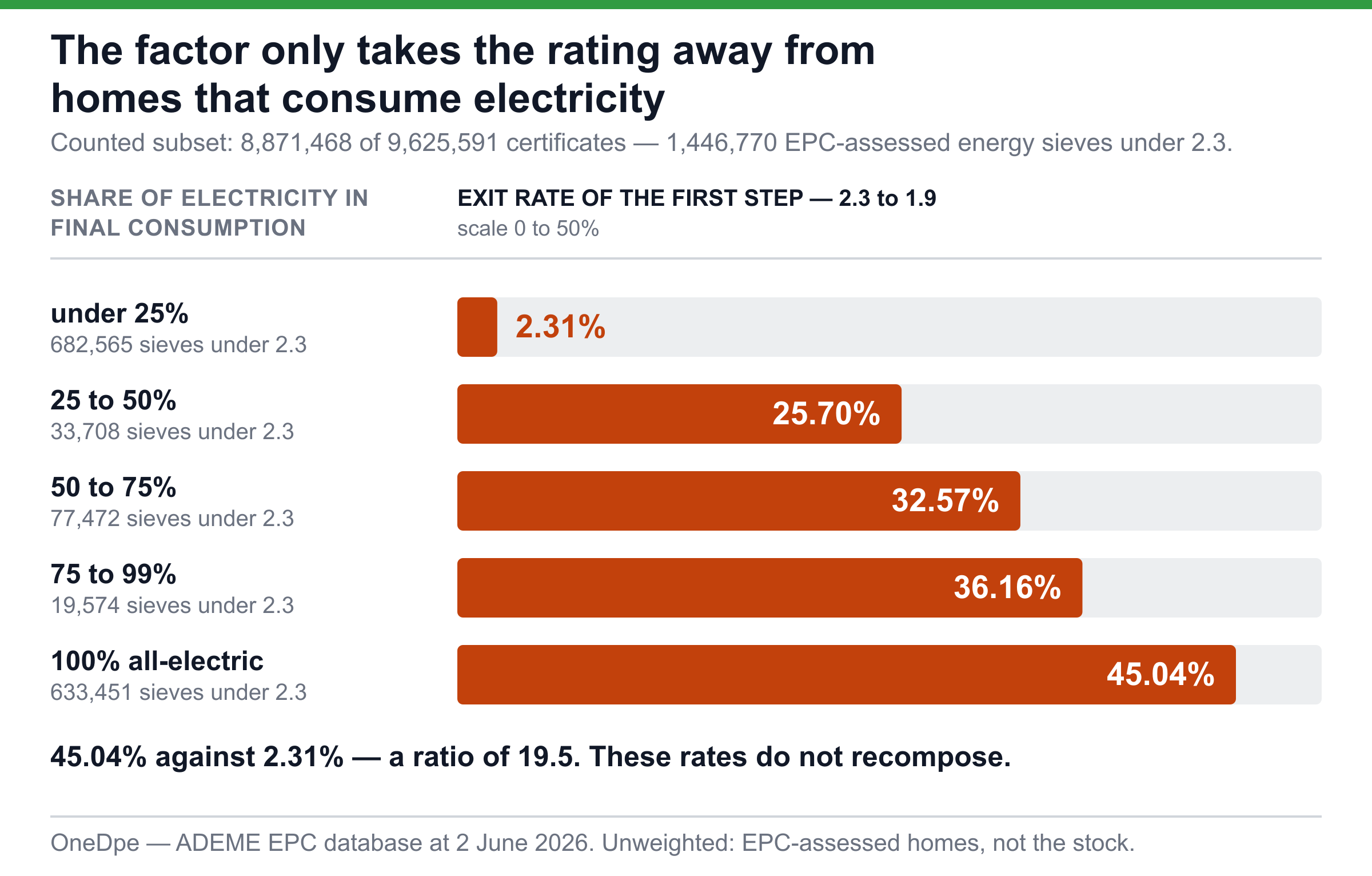
One qualification that cuts against us, and that has to be given: the axis of this table is built on a quantity that overstates the electricity actually carrying the factor. The bias pushes low-electricity homes up the bands and dilutes the top band. The 45.04% is therefore a floor, and the real gradient is steeper than the one we publish. These rates, on the other hand, do not recompose into a national rate: they are measured on the counted subset alone.
What to check on your EPC: the heating energy shown on the first page — storage heaters, radiators, heat pump, electric water heater on one side, gas or oil boiler on the other; your consumption in primary energy and the margin that separates you from the threshold applicable to your floor area and altitude, not from the generic 330; and the date the certificate was issued, because, in mainland France, if it predates 1 January 2026 it still displays the calculation at the 2.3 factor.
One last check if your certificate was issued in 2026 in mainland France: it must apply the factor applicable on the date it was issued, and not 2.3. An EPC issued in 2026 that still applied 2.3 penalises the home by roughly one full class — it is one of the signs that give away an inconsistent EPC.
What the order of 19 August 2026 does on 1 January 2027
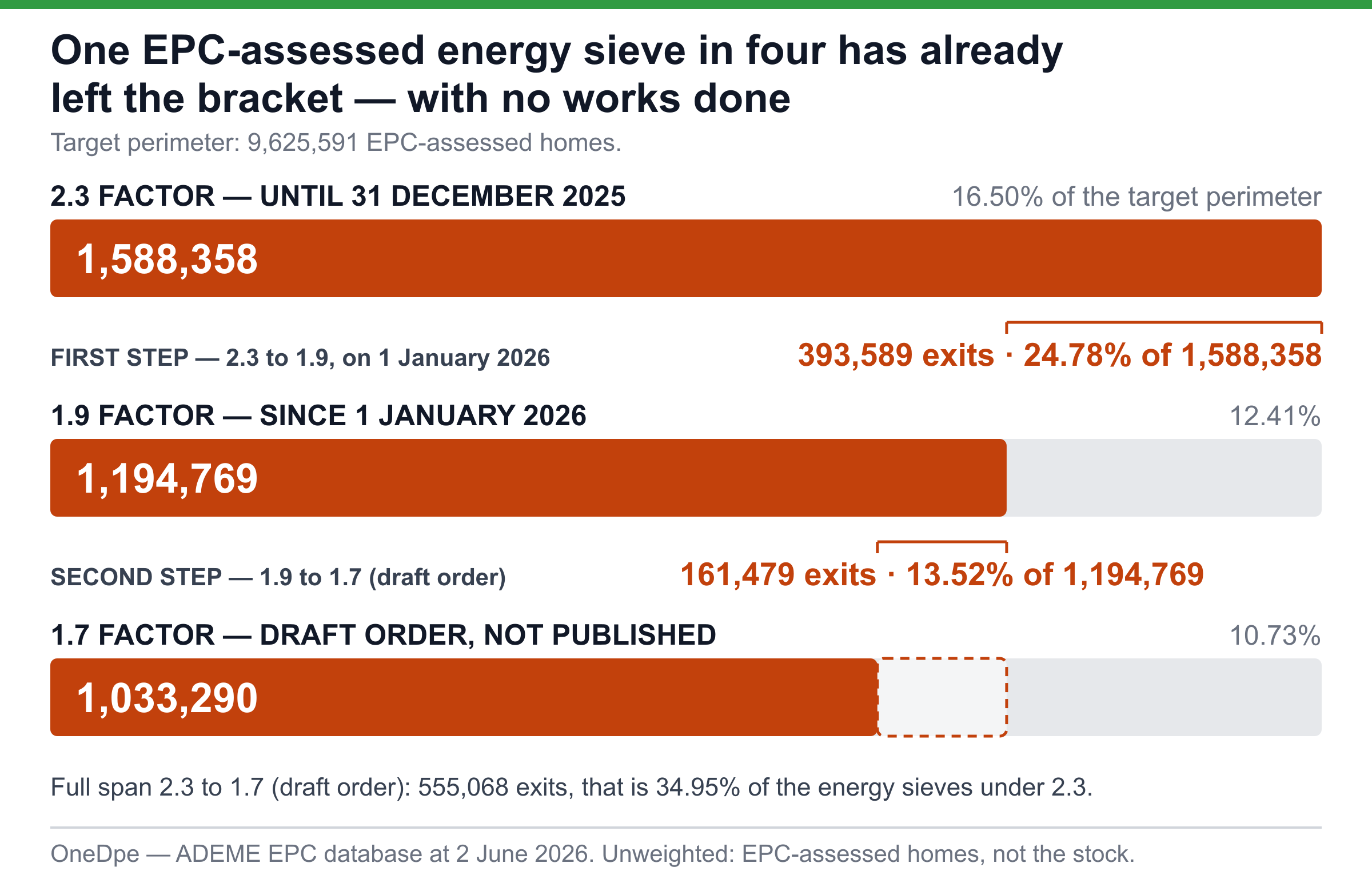
On our target perimeter of 9,625,591 EPC-assessed homes, the move from 1.9 to 1.7 takes a further 161,479 EPC-assessed homes out of the bracket, that is 13.52% of the 1,194,769 energy sieves that survive under the 1.9 factor. Of those exits, 147,117 are counted on the two consumptions published by ADEME; 14,362 are simulated, on the 7.8% of certificates for which ADEME never produced a state at 2.3.
A word on the official figures, since they circulate. We do not compare our count with the administration's estimates: theirs are ex ante estimates on a modelled stock of principal residences, ours a count of certificates, after the fact. What does compare is rates. The official simulation of the first reform takes energy sieves among principal residences from 3.9 to 3.2 million, that is 17.7% of exits; we count 22.86%. We first drew the opposite conclusion from this. The measurement says otherwise, and it needs saying: at equal heating energy our rates are lower than the official ones — 43.42% against 45.40% on electricity. The overall gap is therefore an effect of composition, not of responsiveness: our energy sieves are simply more electric than those of the stock.
So how many homes, nationally? There is a way of saying it without grossing up our own sample: borrow the official denominator and lend nothing but our rates, one heating energy at a time. And that method can be tested, because the move from 2.3 to 1.9 is already in force and the administration has published its result: there it gives 650,000 against the official 694,000, that is −6.3%, where a plain rule of three misses the same target by +29%. The criterion authorising publication was written before the measurement.
Applied to the 1.7 order of 19 August 2026, the same transposition gives 275,000 principal residences, within a range of 248,000 to 294,000. The public-consultation summary, for its part, puts the number of homes leaving the bracket at « estimé à 300 000 logements » — 300,000, above our upper bound. So we do not reproduce it exactly: we reproduce its order of magnitude, and we publish how. That figure is not a count, unlike the 161,479: it is a transposition, and it rests on a stock the administration models.
That 13.52% does not read against the 22.86% of the first reform either: its denominator is a stock of energy sieves already skimmed by it. On that same target perimeter, the first reform takes 24.78% of the energy sieves out from under the 2.3 factor, the second 13.52% of those that remain. Combined, the two steps carry 555,068 exits on that perimeter of 9,625,591 certificates, that is 34.95% of the 1,588,358 energy sieves it held under the 2.3 factor. Take care not to set that 555,068 against the 392,948 of the headline: they do not bear on the same population, the second perimeter being narrower than the first.
And in your département?
The combined exit rate varies by a factor of 4.3 between départements, France's administrative counties. In the Hérault, two EPC-assessed energy sieves in three leave the bracket across the full span (66.61%); in the Haute-Saône, one in six and a half (15.40%). Behind them: the Aude (62.09%), the Bouches-du-Rhône (59.94%) and the Var (59.24%) on one side, the Creuse (18.19%), the Moselle (18.37%) and the Ardennes (19.22%) on the other. Our map is mainland: it covers the 96 départements of mainland France, served as 95 units — Corsica is aggregated, and every rank in this file is out of 95. We serve no rate below 1,000 energy sieves under the 2.3 factor — our publication threshold.
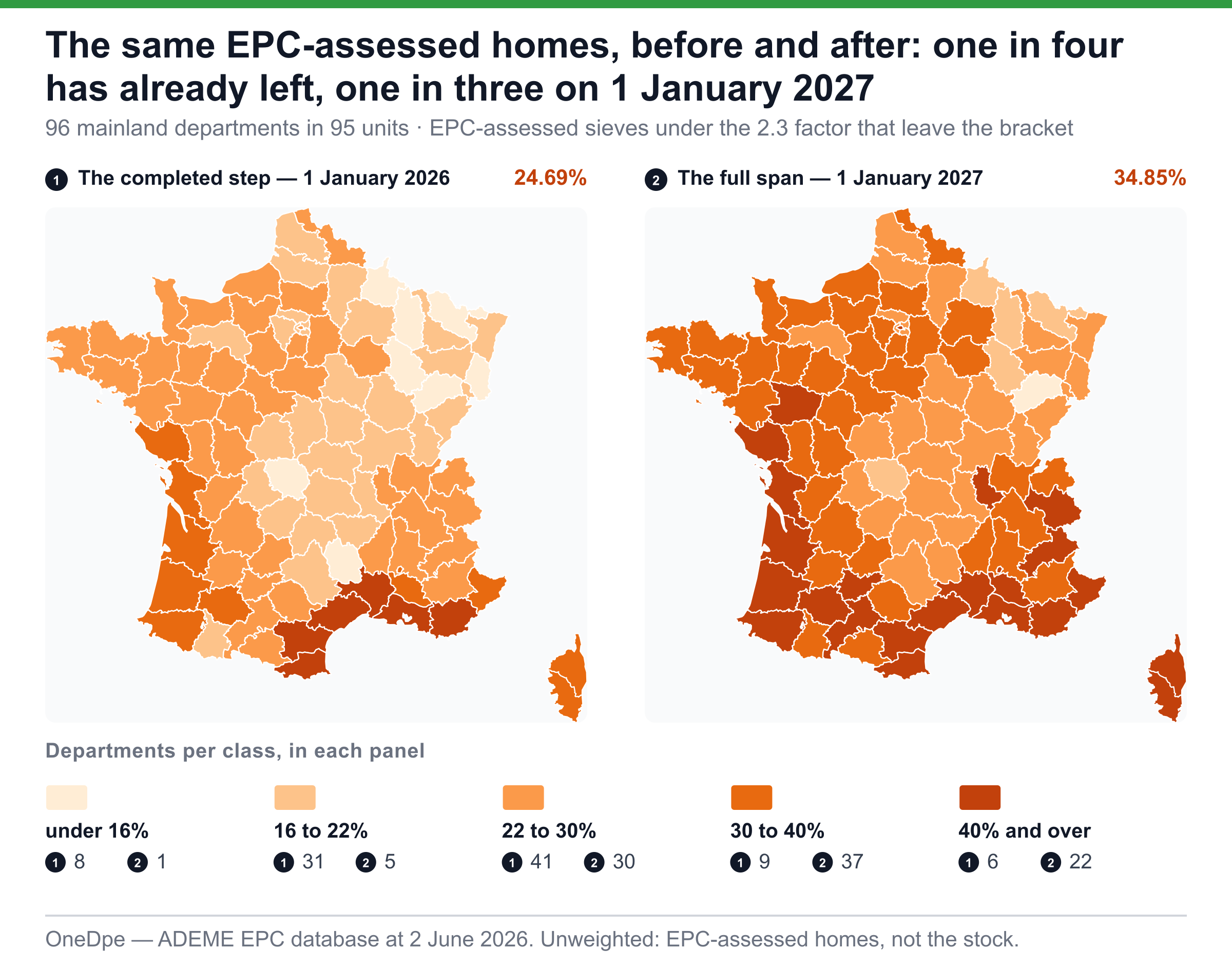
We do not explain this map by climate and we draw no correlation from it. We give the second series beside the first: the share of all-electric homes among energy sieves under the 2.3 factor is 73.67% in the Hérault and 14.53% in the Haute-Saône. Two series set side by side, not linked — the mechanism is demonstrated inside one and the same pool, as in the table above, never between territories.
The territorial detail of this count is public: the data by département can be downloaded as a CSV from our press dossier, together with the full method note, the reusable infographics and the attributable quotes. The study, published on 25 August 2026, describes the state of the law at that date.
604,669 EPC-assessed homes that nothing will take out of the bracket
This is the least commented result, and the most useful for an owner. A home is an energy sieve through its consumption, through its greenhouse-gas emissions, or through both: the rating retains the worse of the two classes. A factor that touches consumption alone can do nothing for a home that its emissions rate.
It is also the check that could have contradicted our measurement, and did not: of the 1,718,766 energy sieves under the 2.3 factor, 714,457 were already rated F or G on the emissions axis. Among them we count zero exits. Exactly zero — had our measurement chain been wrong, that number would have been positive.
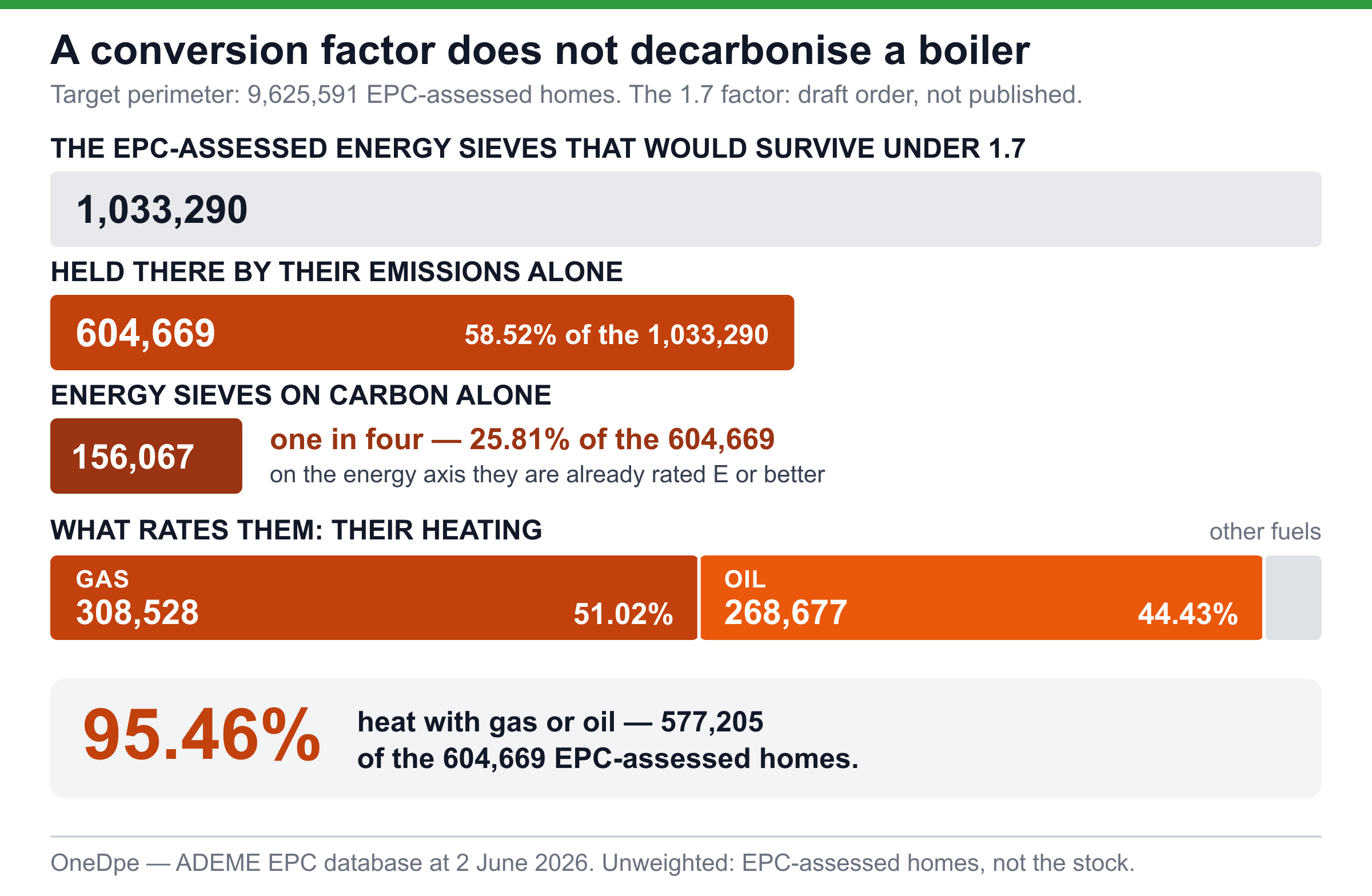
On our target perimeter, 604,669 EPC-assessed homes are in that position — 58.52% of the 1,033,290 energy sieves that will survive under the 1.7 factor. 95.46% of them heat with gas or oil (577,205 homes: 308,528 on gas, 268,677 on oil), 95.44% were built before 1975 and 59.34% are houses, against 41.9% of the perimeter. Their median emissions reach 87.9 kg CO₂/m²/year, and their median distance to the threshold that applies to them 17.0 kg — both measured on the 601,313 homes of the cohort for which those quantities are usable.
Two figures matter to an owner weighing up works. 432,306 of these homes — 71.89% of the 601,313 measurable — exceed their carbon threshold by one class only. And 156,067, one in four (25.81%), are energy sieves on their carbon alone: on the consumption axis they are already E or better, against the statutory threshold that applies to them. For those, the rating no longer depends on the factor at all.
Profile: a house built before 1975, heated with gas or oil, rated F or G, whose distance to its carbon threshold fits inside one class. No conversion factor applied to electricity will move it out of its category.
It will be objected that changing energy vector is enough. We measured that, and the result cuts both ways. At constant final energy, replacing heating alone with an electric vector would bring 589,593 of these homes below their carbon threshold — 98.05% of the 601,313 — and their median emissions from 87.9 to 32.9 kg. But the same substitution, read on the consumption axis, would take their median primary-energy consumption from 374.2 to 656.3 kWh/m²/year: 99.873% would remain blocked by energy. Changing vector without touching efficiency lifts both locks for 750 homes out of 600,924: at constant efficiency, you move the lock, you do not open it.
"The most important result is not the headline figure, it is the one that stays: 604,669 EPC-assessed homes that this factor will never release, because it is not their consumption that rates them, it is their boiler. A conversion factor does not decarbonise a boiler. We are not saying whether the reform is good; we are saying what it has done, and what it will not do."
Steven Annonziata, co-founder of OneDpe (RIANN SAS)
What reclassification changes for you as a landlord
A home that leaves the energy-sieve bracket through the factor becomes lettable again when it is next let. The regime itself remains that of the Climate and Resilience Act: the letting ban (construction and housing code, article L. 173-1-1) and the rent freeze — introduced by article 159 of Act No. 2021-1104 of 22 August 2021 into articles 17-1 and 17-2 of Act No. 89-462 of 6 July 1989, the statute governing residential tenancies in France, and applicable since 24 August 2022 in mainland France and 1 July 2024 in the French overseas départements — attach to tenancy agreements entered into, renewed or tacitly extended after each class's milestone.
⚠️ Warning: a reclassification lifts the rent freeze for the future only. It opens no catch-up on past rents, and the 1.7 order of 19 August 2026 is silent on running tenancies.
In practice: if your home was rated G and comes out E, you recover the ability to let it again, but you do not recover the rent reviews the freeze denied you in the meantime. And if it stays rated F, the 1 January 2028 milestone keeps running: neither of these two texts alters the timetable of the Climate and Resilience Act.
On the validity of your certificate, the question will not bite: no certificate in our base expires before 1 January 2027, the earliest falling on 29 June 2031, across 14,379,621 certificates tested. An EPC remains valid for ten years (construction and housing code, article D. 126-19).
What the rating is worth — on houses, and on houses only
A rating has a market price. Across 825,719 sales of houses matched to their certificate (BDNB data published by CSTB, France's building science centre, 2025-07-a vintage, already published on our EPC price-discount tool), the median price per square metre of an E-rated house exceeds that of an F-rated house by €190.00. The 114,738 houses on the counted subset — those for which ADEME kept both ratings — that leave the bracket at the first step carry a price gap associated with the rating of €1.95 billion, for an average floor area of 89.4 m². The simulated share is valued nowhere: the amount is a floor on that count too. That is a price difference observed between two classes, applied to homes of which nothing has changed — neither new wealth, nor a forecast of transactions.
We publish no amount on flats, nor on all segments together. Our own source forbids it: outside Paris and the inner suburbs, a G-rated flat sells per square metre 6.2% above a D-rated one — the gradient flips. Applying a house gradient to a flat would not be an approximation, it would be a sign error.
For the owner of a house, the trade-off holds in two numbers. The median price gap between a G-rated house and a D-rated house is €470/m² (€2,119 against €1,649); taking that same house from G back up to D through works costs of the order of €600/m² before grants. The discount does not cover the works — and the factor takes the rating away for nothing at all.
The four mistakes not to make
Mistake 1 — Believing the rating updates itself
In mainland France, an EPC issued before 1 January 2026 goes on displaying the rating calculated at the 2.3 factor. The new calculation does not rewrite your document. If your certificate was drawn up after 1 July 2021 and is still valid, ADEME's DPE-Audit Observatory issues, free of charge, an attestation carrying the new rating, with no new survey: the procedure is set out in our guide to the free update of the EPC rating.
Mistake 2 — Conflating the two reforms
The small-floor-area reform (order of 25 March 2024, effective 1 July 2024) and the conversion-factor reform (order of 13 August 2025, effective 1 January 2026) are two separate texts with separate effects. A 25 m² studio flat may have changed class in 2024 for the first reason, then again in 2026 for the second.
Mistake 3 — Expecting a lower bill
There is none. The factor changes the consumption counted in primary energy inside a conventional calculation, not the energy that crosses your meter: your rights and obligations change, your heating spend does not move by a cent.
Mistake 4 — Hoping for a reclassification on a gas- or oil-heated home
This is the reading the gradient table closes off. Below 25% electricity, the exit rate of the first step is 2.31%, and 85.56% of the energy sieves that remain in that band are held there by their emissions. For those homes, the only route that moves the rating is still renovation — and our analysis of the 2034 letting ban on class E shows that the next milestone reaches a far wider stock than the F and G classes alone.
⚠️ Warning: the 1.7 order was published in the Journal officiel on 26 August 2026, but it does not come into force until 1 January 2027. Until that date the factor applied to every certificate issued in mainland France remains 1.9; from 1 January 2027 it becomes 1.7, which an EPC issued before that date does not anticipate.
Check your home's rating under the 2026 and 2027 factors
My DPE 2027 simulator, by OneDpe
Take the figures from your existing EPC: for a home in mainland France, the simulator applies the primary-energy conversion at the 1.9 factor of certificates issued in 2026 — even if your EPC was issued before 2026 on the 2.3 factor —, shows your recomputed class and your margin to the next threshold, against the threshold applicable to your floor area rather than the generic one. Since the order of 19 August 2026 it also shows, next to the rating on your certificate, the one your home would get on the 1.7 scale, which applies to certificates issued in mainland France from 1 January 2027.
Going further: our EPC price-discount calculator and our EPC consistency check.
Conclusion
A reform of convention took the energy-sieve rating away from 392,948 EPC-assessed homes — counted across the 14,938,757 certificates for which ADEME kept both ratings — without a wall being insulated; and on our target perimeter of 9,625,591, the order of 19 August 2026 takes 161,479 more out of the bracket on 1 January 2027. The two do not add up: they do not rest on the same population. The split is clean: it is the electric homes that leave, it is the gas and oil boilers that stay — 604,669 EPC-assessed homes that their emissions alone keep in the bracket. For an owner, the question is which side of that line their home sits on.
Two reflexes follow. Check: the My DPE 2027 simulator recomputes your class from your existing certificate and gives you your margin to the applicable threshold. Formalise: if the class changes, the free attestation from ADEME's DPE-Audit Observatory makes the new rating official, which is what conditions a fresh letting — and it weighs on financing too, as our analysis of the impact of the EPC rating on a mortgage sets out.