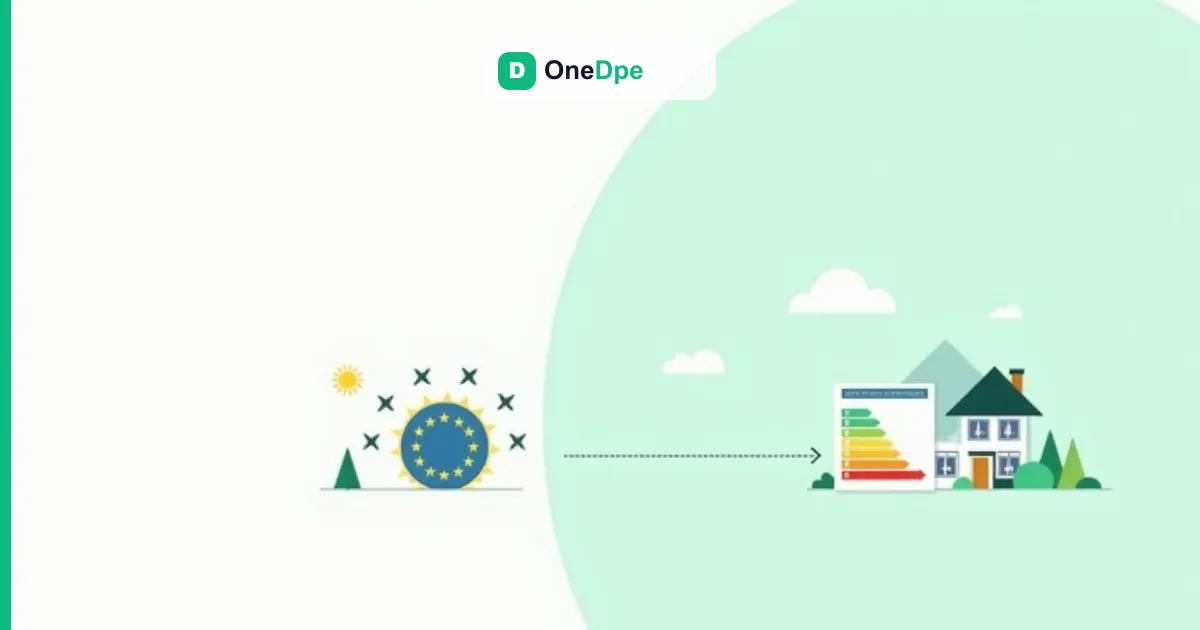
On 1 January 2026, around 850,000 French homes exited DPE classes F and G without a single euro of renovation work being spent (government estimate, announcement of the new DPE 2026 — economie.gouv.fr). The cause comes down to one number: the primary-energy conversion coefficient for electricity dropped from 2.3 to 1.9 (ministerial order of 13 August 2025 (published 26 August 2025)), and this recalculation applies to all existing DPEs (Diagnostic de Performance Énergétique — the French Energy Performance Certificate). If your home is electrically heated, its official rating may already have changed — without anyone telling you.
The document that materialises this change exists: the new-rating certificate, generated free of charge on the DPE-Audit Observatory run by ADEME (the French Environment and Energy Management Agency), using your DPE number. No diagnostician to pay, no site visit, no waiting period: the procedure takes a few minutes and the document is legally enforceable for a sale or a rental. Yet it remains largely unknown — to the point that commercial intermediaries are already charging for a "DPE 2026 update" that costs nothing.
850,000 homes reclassified on 1 January 2026, an official certificate that is free and immediate — and a procedure most affected owners have not yet completed.
What this article covers
The regulatory framework of the electricity coefficient reform (ministerial order of 13 August 2025 (published 26 August 2025)), the exact mechanism of the rating recalculation, the step-by-step guide to the certificate on ADEME's DPE-Audit Observatory, its legal value for a sale or a lease, the three cases where it changes nothing, the situations where a new diagnostic is required instead, and the four common mistakes — including the most expensive one: paying for a free procedure.
DPE 2026 reform: what the order of 26 August 2025 changes
The ministerial order of 26 August 2025, which amends the order of 31 March 2021 on the 3CL-DPE 2021 calculation methodology, lowers the primary-energy conversion coefficient for electricity from 2.3 to 1.9 as of 1 January 2026. This coefficient is the factor applied to each kilowatt-hour of electricity consumed by the dwelling (final energy) to obtain the conventional consumption in primary energy — the figure which, divided by the living area, determines the DPE class from A to G.
The effect is mechanical: the electric share of each dwelling's primary-energy consumption is reduced by around 17% (the 1.9/2.3 ratio). According to the government estimate published when the reform was announced (economie.gouv.fr), around 850,000 electrically heated dwellings thereby exit classes F and G — the "thermal sieve" perimeter targeted by the rental ban schedule of article L.173-1-1 of the French Construction and Housing Code (law no. 2021-1104 of 22 August 2021, the Climate & Resilience Act). For the detailed figures of the reform and the profiles of the winning dwellings, see our analysis of the 2026 electricity coefficient and the 850,000 reclassified homes.
Three rules frame the scheme:
- No dwelling sees its rating downgraded. Only the electricity coefficient decreases; the coefficients of the other energy sources are unchanged. The recalculation improves or maintains the rating — it never degrades it.
- Existing DPEs remain valid. A DPE established under the 3CL-DPE 2021 methodology keeps its ten-year validity period. The reform creates no obligation to redo a diagnostic.
- The class change is materialised by a certificate. ADEME's DPE-Audit Observatory (observatoire-dpe-audit.ademe.fr) recalculates the conventional consumption of each eligible DPE with the 1.9 coefficient and issues an official new-rating document, downloadable free of charge (service-public.gouv.fr, practical guide "Check your DPE and download a certificate").
The rental ban schedule itself does not change: class G banned since 1 January 2025, class F on 1 January 2028, class E on 1 January 2034 (CCH art. L.173-1-1). For owners affected by the last deadline, our analysis of the 2034 rental ban on class E dwellings and its exceptions complements this schedule.
How the recalculation of your DPE rating works
The recalculation performed by the Observatory does not redo the diagnostic: it takes the input data of the original DPE — surface area, insulation, systems, conventional consumption by usage — and applies only the new conversion coefficient to the electric share. That is why no diagnostician visit is needed.
The formula: primary energy = final energy × coefficient
The 3CL-DPE 2021 methodology first calculates the dwelling's final-energy consumption — the kilowatt-hours consumed across the five conventional usages (heating, domestic hot water, cooling, lighting, auxiliaries). It then converts each kilowatt-hour into primary energy, i.e. the energy drawn at the source to produce and deliver the energy supplied: primary energy = final energy × conversion coefficient. Gas and heating oil keep a coefficient of 1.0 and wood of 0.6, unchanged by the reform. Only electricity moves from 2.3 to 1.9.
A worked example: 10,000 kWh of electricity
Take an all-electric 65 m² apartment consuming 10,000 kWh of final energy per year, all conventional usages combined.
| Step | Calculation | Result |
|---|---|---|
| Final-energy consumption | Data from the original DPE | 10,000 kWh/yr |
| Primary energy before 2026 | 10,000 × 2.3 | 23,000 kWh PE/yr, i.e. 354 kWh/m² (class F) |
| Primary energy since 2026 | 10,000 × 1.9 | 19,000 kWh PE/yr, i.e. 292 kWh/m² (class E) |
| Recalculation gain | −17% on the electric share | −4,000 kWh PE/yr, one class gained with no works |
In this example, the dwelling moves from 354 to 292 kWh/m²/yr of primary energy: it drops back below the 330 kWh/m²/yr threshold and leaves class F for class E. It exits thermal sieve status without any renovation work — exactly the typical profile of the 850,000 reclassified homes.
Why the gain depends on your energy mix
The roughly 17% reduction only applies to the electric share of consumption. An all-electric dwelling benefits in full; a gas-heated dwelling with electric domestic hot water benefits only on the hot water; an all-gas dwelling does not benefit at all. And even for an all-electric dwelling, gaining a class requires the recalculated consumption to cross a threshold: a property sitting in the middle of its class band sees its conventional consumption fall without its rating changing.
DPE 2026 certificate: the step-by-step guide on the ADEME Observatory
Who is eligible for the certificate?
The certificate is issued for any DPE established from 1 July 2021 onwards — the entry-into-force date of the 3CL-DPE 2021 methodology — and still within its validity period. DPEs predating 1 July 2021, carried out under the old methodology, are not eligible: for those dwellings, only a new DPE can produce a rating calculated with the 1.9 coefficient.
What to do now — download your certificate in 4 steps:
- Find your DPE number. It is a 13-character identifier printed on the first page of your DPE report. It also appears in the technical diagnostic file handed over at purchase or at lease signing.
- Search for your DPE on ADEME's DPE-Audit Observatory (observatoire-dpe-audit.ademe.fr) by entering this number in the site's search engine.
- Check the dwelling's record — address, surface area, date the diagnostic was established. The new rating recalculated with the 1.9 coefficient is displayed alongside the original rating.
- Download the new-rating certificate as a PDF and keep it with your original DPE. The procedure is free, immediate, and requires no diagnostician visit.
What legal value for a sale or a rental?
The certificate complements the existing DPE: it does not replace it and does not alter its validity period — the original DPE remains valid until its ten-year expiry. Attached to the diagnostic, the certificate is legally enforceable for a sale or a lease: it is the document that evidences the new class to the notary during a transaction, to the tenant when the property is let, and in the property listing (service-public.gouv.fr). In practice, you display the new rating in the listing and you attach the certificate to the DPE in the technical diagnostic file.
Key takeaway: the certificate and the original DPE form an inseparable pair. The certificate alone, without the DPE it relates to, has no value; the DPE alone, without the certificate, displays the old rating.
The cases where the certificate changes nothing — and when to redo a real DPE
Three profiles for which the recalculation is neutral
| Profile | Why the recalculation is neutral | What to do |
|---|---|---|
| Gas, oil or wood heating | Conversion coefficients unchanged (1.0 for gas and heating oil, 0.6 for wood): the primary-energy consumption is identical | Nothing — the rating does not move |
| Very energy-hungry dwelling | Even at 1.9, the recalculated consumption stays above the F or G thresholds: the 17% gain on the electric share is not enough | Renovation works (see below) |
| Already well-rated dwelling | The consumption falls but does not cross a class threshold, or the class gained changes no regulatory obligation | Certificate optional, no urgency |
If you are in one of these three cases, the procedure is pointless or has no effect on the rating: better to know before spending time on it. That is precisely what a prior simulation of your recalculated rating gives you.
When to redo a real DPE rather than request the certificate?
Three situations justify a full new diagnostic rather than a simple recalculation:
- You have carried out works since the DPE. Insulation, heating replacement, windows: the certificate recalculates the coefficient, not your home. Only a new DPE incorporates the works and captures the full gain — often greater than that of the coefficient alone.
- You suspect data-entry errors. Wrong surface area, ignored insulation, misrecorded heating system: the recalculation faithfully reproduces the errors of the original DPE. Our guide on the inaccurate DPE, the diagnostician's liability and your remedies details the steps to take.
- Your DPE predates 1 July 2021. Established under the old methodology, it is not eligible for the certificate. A new DPE is in any case the only way to obtain a rating at the 1.9 coefficient.
Your property stays F or G after recalculation: the two remaining levers
If the simulation or the certificate confirms that your dwelling remains rated F or G at the 1.9 coefficient, two paths open up. The first: energy renovation works, the only lever that genuinely improves the building's performance — the OneDpe works and 2026 subsidies simulator prices the bundle needed to exit F or G and the subsidies available. The second: the "Relance logement" housing bill, presented on 23 April 2026, which provides for an easing of the rental ban in exchange for a commitment to carry out works. That text has not been passed to date: it grounds no legal decision until the law is enacted.
The four common mistakes around the DPE 2026 certificate
Mistake no. 1 — Paying for a DPE "update service"
Websites and intermediaries offer, for a fee, to "update your DPE 2026" or to "claim your new rating". The official procedure is free, without exception: the certificate is downloaded directly from ADEME's DPE-Audit Observatory, with no paid account and no fees. No organisation — neither diagnostician, nor agency, nor platform — is authorised to sell you this document.
⚠️ Warning: if you are asked to pay to obtain your home's new 2026 rating, that is a red flag. The only official document is the free certificate from the DPE-Audit Observatory (observatoire-dpe-audit.ademe.fr), a procedure described on service-public.gouv.fr.
Mistake no. 2 — Redoing a full DPE for nothing
If your DPE dates from after 1 July 2021, no works have been carried out since, and you simply want the rating at the 1.9 coefficient, ordering a new diagnostic is a pointless expense: the free certificate leads to exactly the same class. Reserve the new DPE for the three situations seen above — works carried out, suspected data-entry errors, DPE predating July 2021.
Mistake no. 3 — Believing your energy bill goes down
The recalculation changes nothing about the physics of your home: the final-energy consumption — the one you pay for — is strictly identical. Only the primary-energy conversion convention changes, so only the rating changes. A dwelling reclassified from F to E consumes exactly the same kilowatt-hours as before; what changes are its value, its rentability and its regulatory obligations — not your bills.
Mistake no. 4 — Forgetting the certificate when letting the property
The rental stake is the most concrete one: a G-rated dwelling has been banned from rental since 1 January 2025 (CCH art. L.173-1-1). If the recalculation takes your property out of class G, the certificate is the document that proves it — in the listing, in the technical diagnostic file attached to the lease, and before a tenant or a judge in the event of a dispute. The same logic will apply to F-rated dwellings on 1 January 2028. Letting with the old rating means applying to yourself a ban your property may already have escaped.
Simulate your new rating before starting the procedure
Simulate in 30 seconds your rating recalculated with the 1.9 coefficient before starting the procedure: the simulator applies the 1.9 conversion to the electric share of your DPE's primary-energy consumption and tells you whether your home changes class — and therefore whether the certificate is worth it for your property.
To go further: DPE reliability check tool, to detect a data-entry error before locking in the new rating.
Conclusion
The electricity coefficient reform is one of the rare DPE regulatory changes that requires no works, no spending and no expert: a 13-character number, a search on ADEME's DPE-Audit Observatory, a free and legally enforceable PDF. The procedure is a must for any electrically heated dwelling with a DPE issued after 1 July 2021 — first and foremost if it is rated E, F or G, where a class change alters the property's value and its rental rights. It is pointless for gas, oil or wood-heated dwellings, and insufficient when works have been carried out or the original DPE is inaccurate.
Before starting the procedure, the OneDpe My DPE 2027 simulator tells you in 30 seconds whether your rating changes with the 1.9 coefficient — and saves you from requesting a certificate that would change nothing for your property.