Your home uses little energy, yet it is still rated F. The assessor confirmed it: this is not a mistake. The reason lies in a detail many owners discover too late — the French EPC (the DPE, Diagnostic de Performance Énergétique — France's Energy Performance Certificate) does not give one rating, but two. An energy label and a climate label. And it is the worse of the two that decides your final class, the one shown in the listing and that conditions your right to let.
This "dual threshold" mechanism explains why a gas-heated home — frugal but a CO₂ emitter — can stay stuck at F or G, and why an electric home has been gaining ground since 1 January 2026. Understanding this logic means knowing where to act: switch energy source or insulate. The two do not produce the same result on the label.
Two labels, one class. Since the order of 31 March 2021, the EPC combines an energy label (in kWh of primary energy/m²/year) and a climate label (in kg CO₂/m²/year). The class shown is always the worse of the two.
What this article covers
How the two EPC labels work, why the final class always keeps the worse one, what this means for a home heated by gas, oil or electricity, the effect of the new electricity coefficient (1.9) that came into force on 1 January 2026, and how this rule guides the choice between switching energy source and insulating.
The legal framework: two labels, one class kept
The EPC for homes relies on the so-called 3CL-DPE 2021 methodology (Calcul de Consommation Conventionnelle des Logements — the official French calculation method), defined by the order of 31 March 2021 on the energy performance certificate for residential buildings in mainland France. That text marked a break from the earlier EPC: it made the certificate legally binding and introduced the dual scale.
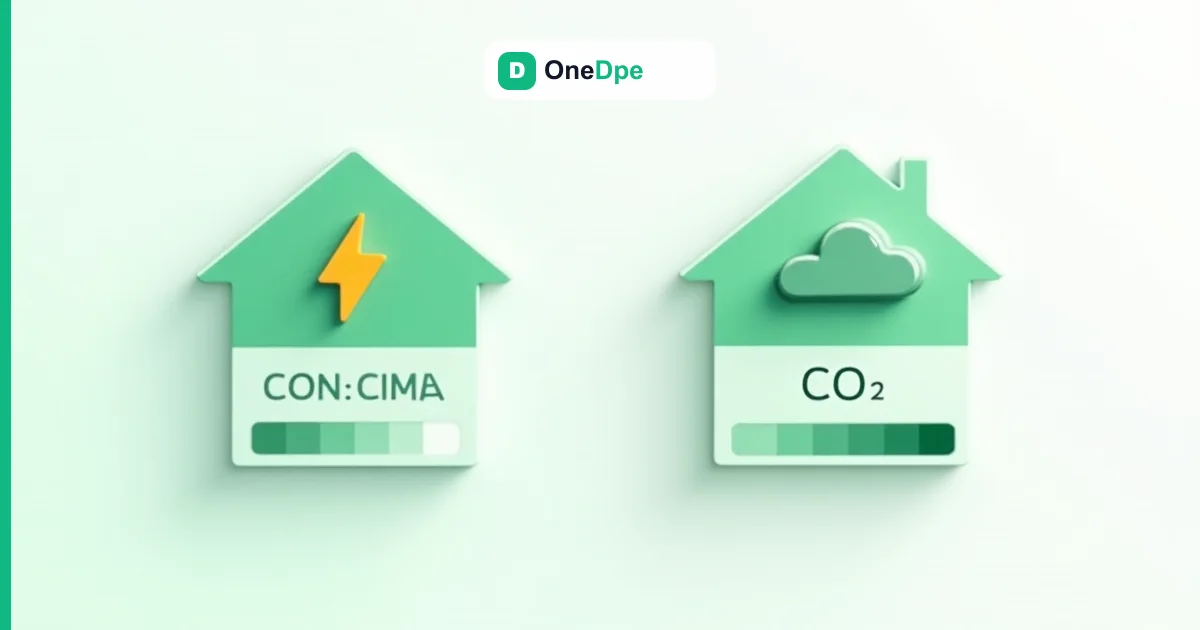
In concrete terms, the EPC rates the home on two distinct axes. The first, the energy label, measures primary-energy consumption for regulated uses (heating, domestic hot water, cooling, lighting, auxiliaries), expressed in kilowatt-hours of primary energy per square metre per year (kWh PE/m²/year). The second, the climate label, measures the greenhouse-gas emissions tied to that consumption, expressed in kilograms of CO₂ equivalent per square metre per year (kg CO₂/m²/year).
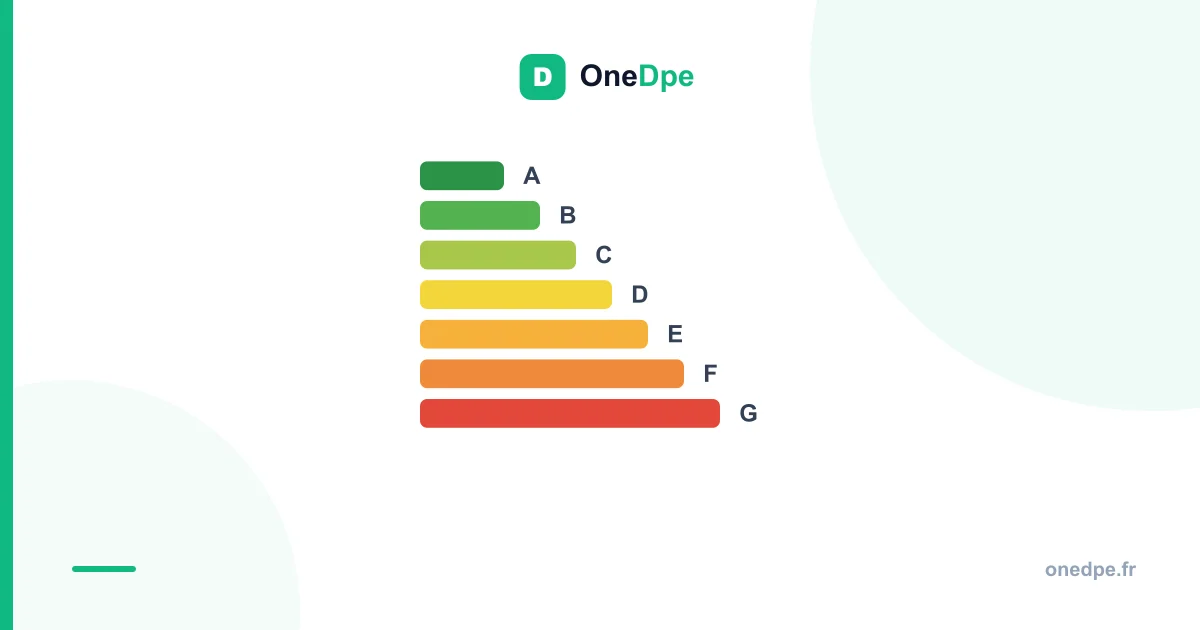
Each axis is rated A to G against thresholds set by the order of 31 March 2021. The decisive rule is this: the final class — the one shown on the EPC and on property listings — is the worse of the two labels. A home rated C on energy but E on climate will therefore be displayed as class E.
| Class | Energy label (kWh PE/m²/year) | Climate label (kg CO₂/m²/year) |
|---|---|---|
| A | ≤ 70 | ≤ 6 |
| B | 71 to 110 | 7 to 11 |
| C | 111 to 180 | 12 to 30 |
| D | 181 to 250 | 31 to 50 |
| E | 251 to 330 | 51 to 70 |
| F | 331 to 420 | 71 to 100 |
| G | > 420 | > 100 |
These thresholds apply to homes larger than 40 m² in mainland France; altitude coefficients may adjust classes E, F and G in certain zones. The binding nature of the certificate is set out in article L.271-4 of the French Construction and Housing Code (CCH): the EPC's information engages the seller's liability, and a wrong certificate can ground an action. The EPC is, moreover, valid for ten years (CCH art. D.126-19), subject to the transitional provisions specific to the oldest certificates.
The dual-threshold mechanism: why the worse one wins
The "maximum of the two" logic is no regulatory accident: it reflects a policy choice. A home is judged efficient only if it is efficient on both dimensions at once — frugal in energy and low in carbon. It only takes one of the two axes being poor to pull the whole class down.
Energy and climate do not measure the same thing
The energy label depends on the quantity of energy consumed and on the primary-energy conversion coefficient specific to each source. The climate label depends on the carbon content of the energy used. Yet energy sources have very different profiles: the same amount of heat produced from gas, oil or electricity does not emit at all the same quantity of CO₂.
This decoupling is what creates the seemingly paradoxical situations. A well-insulated gas-heated home can show reasonable consumption — hence a good energy label — while emitting a lot of CO₂ through its heating, which degrades its climate label and drags the final class down.
The gas case: frugal in energy, heavy in carbon
Natural gas has a primary-energy conversion coefficient of 1, which favours it on the energy axis. But its combustion emits CO₂. Above 70 kg CO₂/m²/year, the home tips into at least class F on the climate label — and therefore class F overall, even if the energy label is better. This is the typical situation of a properly insulated house heated by a gas boiler: energy keeps up, climate drags it down.
Profile: 1990s house, insulated walls and roof, condensing gas boiler. Controlled consumption, but CO₂ emissions that keep the climate label at E or F. The final class reflects climate, not energy.
The electricity case: the 1.9 coefficient changes things
Electricity has the opposite profile. As the French electricity mix is largely decarbonised (nuclear, hydro, renewables), an electrically heated home generally shows an excellent climate label. Its weak point is the energy label, penalised by the primary-energy conversion coefficient applied to electricity.
This coefficient — a multiplier applied to final electricity consumption to obtain primary energy — was set at 2.3 in the 3CL-DPE 2021 methodology. The order of 13 August 2025 (published in the Official Journal on 26 August 2025) lowered it to 1.9, a measure in force since 1 January 2026. Mechanically, the energy label of electric homes improves: for the same final consumption, the calculated primary energy falls by about 17%, which can earn some homes near a threshold a whole letter.
Key takeaway: moving from 2.3 to 1.9 changes only the energy label of electricity, not its climate label (already good). For an electric home whose class was capped by energy, the effect can be real; for a home already good on energy, the effect is marginal.
Reading your EPC: spotting the deciding label
On your EPC, the two labels are shown side by side. To know which one commands your class, compare each one's letter: the one lower in the alphabet (the worse) is the one that sets the final class. That is the label to target first if you want to gain a letter — acting on the other will not move the overall rating until the worse one improves.
Case study: two identical homes, two different classes
Take two 70 m² flats that are rigorously identical in terms of building fabric — same walls, same insulation, same heating need. Only the heating energy differs. The heating need is the same; it is the primary-energy coefficients and the carbon content that diverge. The figures below are illustrative orders of magnitude meant to show the mechanism, not a certified 3CL calculation.
Scenario A — gas heating · Scenario B — electric heating
| Criterion | A — Gas | B — Electric (coef 1.9) |
|---|---|---|
| Energy label (kWh PE/m²/year) | ≈ 190 → class D | ≈ 240 → class D |
| Climate label (kg CO₂/m²/year) | ≈ 55 → class E | ≈ 7 → class B |
| Final class (worse of the two) | E | D |
Same fabric, same heating need, but two different final classes. The gas home is held back by its climate label; the electric home is capped by its energy label — but the 1.9 coefficient that applied in 2026 let it stay at D rather than tip into E. This is exactly the kind of shift the coefficient reform produces: it touches only the energy axis, and so helps only homes for which that axis is the limiting one.
For the gas home, insulating further would improve the already-good energy label without dislodging the climate label that commands the class. To move it out of E, you would have to act on emissions: the carbon axis is the one to target. The lesson is general: you only make progress by raising the worse label.
Common mistakes with the dual threshold
Mistake 1 — Believing "frugal" means "well rated"
A low energy bill is reassuring, but it does not guarantee a good class. A gas home can consume little and still be rated F: it is the climate label that decides. Before committing to works, identify which of the two labels is dragging your class down — otherwise you risk investing on the wrong axis.
Mistake 2 — Insulating to escape a bad climate label
Insulation reduces the heating need, hence consumption, hence the energy label. But it only marginally improves the climate label if you keep the same carbon-heavy energy: less gas burned, yes, but still gas. If climate commands your class, insulating alone will often not be enough to gain a letter.
Mistake 3 — Ignoring the effect of the 1.9 coefficient on an electric project
Since 1 January 2026, an electrically heated home benefits from a primary-energy coefficient lowered from 2.3 to 1.9. If you ruled out electricity on the grounds that it "rates poorly", the trade-off has changed: a heat pump, which combines low consumption and decarbonised electricity, is today one of the most effective levers on both labels at once.
⚠️ Warning: an unusual gap between the two labels (for example a home rated B on climate but F on energy, or the reverse) is not necessarily an error — it is often the signature of a particular energy source. But a glaring inconsistency with the actual building fabric warrants a second look and, where appropriate, a check of the certificate.
Works: switch energy source or insulate?
Estimate your two labels — energy (kWh PE/m²/year) and climate (kg CO₂/m²/year) — from your floor area, heating energy and insulation. The simulator identifies which of the two commands your class and compares the effect of switching energy source versus insulation works, with the 1.9 electricity coefficient built in.
To go further: the guide to EPC classes A to G in 2026 and the 3CL method explained simply.
Conclusion
The EPC is not a single rating but the result of a trade-off between two labels: energy consumed and carbon emitted. The class shown always keeps the worse of the two (order of 31 March 2021). This rule explains why a frugal gas home sometimes stays at F because of its climate, and why electric homes have gained ground since the primary-energy coefficient was lowered to 1.9 on 1 January 2026.
Before any works project, the right question is not "what should I do?" but "which label is dragging me down?" The OneDpe EPC simulator computes your two labels and shows you, with figures, whether insulating or switching energy actually gains a letter.