Your energy performance certificate (EPC, the French DPE) can be perfectly valid in the eyes of the law — yet wrong in fact. That happens, by construction, as soon as a condominium insulates its façade, replaces its boiler or connects to a district heating network without the individual certificates being redone. The building has changed; your rating has not. We set out to measure this gap by analysing the national EPC database — more than 16 million certificates.
The phenomenon is a blind spot of the market: energy comparison sites handle a dwelling's EPC in isolation, building managers handle the collective EPC, but no one follows the thread linking the two — works voted at the general meeting, real performance improved, and an individual rating never updated that sometimes keeps classing a home as an energy sieve. If you own a condo unit, this gap can cost you a rental, a sale, or a renovation grant.
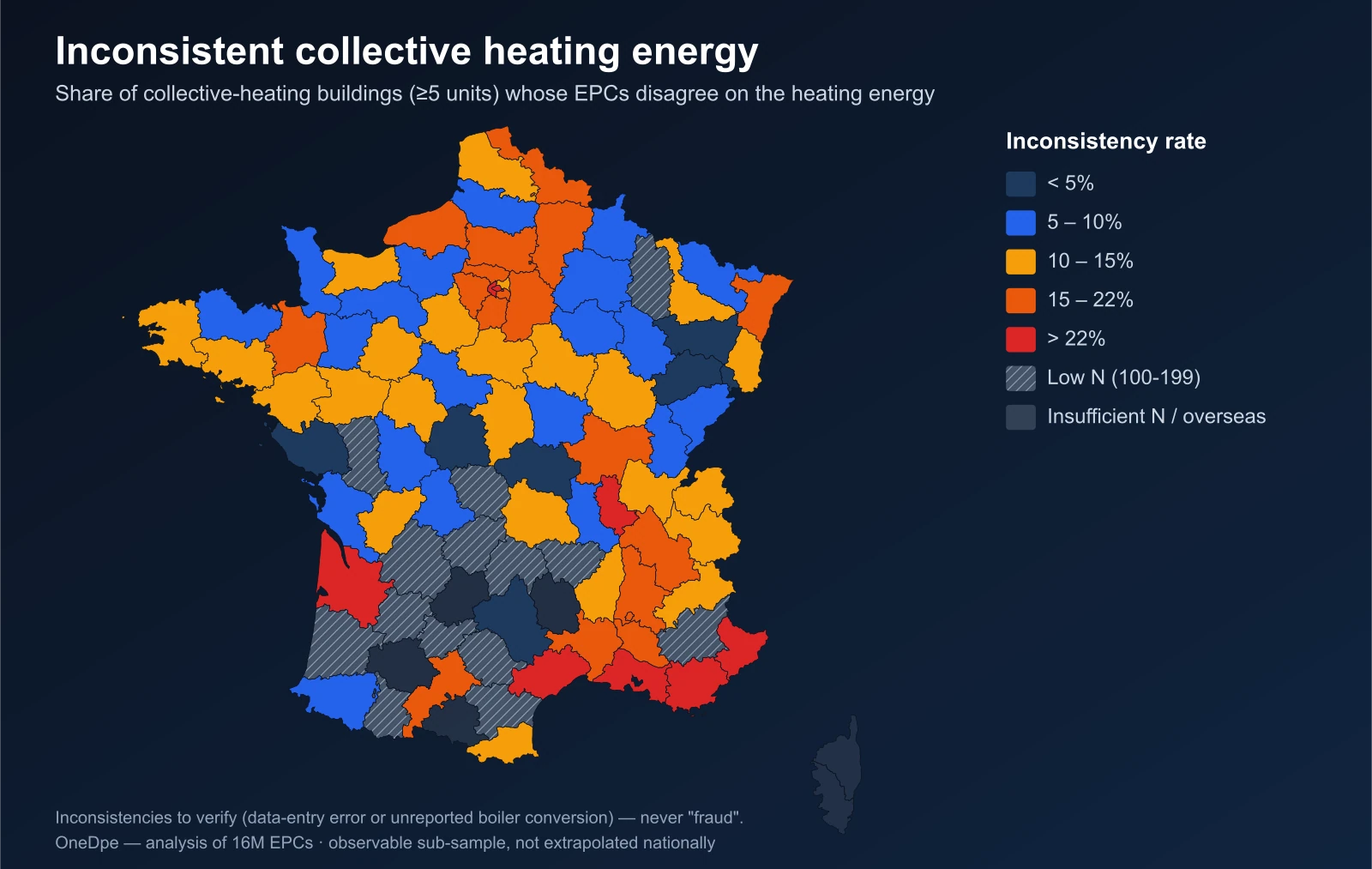
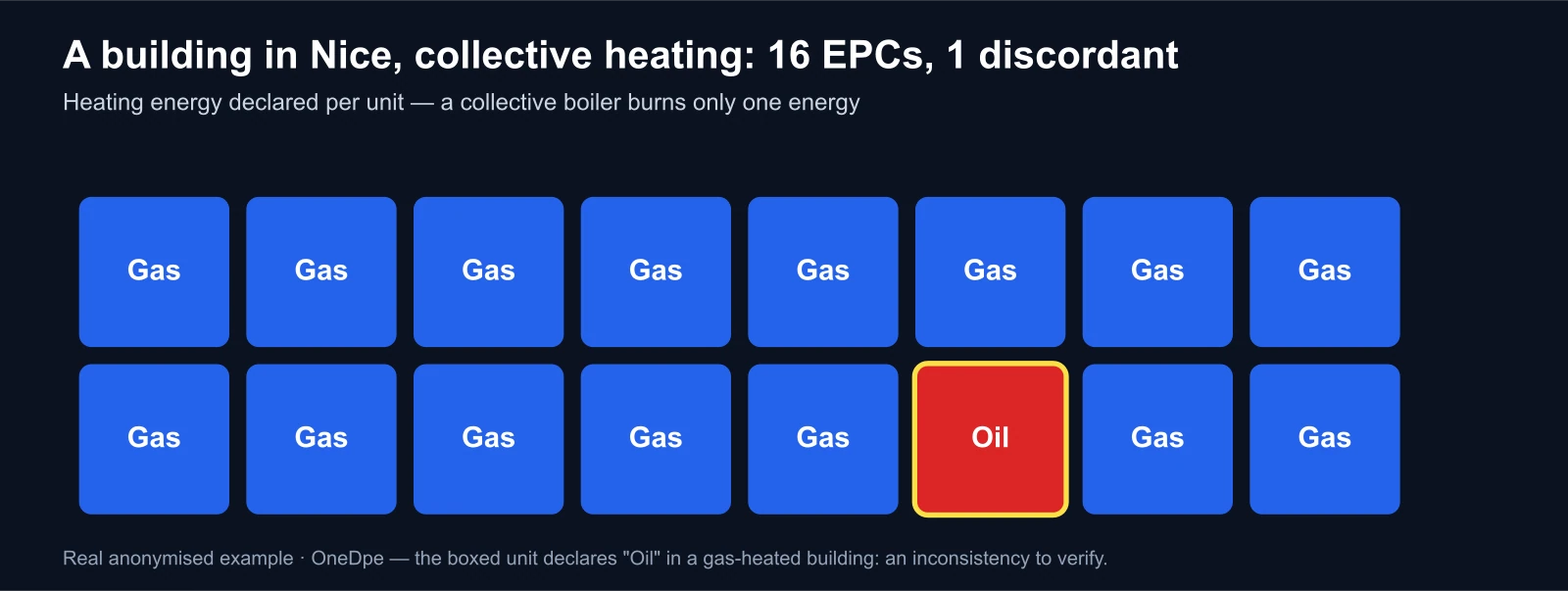
Nearly one building in six — among observable collective-heating condominiums (at least five units of the same calculation method) — shows EPCs that do not even agree on the building's heating energy, although a collective boiler burns only one.
What this article covers
Why an individual EPC becomes wrong with no fraud involved, what the law actually says (collective-EPC timetable, ten-year validity, enforceability, rental bans), the mechanism of the gap between building and dwelling, what our analysis of 16 million EPCs reveals on the observable sub-sample, two real anonymised cases, the four mistakes that cost condo owners dearly, and how to have a certificate corrected or refreshed.
EPCs in condominiums: what French law says in 2026
The EPC became enforceable on 1 July 2021: its information now engages the liability of its author, the seller (article L.271-4 of the Construction and Housing Code, CCH) as well as the landlord (article L.126-29 CCH) — only the accompanying works recommendations keep a purely indicative value. A post-2021 EPC is valid for ten years (article D.126-19 CCH).
Above all, two diagnostics coexist in a condominium and must not be confused. The collective EPC, at building level, was phased in by the Climate and Resilience Act of 22 August 2021 (law no. 2021-1104, article L.126-31 CCH) for multi-dwelling buildings whose building permit predates 1 January 2013. The individual EPC remains required at each sale or letting of each unit. The former feeds the latter but does not replace it — and an up-to-date collective EPC does not retroactively update the individual EPCs already issued.
| Date | Obligation | Reference |
|---|---|---|
| Since 1 Jan. 2024 | Collective EPC mandatory — condominiums over 200 units | CCH art. L.126-31 |
| Since 1 Jan. 2025 | Collective EPC — condominiums of 50 to 200 units | CCH art. L.126-31 |
| Since 1 Jan. 2026 | Collective EPC — condominiums of up to 50 units | CCH art. L.126-31 |
| Since 1 Jan. 2025 | Ban on letting a class-G home (new leases, renewals, tacit renewals) | Law 2021-1104; decree 2023-796 |
| 1 Jan. 2028 / 2034 | Ban on letting class F (2028), then class E (2034) | Decree 2023-796 |
Decisive point: there is no legal obligation to redo your individual EPC after collective works. The certificate stays valid until it expires (ten years). Redoing it is optional — but it is the only way to have an improved real performance recognised, and thus to escape a rental ban based on an outdated rating.
Why an individual EPC becomes wrong without fraud
The issue is not falsification: it is a good-faith timing gap, built into the very mechanics of condominium ownership. Three drivers explain it.
The envelope is shared, the certificates are individual
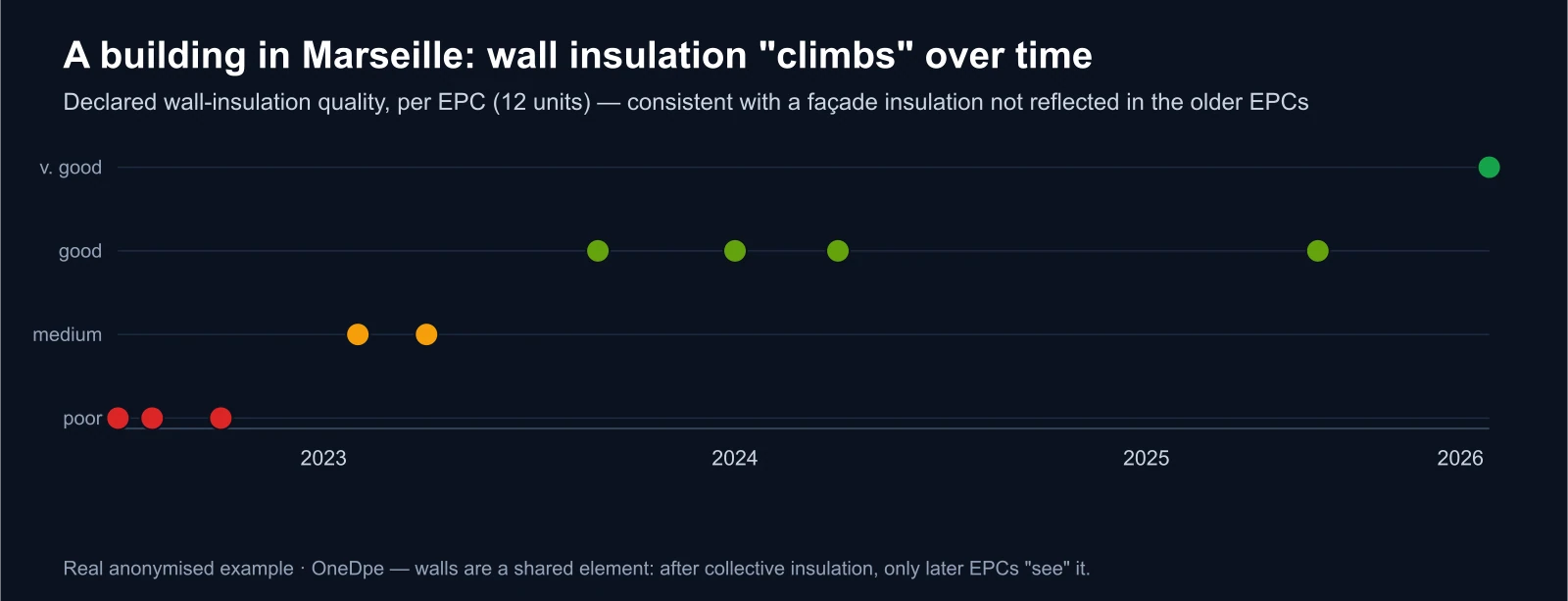
A building's walls are common property. External wall insulation, voted at the general meeting, therefore improves the performance of every dwelling on the façade at once. But individual EPCs are only redone piecemeal, at a sale or a letting. As a result, after insulation works only the units diagnosed since the works "see" the insulation; the others keep, for years, an earlier — still valid — EPC describing uninsulated walls.
Who is affected: the owner who has neither sold nor re-let since the building was renovated, whose rating still reflects the pre-works state.
The boiler is single, so the energy should be too
When heating is collective, a single boiler (or a single district-heating connection) supplies the whole building. The heating energy should therefore be identical on every EPC in the building. When it is not — for instance if one unit declares "heating oil" in an otherwise gas-heated building — at least one certificate is inconsistent: either a data-entry error, or the memory of an old boiler since replaced (conversion from oil to gas, a heat pump or district heating) and not reflected. Either way, the EPC no longer mirrors the real energy.
The collective EPC does not rewrite individual ratings
One might assume a recent collective EPC harmonises everything. It does not. The Paris Climate Agency showed this on ADEME's EPC-Audit database (Thematic note no. 3, December 2024): on the Paris subset matched by address (54,446 dwelling EPCs, 1,954 building EPCs), 31% of addresses show a dwelling EPC differing from the building's, and in 55% of those cases the dwelling gets a rating worse than the building. In other words, the individual rating is often the most pessimistic — and the most likely to be outdated.
What 16 million EPCs reveal
We grouped apartment EPCs produced with the 3CL-2021 method by address (recorded for 96% of them), to compare units within the same building. This work covers the observable sub-sample — buildings for which we have at least three comparable certificates — and is never extrapolated to the national stock. Two families of inconsistencies emerge.
Family A — insulation that "climbs" over time
First signal: within a single building, the declared wall insulation improves markedly with the certificate's date — recent units are rated far better than older ones. That is the expected signature of a façade insulation not reflected in the older EPCs. But we must rule out chance: we therefore measured the reverse motif, physically absurd (well-insulated units diagnosed before the poorly insulated ones), as a noise yardstick.
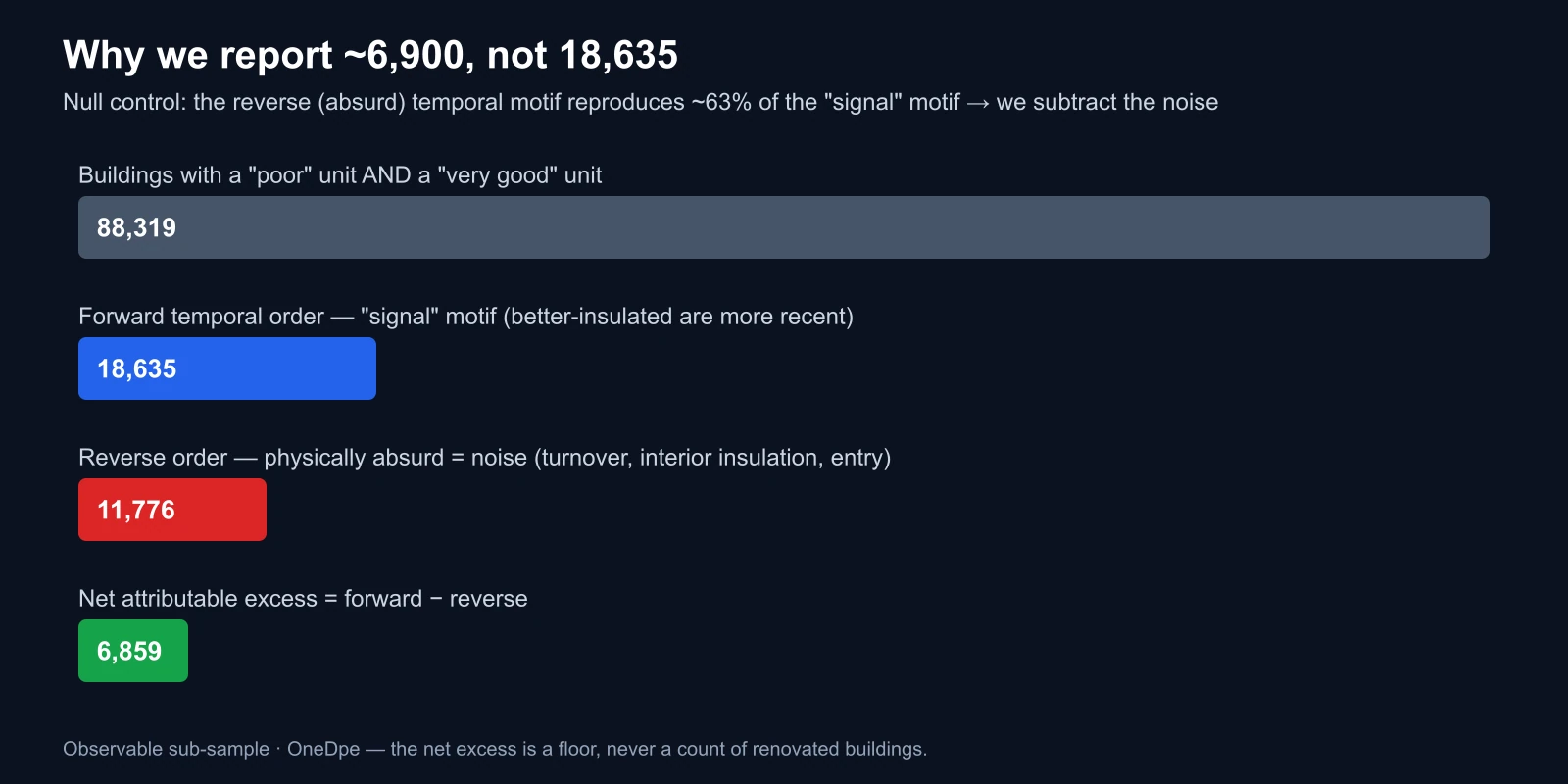
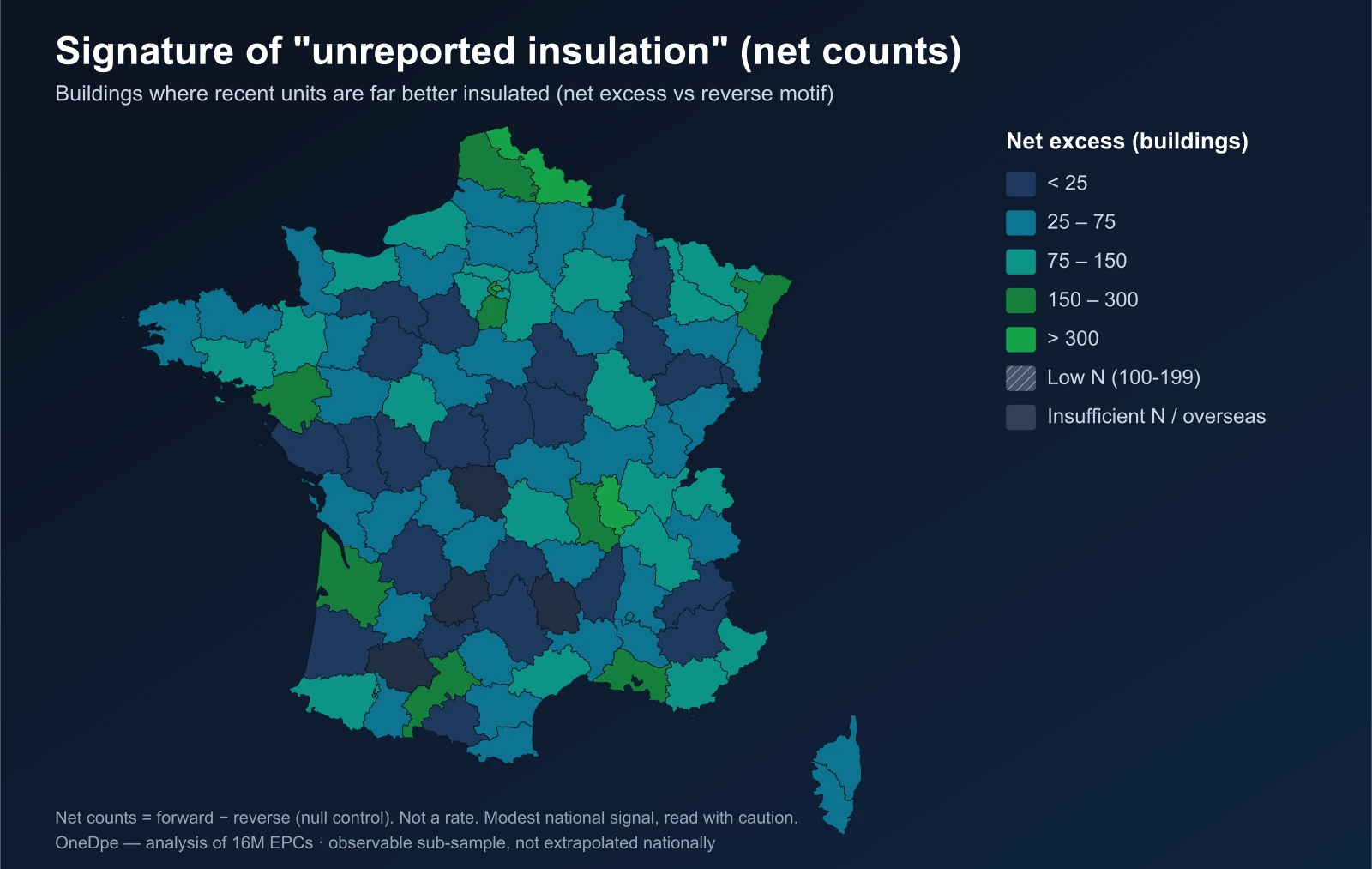
The reverse motif reproduces nearly two-thirds (a ratio of 1.58 to 1) of the "signal" motif: most of the raw divergence is noise (tenant turnover, interior insulation specific to one unit, entry variability). After removing this noise, the net attributable excess is around 6,900 buildings on the observable sub-sample. This is not a count of insulated buildings: it is a cautious floor for the number of buildings where old EPCs likely fail to reflect insulation done since. For those homes, redoing the certificate can gain one or two classes.
Family B — heating energy that contradicts itself
Second signal, more robust because it rests on a physical impossibility: among collective-heating buildings with at least five units, we flag those where one energy clearly dominates (at least 80% of units) but a minority declares something else. This pattern withstands addresses bundling several buildings (which split more evenly). Result: around 23,000 buildings concerned — nearly one in six — and 9,700 at the strictest threshold (at least eight units, dominant energy at 90%).
How to read these figures. They cover the observable sub-sample (buildings with enough comparable EPCs, same 3CL-2021 method), never the whole French stock. The raw energy-divergence measure (a quarter of collective buildings) is an upper bound, inflated by multi-building addresses: we keep only the robust version. And we speak of inconsistencies to verify, not fraud: an old pre-works EPC is valid and made in good faith, and a data-entry error is not fraudulent intent.
The 4 mistakes that cost condo owners dearly
Mistake 1 — Believing the collective EPC updated your rating
The collective EPC describes the building; it does not rewrite your individual EPC and does not exempt you from providing one at sale or letting. The two ratings can diverge for a long time.
Mistake 2 — Keeping a pre-works EPC after the building is renovated
If your condominium has insulated the façade or changed the heating, your old EPC may wrongly class you as an energy sieve — and bar you from letting while the real performance has improved. The only remedy is to have a new certificate drawn up, at your expense, with supporting documents (minutes of the general meeting, invoices, RGE certificates).
Mistake 3 — Confusing inconsistency with fraud
Two heating energies declared in the same collective building, or divergent insulation, do not mean you were lied to. It is most often a data-entry error or an unreported change. The right reaction is not accusation but verification — with the building manager for the boiler energy, then the assessor to correct the document.
⚠️ Caution: an outdated rating is not a mere administrative detail. It governs the right to let (class G banned since 2025), the sale price and access to certain grants. Check your EPC against those of your building before any decision.
Mistake 4 — Thinking you can act "whenever you like"
If a wrong EPC caused you harm, the strongest recourse targets the assessor, on tort liability grounds (article 1240 of the Civil Code). It is time-barred after five years — but from the day you discovered the error (a counter-assessment, an abnormal bill), not indefinitely. For the detail of remedies, see our dedicated guide on challenging an inaccurate EPC and recourse against the assessor.
Check your building's consistency
Analyse your EPC and automatically compare it with the other units in your building: collective heating energy, wall insulation, rating consistency. The tool flags whether your certificate seems to understate a collective insulation done since, or whether the declared heating energy is inconsistent with the rest of the building.
Going further: the difference between collective and individual EPCs and EPC and multi-year works plan obligations in condominiums.
Conclusion
Condominium renovation is accelerating — 82,135 homes renovated in 2025, of which 58,101 through MaPrimeRénov' Copropriété (Anah). But the stock counts 9.7 million condominium homes, 15% of them energy sieves: the flow of works stays small against the stock of old certificates. Mechanically, millions of individual EPCs describe a building that has changed since. This is not fraud; it is a gap to fix, and the stakes are concrete — letting, selling, not being wrongly classed an energy sieve.
The right reflex is to compare your certificate with those of your building before any decision. The OneDpe EPC check does it for you and points out the inconsistencies to resolve. And if you spot a clearly sloppy certificate, learn to recognise the signs of a fake EPC.