In mainland France, since 1 January 2025, a G-rated home is no longer considered decent when a lease is signed or renewed. The housing recovery and decentralisation bill (projet de loi relance et décentralisation du logement), in the version adopted by the French Senate on 8 July 2026, would open a second route: a flat would be considered decent in terms of energy performance once the collective energy performance certificate (EPC, or DPE in French) of its building reaches the required level.
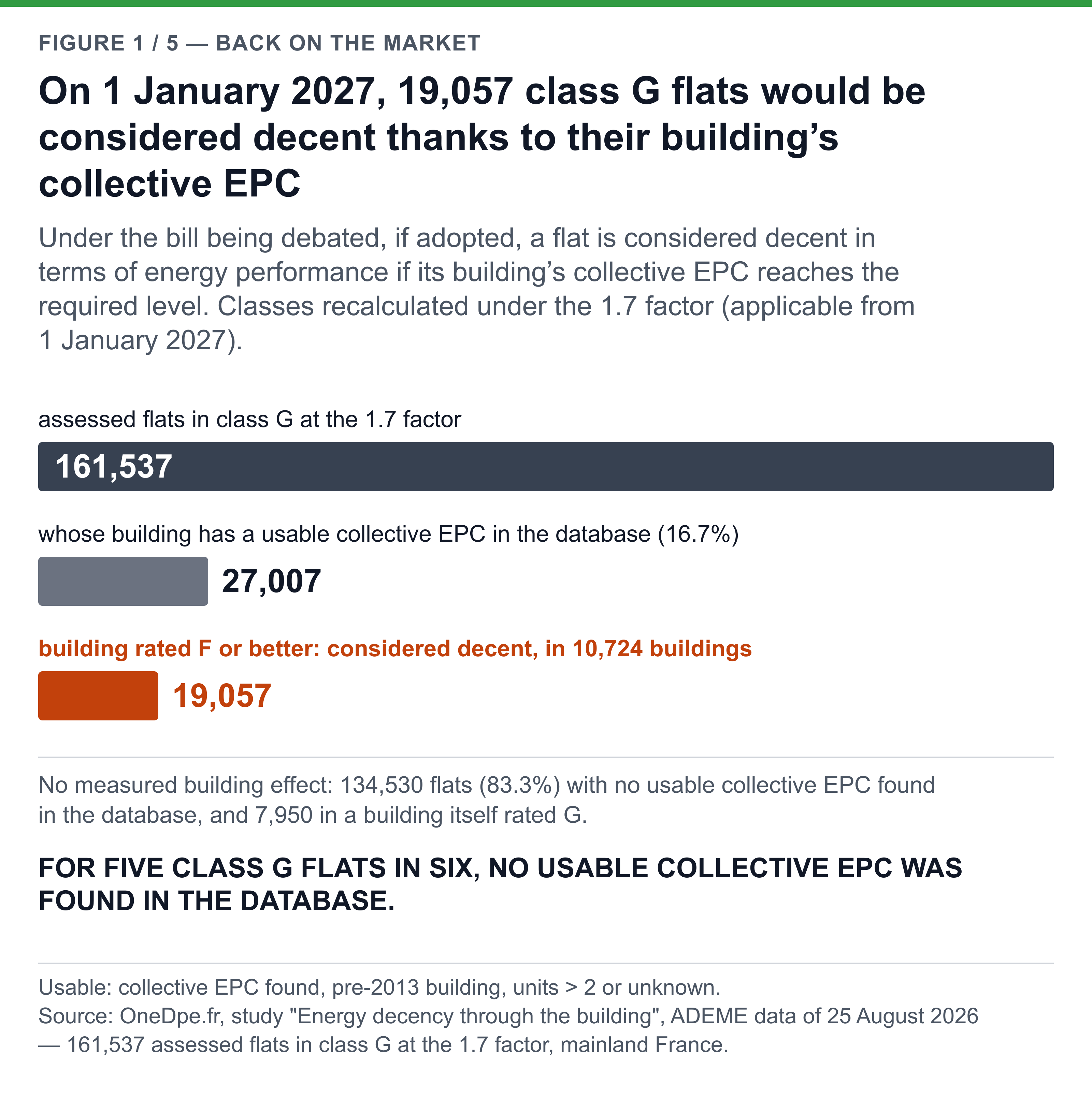
19,057 G-rated homes could return to the rental market — on 1 January 2027, if the bill is adopted, because their building’s EPC is rated F or better (10,724 buildings, database of ADEME, the French environment agency).
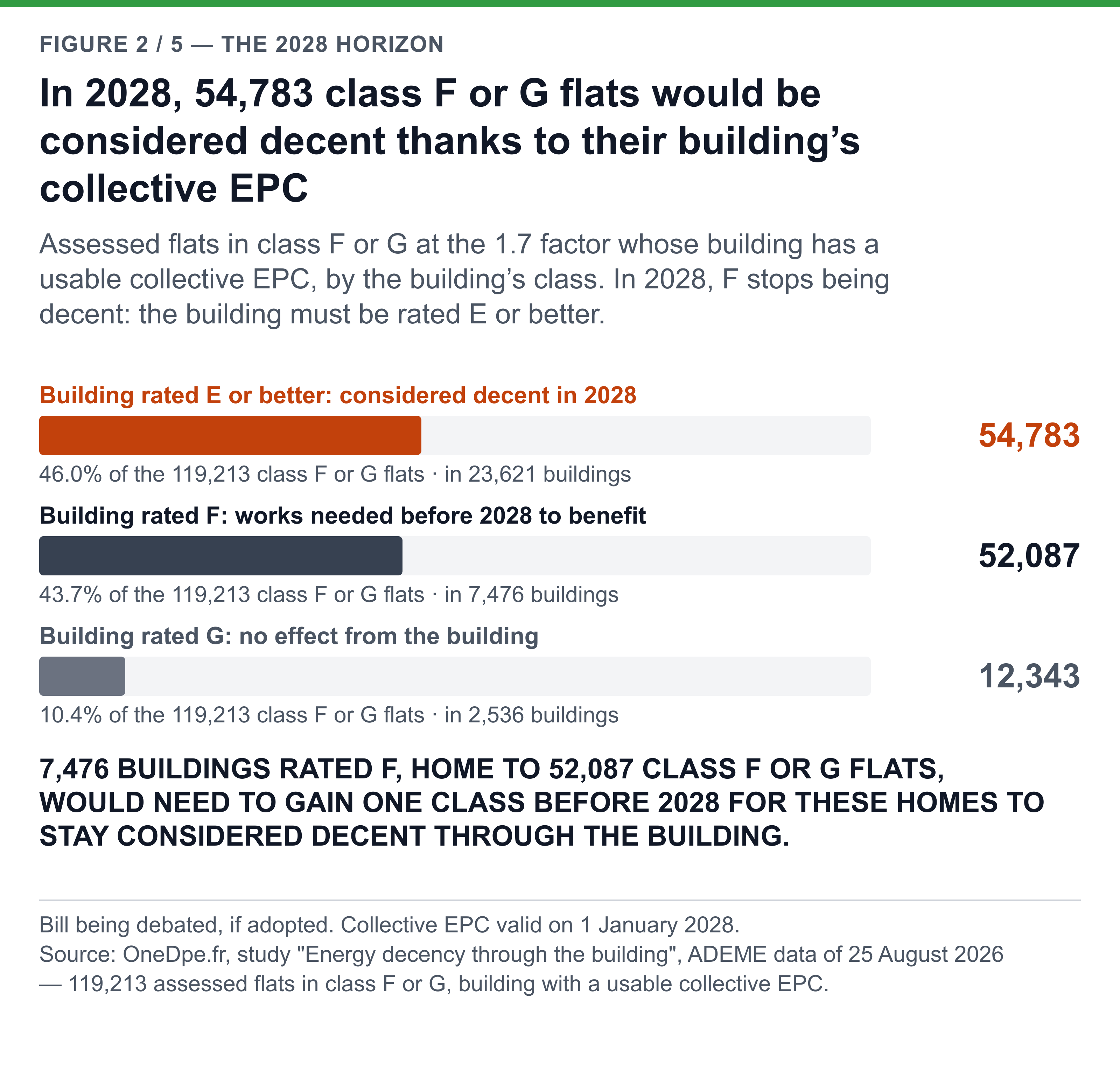
The rule has a counterpart: 7,476 F-rated buildings, home to 52,087 F- or G-rated dwellings, would need works before 2028 for their homes to stay considered decent through the building.
What this article covers
The rule, its effects up to 2034, social housing, and how few buildings have a collective EPC.
The rule voted by the Senate: energy decency through the building’s EPC
Article 6 of the French law of 6 July 1989 sets the energy decency timetable in mainland France: a G-rated home has not been decent since 2025, an F-rated home will not be from 2028, and an E-rated home from 2034.
The bill would amend that article. In the text adopted by the Senate on 8 July 2026, a home “located in a collective residential building whose energy performance certificate […] establishes that the building reaches the required energy performance level” is “considered decent in terms of energy performance” (our translation). The home’s own EPC keeps its value.
This is not the law. The economic affairs committee of the National Assembly rewrote this provision on 22 September 2026 (text no. 3188), and the plenary debate was not on the agenda as of 12 October 2026. We quantify the rule voted by the Senate, and take no position on the reform.
19,057 G-rated homes could return to the rental market
In ADEME’s database, 19,057 flats, spread across 10,724 buildings, are G-rated energy sieves on 1 January 2027 while their building’s EPC is rated F or better. If the bill is adopted, they would be considered decent thanks to the building and could be let. The EPC does not say whether they are let today.
On 1 January 2028, 54,783 F- or G-rated homes (23,621 buildings) would be considered decent thanks to a building rated E or better. For 12,343 F- or G-rated homes in a G-rated building, the rule changes nothing.
Decency only applies to let homes: an owner-occupier is not subject to it, whatever their building’s class.
F- or E-rated buildings: works to benefit from the rule
Before 2028: 7,476 F-rated buildings
7,476 F-rated buildings, home to 52,087 F- or G-rated dwellings, would need works before 1 January 2028 for their homes to stay considered decent through the building. Among those homes, 6,815 G-rated ones would be considered decent from 2027 thanks to the building, and 45,272 F-rated ones are decent on their own until 2028. See the multi-year works plan in a co-ownership (co-owned building).
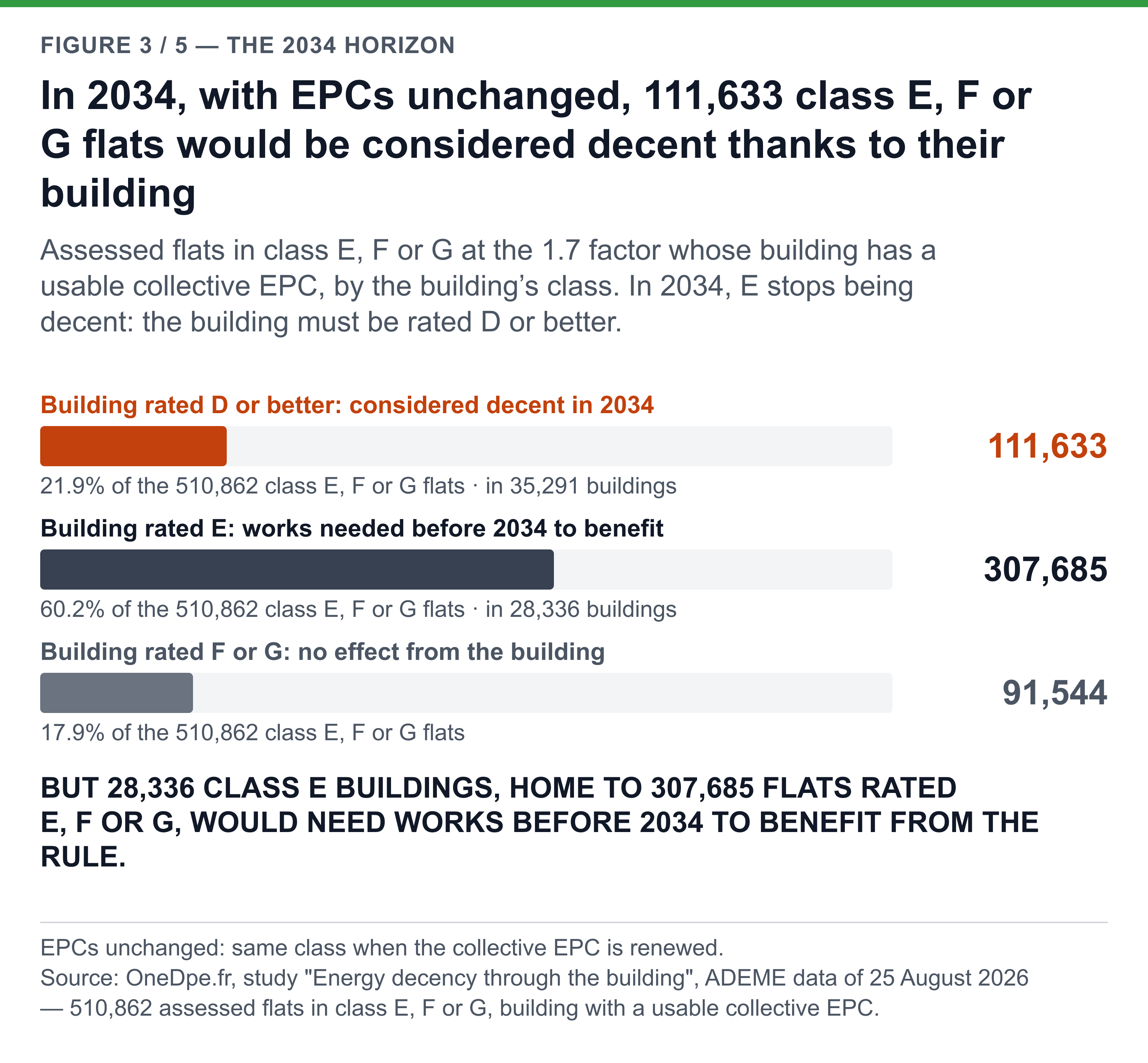
Before 2034: 28,336 E-rated buildings
28,336 E-rated buildings, home to 307,685 E-, F- or G-rated dwellings, would need works before 1 January 2034, for the same reason. Among those homes, 34,689 F- or G-rated ones would be considered decent from 2028 to 2033 thanks to the building. The other way round, 111,633 E-, F- or G-rated homes (35,291 buildings) would be considered decent in 2034 thanks to the building, assuming its EPC is unchanged. See EPC class E and the 2034 deadline.
This provision creates no obligation to carry out works: a home can also become decent through its own works, and an owner-occupier has no decency obligation. The same building can appear in two of these groups: building counts do not add up.
Collective EPC obligation: most buildings are missing from the ADEME database
These counts only cover buildings whose collective EPC is in the database: of 161,537 G-rated flats on 1 January 2027, only 27,007 have a usable one, i.e. 17%. This rate is about flats, not co-ownerships, and a collective EPC that was carried out may be missing from the database. Of the 1,606,208 E-, F- or G-rated flats assessed individually, 1,336,485 have no building EPC found at their address.
Yet the collective EPC is mandatory for residential buildings whose building permit predates 1 January 2013 (article L. 126-31 of the French Construction and Housing Code): since 2024 above 200 units, 2025 from 50 to 200 units, 2026 below that. See collective vs individual EPC in a co-owned building. The rule’s real effect depends first on this.
What it would change for you
Landlord of a G-rated flat. If your building’s collective EPC is rated F or better, your home would be considered decent in terms of energy performance, provided the bill is adopted in the Senate’s version. Nothing is settled: the provision was rewritten in committee at the National Assembly.
Co-owner in an F- or E-rated building. For the building’s let homes to benefit from the rule, the building would need to gain a class before 2028 if it is rated F, before 2034 if it is rated E. If you live in your home, you have no decency obligation.
Tenant. Your EPC and the building’s may differ; your own home’s EPC keeps its value.
What to check: does your building have a collective EPC? Which class? Ask the managing agent, and compare its class with your own EPC.
The tool re-reads your EPC, flags input inconsistencies and shows the EPCs of the other homes in your building.
Estimates for the private rental sector
Scaled to the private rental sector (flats built before 2013, mainland France, 1 January 2025, rent-free homes included, according to the ministry’s statistical service), these counts give estimates. The right-hand column assumes that buildings without a collective EPC resemble assessed buildings.
| Question (estimate) | At current collective EPC coverage | If every co-ownership had its collective EPC |
|---|---|---|
| G-rated homes returning to the market | about 11,000 | about 110,000 |
| Considered decent in 2028 thanks to the building | about 27,000 | about 270,000 |
| Works before 2028 (F-rated buildings) | about 12,000 | about 100,000 (25,000 to 35,000 co-ownerships) |
| Considered decent in 2034 thanks to the building | about 47,000 | about 450,000 |
| Works before 2034 (E-rated buildings) | about 48,000 | about 430,000 (74,000 to 100,000 co-ownerships) |
The rows do not add up. And 19,057 counts every assessed flat, social housing included, whereas about 11,000 is limited to the private rental sector, at current coverage.
Social housing: a comparable share by number of buildings, more than half of the homes on the works side
Matched against the French social housing register (RPLS), the buildings that gain and those that would need works include social housing in comparable proportions, by number of buildings: at least 18.9% to 31.7%. By number of assessed homes, the share exceeds half on the works side: the social buildings concerned are large, and their flats often have an EPC derived from the building’s own. These are homes in a building with some social housing, not necessarily social homes.
| Group (homes; buildings), minimum shares | By number of homes | By number of buildings | ||
|---|---|---|---|---|
| including social housing | fully social* | including social housing | fully social* | |
| Return to the market (19,057; 10,724) | 23.0% | 12.6% | 18.9% | 11.3% |
| Considered decent in 2028 thanks to the building (54,783; 23,621) | 30.7% | 14.6% | 23.9% | 13.5% |
| Works before 2028 (52,087; 7,476) | 54.9% | 26.9% | 23.5% | 15.3% |
| Considered decent in 2034 thanks to the building (111,633; 35,291) | 38.2% | 17.2% | 31.7% | 17.7% |
| Works before 2034 (307,685; 28,336) | 57.0% | 22.6% | 29.8% | 16.3% |
* Fully social: at least 80% of the building’s flats listed in the RPLS register. These are minimums: absence from the register does not prove that a building is not social. How decency applies to social housing is not covered. Building counts do not add up.
How we measured
ADEME’s public EPC database held 16,889,683 valid EPCs in the extract of 25 August 2026: after de-duplication, 10,354,488 flats and 430,120 building EPCs. The study keeps 283,825 eligible buildings: building permit before 2013, more than two units or number of units not recorded, mainland France.
Each flat was matched to its building’s EPC. Classes are recalculated with an electricity conversion factor of 1.7 for all existing EPCs: this is an assumption of the study, not a rule of law, based on the ministry’s press release of 31 August 2026 (factor of 1.7 from 1 January 2027, free update of existing EPCs). At that factor, 16.4% of eligible buildings are rated E, 5.6% F and 2.0% G. See the electricity conversion factor and the my EPC in 2027 simulator. For 2034, the building’s class is assumed unchanged (its collective EPC must be renewed, article L. 126-31): a building that carries out works drops out of the count.
Key takeaway: this is not the law, but a bill still going between the two chambers. The counts cover assessed flats in ADEME’s database, not the whole housing sector. No figure by landlord, no list of buildings.
In short: if the bill is adopted, 19,057 G-rated homes could return to the market, and 7,476 F-rated buildings would need works before 2028 for their homes to benefit. Check your EPC, then ask whether your building has its collective EPC. Full study and methodology note: press page.