On 1 January 2028, a home rated F can no longer be offered for rent. After class-G homes, withdrawn from the market since 2025, this is the second wave of a timetable that will pull hundreds of thousands of homes out of rental supply — unless they are renovated. But the shock will not hit everywhere alike. We cross-checked France's national database of energy performance certificates (EPCs) with INSEE housing data to estimate, city by city, where rental supply is most exposed.
The result reveals two Frances: that of the big metro areas, where the number of affected homes is massive in absolute terms — Paris first, by a wide margin — and that of rural and mountain areas, where the share of energy sieves peaks. Between the two, a largely spared Mediterranean South.
We estimate at about 722,000 the number of class-F homes in private rental affected by the 2028 ban in France. Paris alone concentrates nearly 93,000 — almost one in eight nationwide.
What this article covers
What the 2028 deadline concretely changes for landlords, the national weight of energy sieves in the rental stock, our estimate of the number of rented F homes at risk and the method behind it, the map of the most exposed departments, the ranking of cities that will lose the most rental supply, the Relance logement bill scenario (reprieve or mere postponement?), and what owners, tenants and buyers can do.
2028: what changes for landlords
The Climate and Resilience Act of 22 August 2021 set a timetable banning the letting of energy sieves, codified in article L.173-1-1 of the Construction and Housing Code: class G banned since 1 January 2025, class F on 1 January 2028, class E on 1 January 2034. In practice, a class-F home can no longer be the subject of a new lease from 2028 — it must be renovated to reach at least class E, or leave the rental market.
The stakes are high, because energy sieves are over-represented in the rental stock. According to France's National Observatory for Energy Renovation (ONRE), as of 1 January 2025, 13.8% of the private rental stock is rated F or G, i.e. 1.1 million homes — a higher share than owner-occupiers (14.0%, but on a larger base, 2.5 million) and far ahead of social housing (5.8%, already largely renovated). Across all primary residences, France has 3.9 million energy sieves (12.7%), of which about 2.4 million are class F — the cohort directly targeted by the 2028 deadline.
In practice, "banned from letting" means the home no longer meets the energy-decency criterion: the landlord can neither sign a new lease nor renew the current one with a rent increase, and the sitting tenant can demand compliance works. F and G energy sieves have also been subject, since August 2022, to a rent freeze (no rent increase between tenants or on renewal). The 2028 deadline therefore does not fall into a legal vacuum: it extends a regulatory tightening already under way, making renovation increasingly unavoidable for anyone wishing to keep letting.
722,000 rented class-F homes: our estimate
How many of these rented F homes, and above all where? An EPC never says whether a home is rented or owner-occupied. To estimate it, we combine two sources: the share of class-F homes observed in the national EPC database for each area, and the private rental stock (tenants excluding social housing) measured by INSEE, commune by commune. The product of the two yields an estimate of the number of rented F homes, which we anchor to the national ONRE total (1.1 million energy sieves in private rental) to make the orders of magnitude reliable.
Nationally, we thus estimate at about 722,000 the number of class-F homes in private rental — the wave that will leave the rental market in 2028 without renovation. Notably, this is the same order of magnitude as the Government's stated target under the Relance logement bill (650,000 to 700,000 homes to keep on the market, see below).
How to read this figure. It is an estimate, not a census. The F share is measured on the flow of recent EPCs (which under-represents energy sieves: we correct this bias by anchoring the national total to ONRE). The geographic split comes from our database; the absolute volumes are orders of magnitude. We assume the F share among rentals is close to the F share of the whole local stock (a rather conservative assumption, since ONRE shows slightly more energy sieves in the rental stock). Full methodological note at the end of the article.
The map of the most exposed areas
Relative to the local stock, exposure draws a sharply contrasted France. Rural and mountain departments, with old building stock and a harsh climate, show the highest shares of class-F homes: the Creuse (13%), the Hautes-Alpes (12.5%), the Lozère (11.6%), the Cantal (11%), then the Orne, the Allier and the Corrèze. Conversely, the Mediterranean rim is largely spared — Hérault (1.8%), Aude (1.6%), Gard, Bouches-du-Rhône, Var — thanks to a mild climate and a more recent stock.
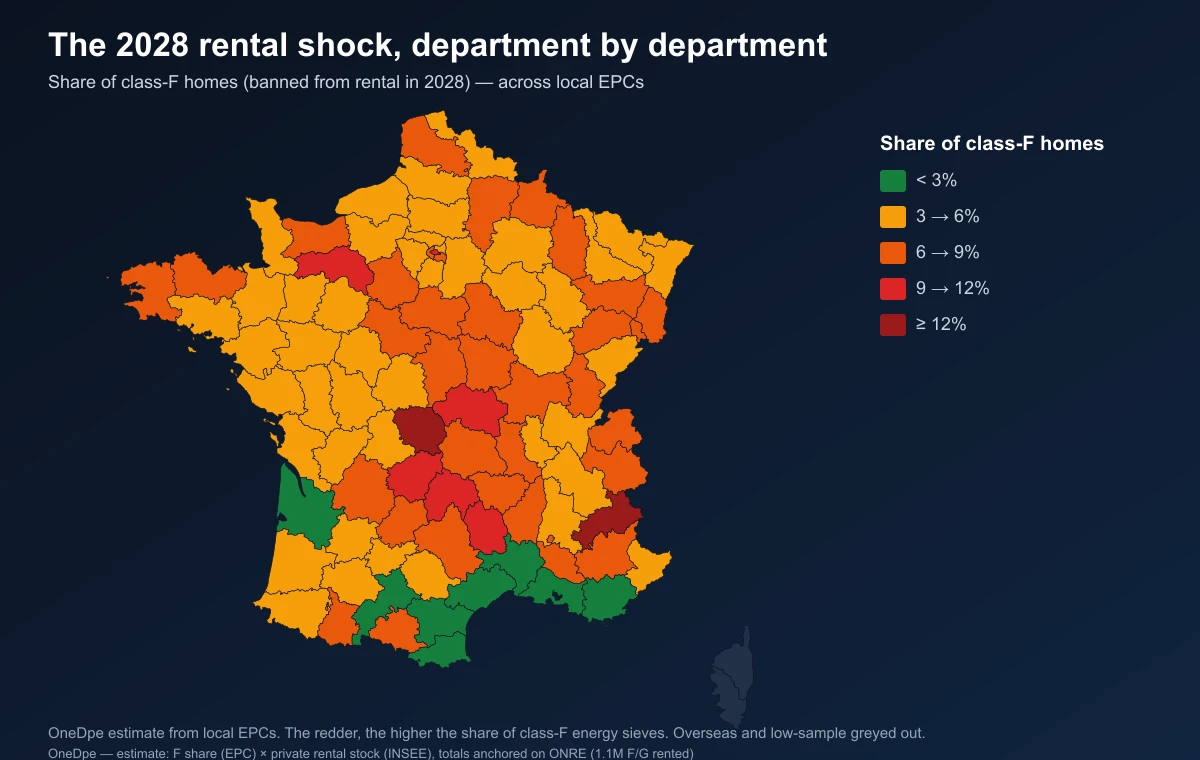
But share is not everything: in absolute terms, it is the big metro areas that concentrate most of the affected homes, because they combine a huge private rental stock with often old building stock. And there, one city dwarfs all the others.
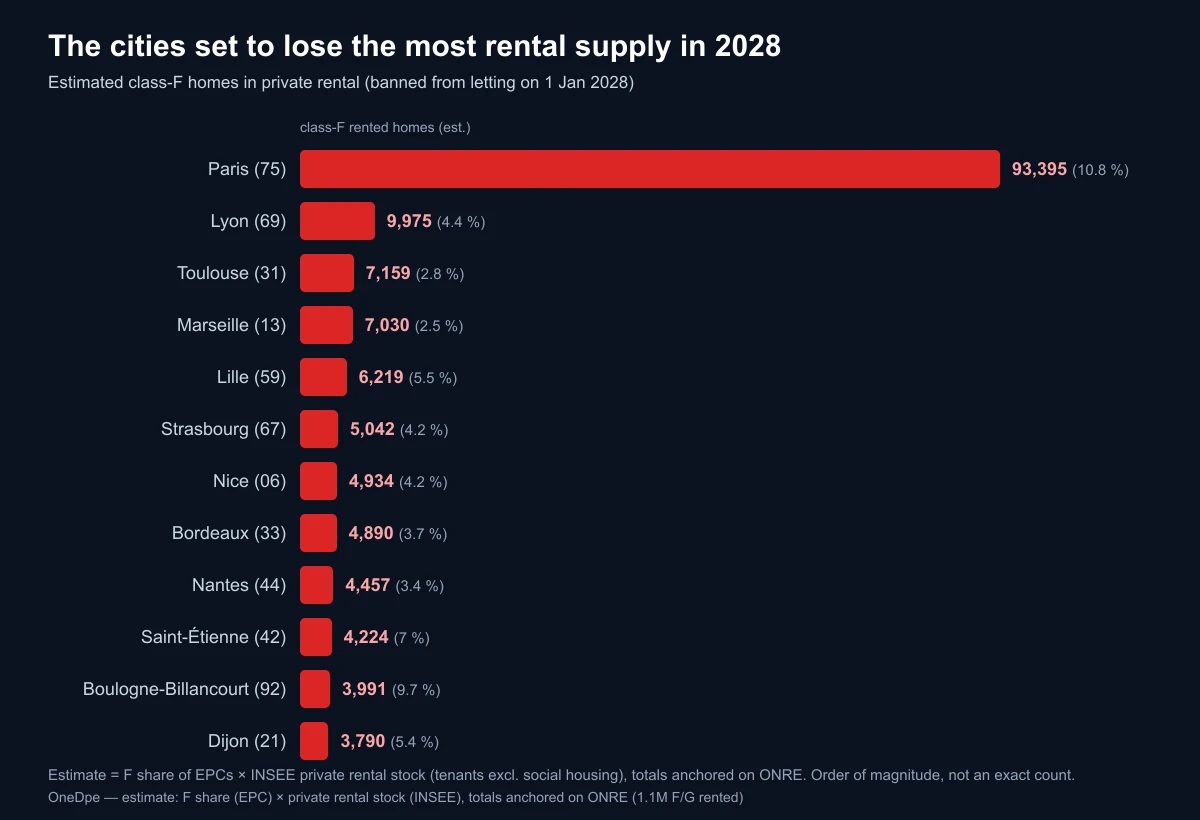
Paris alone concentrates nearly 93,000 rented F homes — about 13% of the national total. The capital combines every aggravating factor: an ultra-rental market, an old Haussmannian stock, and a multitude of small units (studios, former service rooms) that the EPC calculation method penalises more heavily. Then come, at a great distance, Lyon (around 10,000), Toulouse and Marseille (around 7,000 each), Lille (6,200), then Strasbourg, Nice, Bordeaux and Nantes (around 5,000).
A third reading, by F share, brings out affluent, old-stock communes of the inner Paris suburbs — Saint-Mandé (17%), Neuilly-sur-Seine (14%), Vincennes and Bois-Colombes (13%) — where the never-renovated pre-war bourgeois stock concentrates F labels. The 2028 shock is therefore not only a matter of slack markets: it also hits, in the heart of the tightest areas, a sought-after rental stock.
The Paris case illustrates an often-underestimated effect: the small-surface penalty. The EPC calculation factors in hot-water and auxiliary consumption in a way unfavourable to homes under 30 m²; a studio or a former service room can thus slip into F where an otherwise identical large flat would stay in E. Yet these small units make up the bulk of the rental stock in big student and tight-market cities. The result: a double penalty for these markets — many small rented homes, and a calculation method that rates them more severely. This is one reason why Paris weighs so heavily in our estimate, and why the issue there is also one of supply for young workers and students.
The Relance logement scenario: reprieve or mere postponement?
This timetable could be eased. On 23 April 2026 in Marseille, the Government presented the outline of a "Relance logement" bill whose flagship measure directly targets energy-sieve landlords: an F or G home could be let again on condition of signing a works contract, the works to be completed within three years for a single-family house and five years for a condominium flat. The stated objective: to keep or return 650,000 to 700,000 homes to the market by 2028.
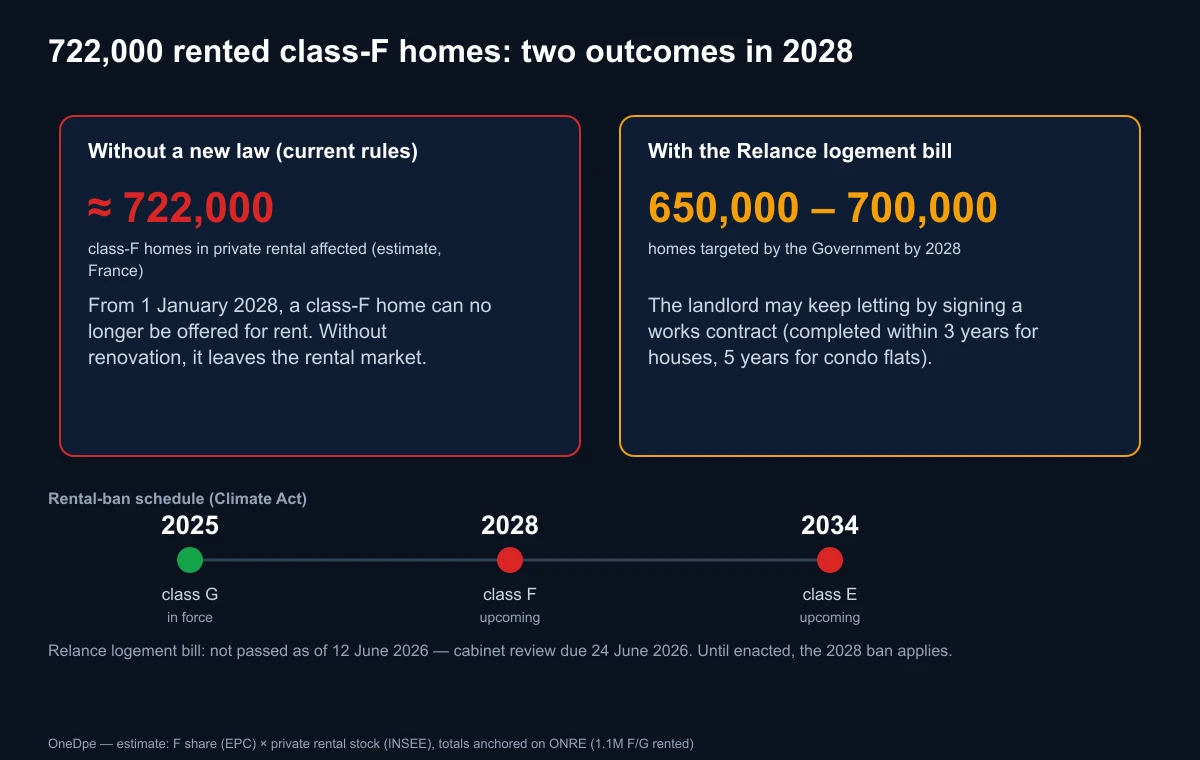
⚠️ Conditional. As of 12 June 2026, the Relance logement bill has not been passed: its cabinet review is scheduled for 24 June 2026, its tabling in the Senate is to follow, and the Government hopes for a vote before the end of 2026. Until the law is enacted, the 2028 ban remains fully applicable. A landlord cannot base their strategy on an unadopted text.
Above all, even if passed, the law would not remove the shock: it would turn it into a renovation obligation. The home would remain lettable, but the works commitment would become binding — with a real risk for condominiums, where voting and financing a collective renovation within five years is often a tall order. In both scenarios, the way out runs through the works.
What to do, depending on your situation
You are the landlord of an F home: anticipate. Get the cost of works to reach at least class E estimated (often an insulation + heating-system bundle), check the available grants (MaPrimeRénov', CEE, zero-interest eco-loan), and schedule the work before the deadline — tradespeople's order books will fill up as 2028 approaches. A jump from F to E, or even D, secures your right to let and adds value to the property.
You are the tenant of an F home: your current lease is not cancelled by the deadline, but the home cannot be the subject of a new lease as-is after 2028. This is a legitimate lever to ask the landlord to undertake improvement works.
You are considering buying to let: factor the renovation cost into your financing plan and avoid buying an energy sieve at the price of a sound home. A well-negotiated and renovated energy sieve can be a good deal; bought too dear, it becomes a trap.
Estimate the works to lift your home out of energy-sieve status
Our renovation simulator computes the renovation bundle needed to move your home from F to E or better, the expected EPC class gain, the cost and the available grants (MaPrimeRénov', CEE, zero-interest eco-loan). Enough to secure your right to let before 2028.
Looking to buy instead? Explore the market by city with our EPC property search — for example in Paris, Lyon or Marseille.
Conclusion
The 2028 deadline is not an abstract threat: it is an identifiable wave of about 722,000 rented F homes, very unevenly distributed. Paris and the big metro areas concentrate the volume; rural and mountain areas concentrate the share. Whether or not the Relance logement bill passes, the only lasting way out is renovation — and the sooner it is anticipated, the cheaper it is.
The useful reflex, for a landlord as much as a buyer: cost out now the works needed to cross the class-E threshold. The OneDpe renovation simulation does it for your home, grants included.