You replaced the windows. The work took three weeks, the invoice is paid, the home is more comfortable. The assessor comes back, redoes the DPE (Diagnostic de Performance Énergétique — the French Energy Performance Certificate) — and the label still reads F.
This is neither an error nor bad luck. In our study published on 17 November, 84.8% of starting energy sieves leave classes F and G when a measure is recorded at the second assessment, excluding cases where that second assessment is worse than the first. In other words, close to 15% do not leave despite a recorded measure. And a “recorded measure” is a change of state declared between two assessments: not dated, not invoiced, not verified. There are four reasons for this, and none of them reflects on the professional.
A DPE is not a measurement, it is a calculation. It applies a conventional method to data describing the home. A measure that improves comfort does not necessarily improve the quantity the method retains — and it almost never improves both labels at once.
What this article covers
This article explains why real works can leave a label unchanged: the dual-threshold mechanism whereby the worse of the two ratings decides, the width of the class bands, the gap in effectiveness between measures, and the role of the data recorded. It gives a worked case, the costliest mistakes, and the method for knowing before the works whether the letter can move.
How the class is determined
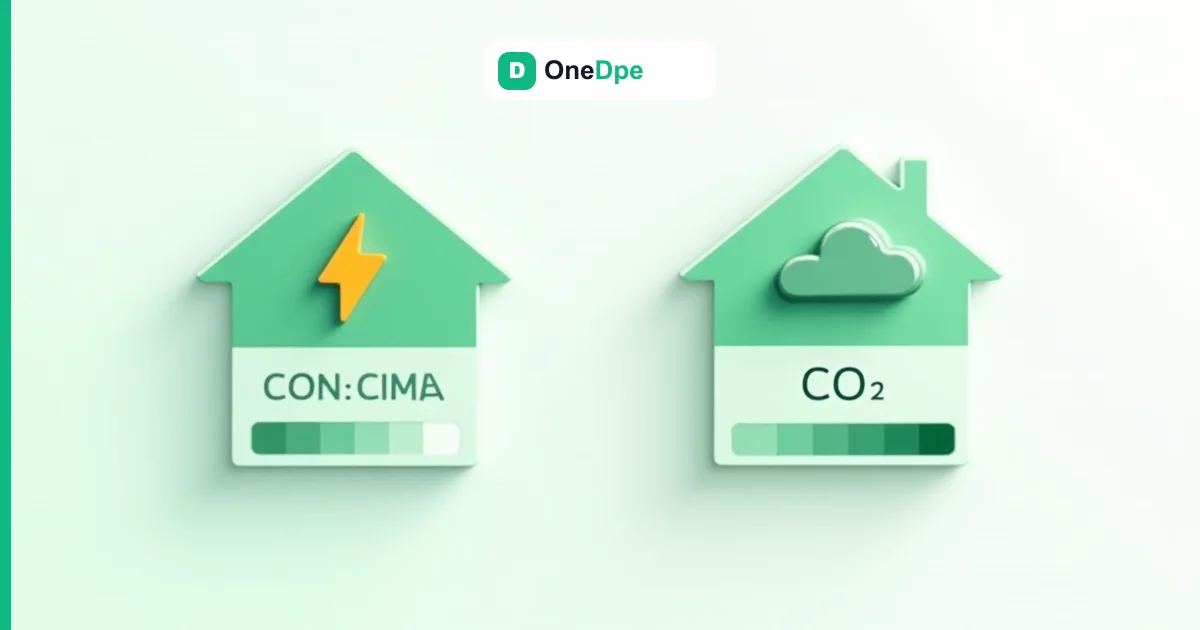
Before asking why the letter did not move, you need to know where it comes from. Since the 2021 overhaul, the DPE computes two distinct quantities for the same home: primary energy consumption, in kilowatt-hours per square metre per year, and greenhouse gas emissions, in kilograms of CO₂ per square metre per year. The calculation method is set by the order of 31 March 2021.
The rule that catches people out: the worse of the two wins
Each of these quantities is graded from A to G on its own scale. And it is the worse of the two that becomes the home's official label. This is the dual threshold, set out in our article on the energy label and the climate label.
⚠️ Warning: for a home heated by gas or oil, the climate scale is more demanding than the energy scale. Since emissions are proportional to the energy consumed, the F/E climate boundary — 70 kg of CO₂ — corresponds, on natural gas, to roughly 308 kWh, where the energy boundary sits at 330 kWh. Between those two values the energy rating has already moved to E while the climate rating is still F: and it is the climate rating that shows.
Classes are bands, not a slope
A class is not a continuous slider: it is an interval. As long as your consumption stays inside the interval, you keep the same letter, whether you sit at the top or the bottom of it. A home falling from 380 to 340 kWh per square metre per year has genuinely improved; it has crossed no boundary.
Two identical homes can therefore draw very different benefit from the same works, depending on where they started within the band. The one that sat two kilowatt-hours from the threshold changes letter; the one in the middle changes nothing.
The bands, in figures
The boundaries of the seven classes are set by the order of 31 March 2021, and the two scales do not have the same granularity.
| Class | Primary energy (kWh/sq m/year) | Climate (kg CO₂/sq m/year) | Width of the energy band |
|---|---|---|---|
| D | 180 to 250 | 30 to 50 | 70 kWh |
| E | 250 to 330 | 50 to 70 | 80 kWh |
| F | 330 to 420 | 70 to 100 | 90 kWh |
| G | over 420 | over 100 | no upper bound |
This table explains a great deal of disappointment. A home at 410 kWh is rated F, and so is a home at 335 kWh: 75 kWh separate them, more than a fifth of the second one's consumption, with no letter to tell them apart. Works gaining 50 kWh will take the second out of class F and leave the first exactly where it was.
Class G has no upper bound. A home at 700 kWh and one at 430 kWh carry the same letter, although the first consumes more than 60% more than the second. That is why leaving G often requires a package of works where leaving F may turn on a single well-chosen measure.
What to check on your DPE: find the two numerical values, in kWh/sq m/year and kg CO₂/sq m/year, shown beneath the labels. Compare each against the lower boundary of its class. The gap separating you from the threshold is the real target of your works — not the letter itself.
The four reasons the letter does not move
1. The other label is what blocks you
You improved consumption, but emissions were what decided — or the other way round. Your energy rating gained a class, your climate rating has not yet crossed its own boundary, and since the worse of the two is displayed, the label is unchanged. On a carbon-emitting energy source both ratings improve together: you simply have to go a little further for the second to tip as well.
How to check: your DPE shows both labels side by side. Look at which of the two is worse. That one, and only that one, is what needs to move.
2. You were far from the boundary
The measure had its effect, but the effect was smaller than the distance separating you from the next threshold. This is the most frequent case in very energy-hungry homes: classes F and G are wide, and it often takes several combined measures to leave them.
3. The chosen measure weighs little on the label
Not all works move the letter in the same way. In our study, where a single measure is recorded between the two assessments, changing the heating system gains 1.26 classes on average, replacing the windows 0.69. Yet windows are the measure that comes up most often.
⚠️ Warning: these averages do not say you should not replace your windows. Joinery at the end of its life creates comfort, noise and air-tightness problems that a heat pump will never solve. They say only where the label moves most, if your objective is explicitly to change class.
4. The change was not described to the assessor
A DPE rests on what the assessor observes and on what you pass on. Insulation fitted behind a partition is invisible; so is recent equipment without an invoice or a legible rating plate. In those cases the method falls back on default values, generally unfavourable, and your work stays invisible to the calculation.
Those defaults are not arbitrary: the method sets them by construction period and by building type, so that an undocumented home is treated as typical of its era. The logic is sound for a national statistical system, and costly for an owner who has done better than typical. A wall insulated in 2019 but evidenced by nothing will be calculated as the wall of an uninsulated home of its vintage.
This is also why two assessors visiting the same home on the same day can reach different results without either being at fault: they will not necessarily have been shown the same documents. The gap does not come from their judgement but from what was placed in front of them.
What to do before the visit: gather the invoices for the works, the technical data sheets for the equipment fitted, the references of the joinery and the thickness of the insulation. These are the documents that let the assessor retain your real values rather than the defaults.
Worked example: a two-bedroom flat on gas heating
Profile: 70 sq m flat in a 1970s block, communal gas heating, rated F. The owner has all the windows replaced with high-performance double glazing, for €14,000.
| Item | Before works | After works |
|---|---|---|
| Primary energy consumption | 340 kWh/sq m/yr | 320 kWh/sq m/yr |
| Energy rating (boundary at 330) | F | E |
| CO₂ emissions | 77 kg/sq m/yr | 73 kg/sq m/yr |
| Climate rating (boundary at 70) | F | F |
| Label displayed (the worse of the two) | F | F |
The works did their job: consumption fell by 20 kWh and emissions followed, from 77 to 73 kg. The energy rating crossed its boundary; the climate rating stops three kilograms short of its own. Since the worse of the two is displayed, the owner spent €14,000 and remains at F.
What should have been known beforehand: three kilograms were missing. One further measure on the fabric would have found them, and a change of energy source would have wiped them out at a stroke. What was foreseeable is that the windows alone would not do it — and that could be computed before signing the quote.
The order of works changes the result
Two owners carrying out exactly the same works, for the same budget, do not end up with the same label if they do them in a different order. This is not a subtlety of the calculation: it is a physical consequence.
Fabric before equipment
A heating system is sized against the home's needs. Installed before the insulation, it is sized for an energy sieve: oversized once the insulation is in, it will run outside its optimal efficiency range. Installed afterwards, it is smaller, cheaper and more efficient.
This holds particularly for heat pumps, whose efficiency depends on the water temperature required: a poorly insulated home demands hotter water, hence lower efficiency. Our article on the order of energy renovation works sets out that chain.
The consequence for the label
For an owner whose climate rating is what blocks them, changing energy source moves both ratings at a stroke, where fabric works move them together but more slowly. The two logics — technical performance and label gain — therefore do not always point to the same first job.
How to decide: if you face a regulatory deadline, start with what unlocks the letter. If you have time, follow the technical order: it costs less overall and delivers a better home at the end.
Common mistakes
Redoing the DPE in the hope of a better result
This is the costliest reflex, and the least well founded. Our study measures a gap between two assessments of the same home, and that gap works both ways: 18% of second assessments are worse than the first. A DPE must describe the home as it is; if it contains an error, it is that error that needs correcting, not the document that needs replaying.
Stacking measures without checking which one unlocks
Chaining insulation, ventilation then joinery on a home whose climate rating is the blocker amounts to improving a rating that decides nothing. The order of works matters as much as their nature.
Believing an invoice is proof
An invoice attests to spending, not to a technical characteristic. What the calculation needs is performance: the thermal transmittance of the joinery, the thickness and conductivity of the insulation, the efficiency of the equipment.
Confusing comfort with label
A home can become markedly more pleasant without changing letter. These are two distinct objectives, and they are not pursued with the same works.
Know before you pay whether the letter can move
OneDpe renovation works simulator
From your DPE reference number, the tool pulls the data filed with ADEME and recalculates the label measure by measure: for each proposed work it shows the energy gain, the emissions gain and the resulting class — hence whether it crosses a boundary or not. You see immediately which of the two ratings is blocking your home.
Further reading: the five works that gain a grade.
Conclusion
A label that does not move after works is almost never the sign of a sloppy assessment. It is usually the meeting of four mechanisms: the worse of the two ratings governs what is displayed, classes are wide bands, measures do not all carry the same weight, and whatever is not described to the assessor does not enter the calculation. Our study of 17 November quantifies it: 84.8% of energy sieves leave F and G when a measure is recorded, excluding worse second assessments.
Which leaves close to 15% of projects followed by an unchanged letter.
The practical consequence fits in one sentence: the question "will these works change my class?" is settled before signing the quote, not after. The OneDpe renovation works simulator answers it in minutes from your assessment's reference number, and it tells you which of the two ratings is blocking you.