
Redoing the energy performance certificate (DPE) of an energy sieve — a home rated F or G — can change its class. It can do so even when the second certificate records none of the six tracked renovation measures: windows, wall insulation, roof insulation, ventilation, heating, hot water. We measured how often, across 104,759 homes in the database of ADEME, the French environment agency, assessed twice since 2021, on two separate visits.
The result comes down to two figures: 44.8% of energy sieves leave classes F and G at the second certificate with no measure recorded, and 84.8% when a measure is recorded. Both rates leave aside the cases where the second certificate is worse than the first. When a measure is recorded, the difference is clear. But two certificates for the same home do not always say the same thing, and “no measure recorded” does not mean “no works”.
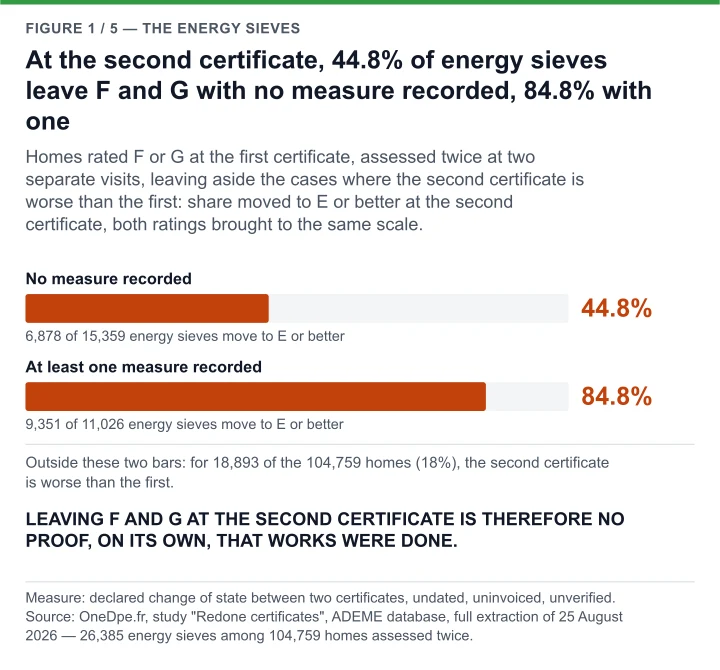
At the second certificate, 44.8% of energy sieves leave F and G with no measure recorded, 84.8% with one
Since July 2021, 104,759 homes assessed twice on two separate visits fall within the study’s scope: a certificate, then the one that replaced it, more than seven days later. We compared, component by component, what the two certificates declare: windows, walls, roof, ventilation, heating, hot water. A measure is recorded when the second certificate declares an improvement to equipment or insulation.
Among energy sieves whose second certificate records none of these six measures, 6,878 out of 15,359 leave classes F and G, i.e. 44.8%. When a measure is recorded, 9,351 out of 11,026 leave, i.e. 84.8%. To compare like with like, homes whose second certificate is worse than the first are left aside, whether or not a measure is recorded: they make up 18% of homes assessed twice.
The gap therefore works both ways. And “no measure recorded” does not mean “no works”: the second certificate simply describes none.
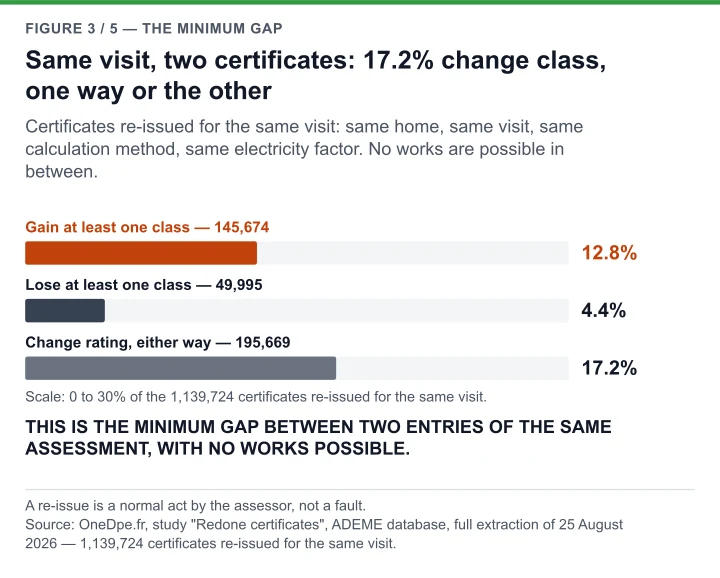
Same visit, two certificates: 17.2% change class
To measure the minimum gap between two entries of the same visit, look at re-issued certificates: a corrected floor area, a re-entered input. No works are possible there. Out of 1,139,724 re-issues with the same electricity conversion factor and calculation version, 17.2% change class: 12.8% gain at least one, 4.4% lose at least one. And 26.2% of energy sieves leave classes F and G; the study does not say why the certificate was re-issued.
The displayed final energy consumption changes in 59.5% of cases. The median gap is nil. But at the edge of a class, a small gap is enough to change the rating: that is where energy-sieve status is decided.
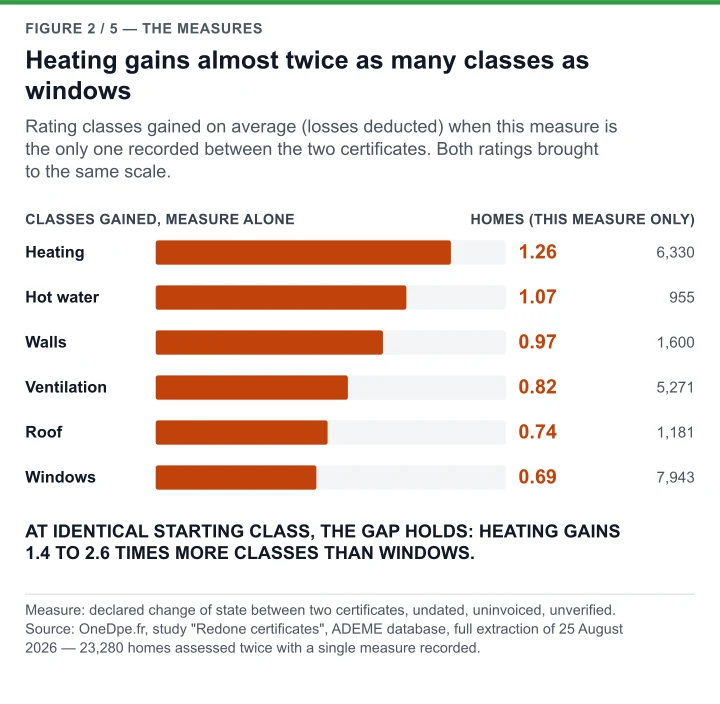
Heating gains the most classes
When a single measure is recorded, the average classes gained differ sharply from one measure to another. A change of heating system gains 1.26, hot water 1.07, wall insulation 0.97, ventilation 0.82, the roof 0.74 and windows 0.69. Yet windows are the most frequent measure: 40.7% of homes where a measure is recorded.
Another benchmark: 2,305 homes had an old certificate that recommended a package of works, and a second assessment that records at least one measure. 8% of them reach the consumption simulated after that package: 3.8% when they start at F, 22.9% when they start at C. The study does not know which works in the package were done: the second assessment records measures, not a package.
Simulate the effect of my works on my certificate
From your certificate number, the simulator takes up your home and shows what each measure changes to the rating.
For the order in which to carry out works, see our guide to the sequence of energy renovation works, and for walls, our comparison of external and internal insulation.
What it means for an owner or a landlord
In mainland France, since 1 January 2025, a G-rated home no longer reaches the performance level required of a decent home; an F-rated home will no longer reach it from 1 January 2028. The home’s official rating is the one that counts. On that rating, among homes starting at G where a measure is recorded, 912 out of 6,364 reach F (14.3%): they then fall under the 2028 deadline (class F) and no longer under the 2025 one (class G). ADEME’s file does not say whether they are let.
The practical lesson is simple: at the edge of a class, two certificates for the same home can say two different things. Before deciding on works or a price, it is worth checking that the certificate really describes the home.
What to check on your DPE: the floor area, the heating and hot water systems, ventilation, the declared insulation of walls, roof and windows. A single wrong input can change the class.
Our free certificate consistency checker re-reads those inputs from the certificate number, and the my certificate in 2027 simulator shows the rating of certificates issued in mainland France from 1 January 2027, after the change in the electricity conversion factor.
How we measured
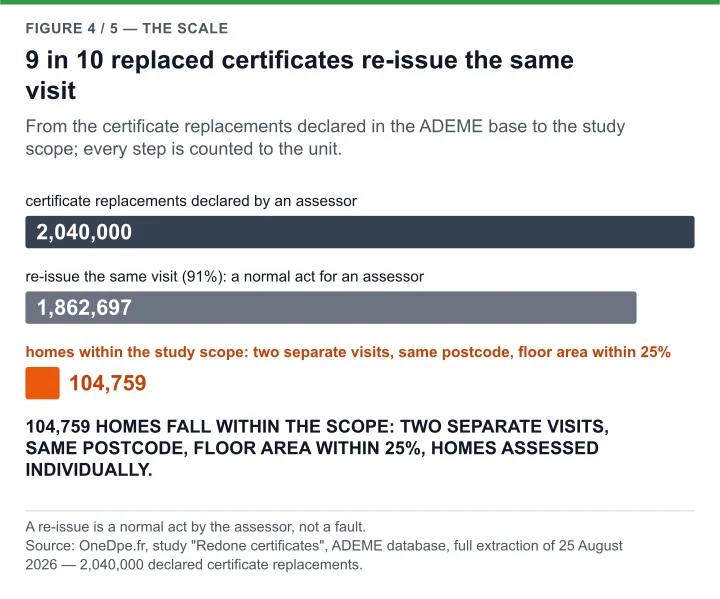
ADEME’s public database keeps every certificate, including those that have been replaced: it has recorded 2,040,000 certificate replacements since July 2021. When an assessor issues a new certificate for a home, they declare the document it replaces; we kept only the links that are consistent both ways (2,039,333 out of 2,040,000).
Nine replacements in ten (91%) re-issue the same visit: a normal act for an assessor, for example to correct a floor area or an entry, not a new assessment. To tell a correction from a genuine second assessment, we required two separate visits, more than seven days apart, with the same postcode and a floor area within 25%. In all, 104,759 homes assessed individually fall within the study’s scope.
The stated reason for the replacement says little about works, both ways: 54.8% of second certificates citing “works” record a measure, and 84.4% of second certificates that record a measure do not cite “works”.
Both ratings were then brought to the same scale and the same electricity conversion factor: 1.9, the one for certificates issued in 2026 in mainland France (order of 13 August 2025). That way, the reform of the factor is not mistaken for a change in the home. For certificates issued in mainland France from 1 January 2027, this factor is 1.7 (order of 19 August 2026), a text that postdates our data. This recalculation finds the published class for more than 99.6% of the 3.95 million certificates tested.
Finally, a measure is recorded when the declared state of a component improves between the two certificates: better windows, insulated walls or roof, ventilation turned mechanical, heating changed to another system type, heat-pump or solar hot water. This record is neither dated, invoiced nor verified on site. The full method note, the tables and the data by département are published with the study.
Key takeaway: the study blames no assessor, and does not say that redoing a certificate is a way out of energy-sieve status: the gap works both ways. A “recorded measure” is a declared change of state between two certificates, neither dated, invoiced nor verified. The study covers neither the cost of works nor grants.
To aim for a class, our scenarios to go from F or G to D and our article on the works that gain a class set out the options. The works simulator estimates the effect of each measure on your home. The full study, its tables and its method note are on its press page.